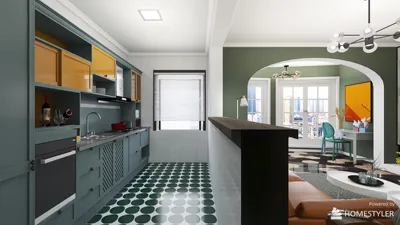


The future is prompting us to rethink our spaces: work is merging with home, climate demands passive solutions, and there is an expectation for privacy even among neighbors. Recent reports by NAHB indicate a significant rise in the desire for outdoor living, transforming balconies into essential micro-environments rather than mere decorative elements. When I create a house plan incorporating a balcony, I envision a design for future lifestyles—a space that harmonizes light, air, and social connectivity, ideally supported by tools like Homestyler to visualize these concepts.
We find ourselves navigating between the present and the near future, facing challenges like energy fluctuations, hybrid working conditions, and limited land. Surveys conducted by AIA reflect the trend towards versatile outdoor areas, with balconies acting as relief valves—a compact terrace that helps manage our daily lives. I consider it a finely-tuned interface rather than just an additional feature.
Split-Level Concept with East-Facing Balcony
Design Principle: Stack living spaces above sleeping areas to allow morning sunlight to enhance our cognitive functions; the balcony serves as a natural circadian booster, aligning with future wellness standards and maximizing passive solar benefits.
Flow: Entry → stair junction → living hub → sliding door → balcony; akin to a function call that transitions into an asynchronous outdoor experience before returning to the kitchen for completion.
Sightlines: The front entry obstructs direct views into private areas; while seated on the sofa, one’s gaze moves from the kitchen island to the treetops, creating a layered visual interface of near, mid, and far perspectives.
Storage: A bench with lift-top compartments near the slider, with a niche on the balcony for storage bins; this approach keeps clutter organized at the entrance while ensuring the main living area remains tidy.
Furniture Arrangement: A 9–10 foot sofa wall with 36 inches of circulation behind it, and a balcony depth of 5–6 feet allows for chair placement with sufficient knee space; this setup avoids collisions in user interfaces.
Conclusion: In five years, this design will evolve into a morning meeting area and evening relaxation space—compact in size but significant in managing our personal bandwidth.
save pin
L-Shape Family Plan with Corner Balcony
Design Principle: The L-shaped structure shelters the balcony from winds, creating a microclimate that will be crucial in future heatwaves; corner positioning enhances the perception of space without increasing the footprint.
Flow: Mudroom → great room transition → corner sliding door → balcony wedge; this design allows for social interactions while keeping the kitchen as a central commitment point.
Sightlines: Diagonal perspectives connect the dining area, fireplace, and skyline; large windows provide a 120° view, layered like a menu—primary (interior), secondary (edge), tertiary (street).
Storage: A tall pantry anchors the interior elbow, while the balcony’s planter-rail doubles as concealed storage; these caches are strategically placed to maintain lightness in the central living space.
Furniture Arrangement: A round 48-inch table eases movement; the balcony comfortably fits two lounge chairs at a 30° angle, facilitating conversations without obstructing views or legroom.
Conclusion: This layout is designed for future social gatherings, where indoor spaces expand outward via the balcony, preserving the home’s overall footprint.
save pin
Main Suite Stack with Sunset Balcony
Design Principle: Situate the suite to the west to capture the relaxing atmosphere of sunset; future work-life integration requires a private outdoor space separate from communal areas.
Flow: Stairs leading up → private office landing → suite entry → glass door → balcony; this secure layout honors both focus and retreat scenarios.
Sightlines: The bed is positioned to face the horizon, while the workspace is arranged tangentially to minimize glare; maintaining a slim balcony railing enhances views of the sky, acting like a broad status indicator.
Storage: A wall-to-wall closet serves as the suite’s backbone, paired with a shallow balcony cabinet for cushions; quick access to storage points reduces latency during use.
Furniture Arrangement: A king-sized bed accommodates 36-inch aisles on the sides; the balcony maintains a minimum clearance of 4'–8" for a bistro setup, ensuring compliance with ADA guidelines.
Conclusion: Over the next five years, this balcony will serve as a mental reset space, with sunsets acting as daily updates for mental well-being and sleep quality as the outcome measure.
save pin
Final Insight
Incorporating a balcony into house plans is not merely a stylistic choice but rather a significant upgrade to how a home operates—acting as an exterior component that bolsters internal functionality. It’s akin to a small studio for climate control, natural light, and privacy that enhances the entire living experience. As trends like hybrid work zones and passive cooling outdoor areas emerge, this interface will continue to evolve; from my observations, the most intelligent homes of the future won’t simply be larger—they will be more purposefully designed, with Homestyler as a valuable tool in this evolution.

Modway EEI-6401-IVO Oasis Upholstered Fabric Sofa,

Fluted 9 Drawers Dresser, 59.1" Wide Modern Chest


Homestyler is an exceptional online home design platform perfect for anyone looking to create stunning interiors. With its easy-to-use design tool, impressive 3D rendering options, diverse design projects, and helpful DIY video tutorials, you can effortlessly transform your vision into reality!
Design jetzt kostenlos
































