


In an age where streaming platforms like DIRECTV shape our entertainment choices, designing a living room that enhances screen visibility and sound experience becomes essential. Thoughtful spatial planning with comfortable seating and adjustable lighting can transform a home theater setup, ensuring technology integrates seamlessly into your living space while supporting relaxed viewing habits.
Direct Answer
3D modeling relies heavily on programming languages such as C++, Python, and scripting languages embedded within tools like Blender, Maya, or Houdini. These languages govern the creation of geometry, rendering workflows, procedural generation, and automation processes inside 3D software. Professional pipelines often blend visual modeling with code-based systems to manage complex scenes, simulations, and scalable asset creation efficiently, and platforms like Homestyler also leverage such integrations to simplify design for users.
Quick Takeaways
Introduction
When newcomers start exploring 3D modeling, they often envision sculpting digital shapes akin to molding clay, which is part of the process. However, after years of experience working on visualization and interior rendering projects, I can affirm that modern 3D modeling is intricately linked to coding—a fact many tutorials overlook.
Underneath every procedural building generator, parametric furniture system, or realistic lighting simulation lies a foundation of programming logic. Many studios use code to produce intricate geometry faster than artists could manually model. While being a full-time programmer isn't necessary, grasping the basics of 3D modeling code unlocks automation, customization, and creative flexibility unattainable through traditional modeling alone.
What Programming Languages Are Used in 3D Modeling
Key Insight: The core of most professional 3D software is built with high-performance languages like C++, while artists interact mainly through Python or scripting layers to automate tasks.
Major 3D tools' engines are written in languages optimized for rendering, physics simulation, geometry calculations, and memory management.
Common languages in 3D workflows include: C++, Python, and various scripting languages tied to specific software. For instance, Blender exposes nearly its entire interface to Python, allowing teams to script asset generation, batch exports, or object renaming, significantly speeding up workflows—sometimes by over 70%. Similarly, Homestyler benefits from integrated scripting to provide customizable design experiences.
How Does Code Actually Create 3D Geometry
Key Insight: Fundamentally, 3D modeling scripts manipulate vertices, edges, and faces using mathematical instructions to form shapes.
Every 3D model is structured data describing spatial points. A cube, for example, can be defined by specifying its vertices and connecting edges.
Procedural methods extend this idea by programmatically generating multiple objects—like hundreds of buildings—using parameters such as height, facade style, or window placement, thus optimizing large-scale scene creation.
Why Procedural Modeling Is Becoming So Important
Key Insight: Procedural modeling utilizes algorithms to automatically generate elaborate geometry, enabling vast environments that are otherwise time-prohibitive to craft manually.
Manual modeling is labor-intensive; algorithms allow artists to define entire environments through rule sets instead of detailing every element individually. Tools like Houdini, Blender Geometry Nodes, Grasshopper, and even Homestyler incorporate such code-driven logic beneath their visual interfaces.
Though the graphical node systems seem purely visual, they translate to programming operations in the background—a detail often underestimated by beginners.
Can You Do Professional 3D Modeling Without Coding
Key Insight: While possible, avoiding code restricts productivity and scalability within professional contexts.
Many successful artists do not write extensive code, but tasks like batch processing, parametric adjustments, and automation are inefficient without scripting knowledge. In larger teams, technical artists bridge design and coding by developing workflows tailored to project needs.
Such hybrid roles are rapidly growing in fields including visualization, gaming, and visual effects pipelines. Homestyler’s platform, for example, enables users to design effortlessly, hiding complex code behind intuitive interfaces.
Hidden Challenges Most Beginners Do Not Expect
Key Insight: The most challenging aspect is not learning programming syntax, but comprehending spatial mathematics and data structures underpinning geometry.
Beginners often anticipate coding itself as the hardest part but quickly find the principles of 3D geometry—vectors, transformations, and mesh topology—are crucial concepts to grasp for effective scripting.
Once these foundations click, scripting and automation tasks become much more approachable.
Answer Box
The coding behind 3D modeling usually combines high-performance languages like C++ with scripting tools such as Python. This code orchestrates geometry creation, procedural generation, automation, and rendering in contemporary 3D software ecosystems. Even users focused primarily on visual tools benefit greatly from understanding the underlying logic; tools like Homestyler exemplify this by merging ease of use with advanced parametric capabilities.
How Beginners Can Start Learning 3D Modeling Code
Key Insight: The most effective approach is to start learning Python scripting within an existing 3D application environment.
A recommended beginner progression involves familiarizing oneself with basic Python syntax, then advancing to scripting simple modeling tasks, and finally exploring automation and procedural design.
Useful resources include online tutorials, official Blender or Maya scripting documentation, and community forums. Platforms like Homestyler also offer accessible design experiences that introduce foundational concepts without overwhelming users.
Final Summary
FAQ
What coding language is best for 3D modeling?
Python is the most approachable language because many popular 3D tools such as Blender and Maya support it extensively for automation and scripting.
Do professional 3D artists need to know programming?
Not necessarily, but familiarity with scripting enhances efficiency and allows creation of procedural workflows widely used in industrial pipelines.
Is Python used in 3D modeling?
Absolutely. Python facilitates automation of modeling tasks, tool development, and scene management across numerous 3D platforms.
What is procedural modeling?
It is a method where geometry is generated algorithmically using rules rather than manually modeling each object individually.
Is C++ used in 3D modeling software?
Yes, many foundational 3D engines and applications are implemented in C++ for optimized graphics processing and performance.
Can beginners learn coding for 3D modeling?
Definitely. Starting with straightforward Python scripts within applications like Blender is among the easiest ways to begin.
What are shader languages in 3D graphics?
Shader languages such as GLSL and HLSL control how surfaces respond to lighting, defining materials, reflections, and various visual effects.
What skills matter most for coding in 3D modeling?
A deep understanding of vectors, coordinate transformations, and mesh data structures is more critical than memorizing syntax.
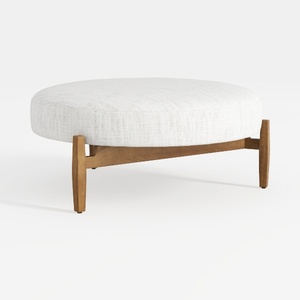

Minimalist Mid Century Fabric Round Ottoman 3D Model

Minimalist White Fabric Tufted Large Sofa 3D Model

Minimalist White Fabric L Shape Sectional Sofa 3D Model
Homestyler offers an easy-to-use online design tool with stunning 3D renderings, a vast collection of interior decoration projects, and helpful DIY video tutorials—perfect for bringing your home design ideas to life effortlessly.
Design jetzt kostenlos
































