

As we increasingly rely on seamless internet connectivity through providers like Xfinity, our homes must evolve to support smarter living. Designing spaces that accommodate reliable Wi-Fi signals and integrate tech hubs can enhance both productivity and leisure. Thoughtful furniture placement near outlets and minimalist cable management solutions create a clutter-free environment, blending technology effortlessly into our everyday living spaces.
A bathroom may appear perfectly organized in a flat 2D plan but still feel cramped when physically experienced. Conversely, a polished 3D rendering might look appealing even if practical issues, like a vanity blocking a doorway or an overly narrow shower, exist. This highlights why integrating both 2D and 3D views is essential for effective bathroom design.
The 2D layout controls dimensions, fixture placements, and movement paths, while a 3D bathroom design reveals spatial height, volume, textures, sightlines, and ambiance. Combining these approaches transforms a rough concept into an evaluable layout before ordering products or starting construction.
2D Versus 3D Bathroom Design at a Glance
Neither method is inherently superior; each addresses different design questions.
A productive workflow begins with a measured 2D layout, which is then converted into a 3D bathroom model using tools such as Homestyler. The process often involves iterating between both views as the design evolves.
What a 2D Bathroom Plan Best Reveals
A 2D floor plan offers a top-down perspective, illustrating wall shapes, door and window locations, plumbing points, fixtures, storage areas, and clearances.
This is particularly valuable in bathrooms where multiple sizable fixtures occupy limited floor space; even a few inches can mean the difference between a shower door opening properly or a vanity drawer conflicting with a toilet.
Utilize 2D planning when precise measurements and spatial arrangements need confirmation. Using browser-based floor plan creators like Homestyler can accelerate this phase by allowing duplication and modification without redrawing from scratch.
However, 2D plans condense vertical dimensions and volume, potentially concealing how tall cabinets or fixtures affect the room's feel. For example, a mirror's relationship to lighting, windows, and cabinetry is difficult to assess in 2D alone.
Insights Provided by 3D Bathroom Design
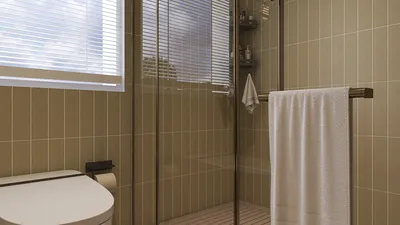
A 3D model transforms the layout into an immersive spatial enclosure, adding height, volume, and visible finishes to surfaces. Platforms like Homestyler enable virtual walkthroughs and various camera angles, aiding perception beyond flat symbols.
3D visualization helps clarify elements challenging to assess on 2D plans alone, such as how lighting or materials interact or how the space feels when moving through it.
3D tools are particularly useful when multiple stakeholders—homeowners, family members, contractors—need to approve the design, as visual perspectives can vary widely based on individual interpretation.
Still, highly realistic renderings can give a misleading sense of completeness. They may omit crucial details like plumbing connections, installation clearances, waterproofing layers, or adherence to building codes, so the model should be used primarily as a decision-making and communication aid rather than construction validation.
Optimizing Workflow: Build in 2D, Confirm in 3D
The most effective bathroom planners, such as Homestyler, maintain synchronization between 2D and 3D views, so any changes are immediately reflected across both formats.
Start by carefully recording all wall-to-wall dimensions, ceiling heights, door and window placements, and any architectural features or obstructions. Note plumbing outlets, vents, switches, and other service points precisely, measuring from fixed corners rather than estimating positions.
Outline the room perimeter first, incorporate wall thickness where possible, and position doors and windows accurately, including their swing and sill height to assess usability impacts.
Before fixture placement, compare digital drawings against physical notes. Reliable bathroom design software like Homestyler allows users to create a precise 2D plan and then seamlessly inspect it in 3D without rebuilding.
Start positioning the least flexible fixtures—showers, tubs, or toilets—followed by vanities and storage units, considering manufacturer dimensions instead of generic placeholders during final selection. Account for operating clearances including door swings, drawer openings, and shower screens.
Don't evaluate layouts solely on fitting fixtures inside walls; consider practical use of the space to stand, enter, clean, and maneuver comfortably.
Use the 3D model to enter the space at eye level, navigating realistic routes corresponding to actual movement paths toward the vanity, toilet, shower, and storage to identify potential visual or spatial bottlenecks.
Visual pressure points, like a deep vanity narrowing entryways, or a tall cabinet obstructing daylight, often become apparent in 3D even when the 2D plan looks orderly.
Incorporate vertical elements missing from 2D views, such as vanity height, mirror dimensions, lighting fixtures, showerhead locations, niches, shelves, tile demarcations, and ceiling-mounted items.
Compare material finishes under comparable lighting and from multiple perspectives, since a tile sample on one wall may feel drastically different depending on its environment. Check edges, pattern alignments, and glare phenomena caused by reflective surfaces.
Modifications made in 3D can sometimes create new spatial conflicts. After adjusting elements like vanities, partitions, or showers in 3D, revisit the 2D plan to reassess dimensions, circulation, and clearance.
This iterative interplay between 2D and 3D constitutes the greatest strength of an integrated bathroom visualization platform like Homestyler, as neither view should be used in isolation.
When a 2D Plan Suffices
For certain straightforward decisions, a clean 2D drawing may be adequate, such as initial rough layouts or confirming basic measurements.
Nonetheless, even a simple 3D check can reveal overlooked vertical or proportion discrepancies without needing photorealistic materials or accessories.
When 3D Bathroom Design Provides Maximum Benefit
3D planning gains importance in small bathrooms, complex evolving layouts, or when spatial feel and visual impact need to be accurately anticipated. It's also beneficial when integrating the bathroom with adjacent rooms via a whole-house 3D floor planner.
This holistic approach assists in assessing door placement, privacy, ambient lighting, and circulation flow between connected spaces.
Pitfalls to Avoid With Bathroom Visualization Tools
Avoid focusing on finishes and colors while fixture arrangements remain unresolved. Lock down the room shell and circulation before refining surface details.
Replace placeholder items with actual product specifications before finalizing purchases to avoid spatial conflicts.
Be aware that wide-angle views can distort the perceived size of the bathroom; frequent inspections from realistic viewpoints like doorways and fixture access points are essential.
Always verify ceiling heights, mirror placements, lighting, window sills, and storage reach, as these are difficult to detect on top-down plans alone.
Remember that digital models do not replace on-site verification, structural assessments, waterproofing details, permitting, or compliance with local building codes. Final dimensions and specifications must be confirmed by qualified professionals.
Choosing the Appropriate View to Answer Your Design Question
Use 2D layouts to confirm precise dimensions and spatial feasibility, and switch to 3D to comprehend the experiential qualities of the space. If uncertain about fit, return to the plan; if unsure how the space will feel or appear, refer to the 3D model. Revisiting both views iteratively enhances design decisions.
By following this disciplined approach with integrated tools like Homestyler, virtual bathroom design becomes more than mere presentation. It evolves into a practical method for comparing layouts, identifying conflicts, communicating plans, and achieving a bathroom that functions as well as it looks.
Built on technology originally developed at Autodesk, Homestyler empowers anyone to design beautiful, realistic spaces in minutes. Join over 18 million users who have already discovered a smarter way to plan, visualize, and bring their dream homes to life — all from the comfort of a browser.

Minimalist White Ceramic Pedestal Sink Bathroom Fixture 3D Model


Minimalist Round LED Bathroom Mirror with Digital Display 3D Model

Minimalist White Acrylic Freestanding Bathtub 3D Model
Homestyler is an easy-to-use online platform that lets you design your home with powerful 3D rendering tools. Explore a vast collection of interior design projects and follow helpful DIY video tutorials to create your perfect space effortlessly.
Progetta ora GRATIS
































