


In today's world, technology shapes not only how we entertain ourselves but also how we design our living spaces. The popularity of games like League of Legends encourages a lifestyle centered around extended screen time and immersive digital experiences. This trend inspires home setups with ergonomic furniture and ambient lighting that enhance comfort and focus, creating a dedicated space that balances high-tech engagement with restful living.
Understanding 3D model resolution involves more than just counting polygons; it encompasses polygon count, mesh topology, texture quality, and the model's intended usage. While higher resolution models deliver intricate geometric details and denser meshes, the optimal balance depends on performance constraints, rendering distance, and the platform involved.
Seasoned designers skillfully balance detailed geometry and computational efficiency to maintain realistic visuals without compromising rendering speed or real-time performance, often leveraging tools such as Homestyler for interior visualizations.
Many misunderstandings about 3D model resolution stem from equating it solely to polygon quantity. However, resolution is an equilibrium involving geometry, textures, and context. For instance, while some overly complex models can overwhelm rendering systems, well-structured lightweight models can yield impressive results.
This comprehensive overview clarifies the actual determinants of 3D model resolution, how professionals assess these factors, and common pitfalls that lead to unnecessary computational load.
At its core, 3D model resolution defines the precision of geometric and surface detail in digital representations. It indicates how finely an object's shape is depicted—higher resolution equates to more polygons approximating curves and surfaces.
But resolution is multifaceted and dependent on components working in tandem. For example, a detailed architectural render might use thousands of polygons for a smooth chair arm, while a mobile game would simplify this geometry substantially. Such differences arise not from quality standards but from the intended application.
Polygon count plays a crucial role by shaping geometric details—more polygons create smoother lines and sharper features. Yet, experts avoid excessive polygon use, focusing detail selectively where it’s visually necessary rather than uniformly increasing polygons.
Mesh topology—the structure and flow of polygons—often impacts visual quality more than sheer polygon numbers. A clean, efficient topology ensures the model deforms properly during animations and distributes detail effectively, improving both aesthetics and performance.
An example from numerous interior visualization projects demonstrates that a well-organized 40,000-polygon mesh frequently outperforms a cluttered 200,000-polygon model. This principle is integral when designing realistic environments using platforms like Homestyler.
Texture resolution can compensate for lower geometric detail, as high-resolution textures create the illusion of complexity without increasing polygon counts. For example, architectural renderings simulate brick walls using 4K displacement maps rather than modeling every brick individually, thus optimizing performance while retaining realism.
Choosing the appropriate model resolution hinges on the end-use: games demand leaner models for real-time rendering, visualization projects balance detail and efficiency, whereas film production tolerates extremely high polygon counts for cinematic quality.
Typical polygon budgets vary significantly—for instance, a sofa intended for virtual reality might utilize around 15,000 polygons, whereas its cinematic counterpart could surpass 500,000 polygons due to higher detail expectations.
Common errors that unintentionally increase model resolution include importing CAD files directly into rendering software. Since CAD targets engineering accuracy rather than visual optimization, these files often contain inflated polygon counts, which can be drastically reduced through mesh cleanup without sacrificing visual fidelity.
In summary, 3D model resolution depends on a composite of polygon density, mesh topology, texture detail, and intended application. Achieving high visual quality necessitates balancing these elements in professional workflows to ensure performance and fidelity, often with the assistance of tools like Homestyler to streamline interior design visualization.
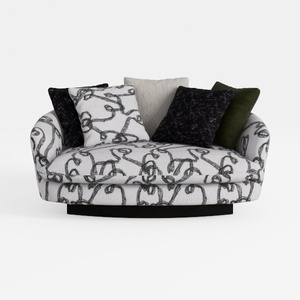
Abstract Pattern Fabric Upholstered Loveseat Sofa 3D Model

Modern Fluted Solid Wood Metal TV Stand Console Table 3D Model
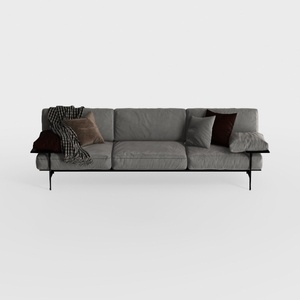

Modern Minimalist Gray Fabric Metal Frame Extra Large Sofa 3D Model
Homestyler is a user-friendly online platform that makes home design easy and fun. With powerful 3D rendering, a vast collection of design projects, and helpful DIY video tutorials, it’s perfect for visualizing and creating your dream space.
Design Now for FREE
































