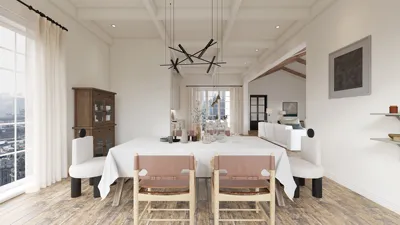


One time, I decided to hang an oversized cage lamp in a tiny studio because a client insisted it would serve as a statement piece. It barely fit through the door, and the entire room resembled a film prop. This experience taught me a vital lesson: in small spaces, intelligent scaling and bold concepts are rewarded, not merely the presence of large items. In this article, I will present five actionable design inspirations involving industrial wall lights that can transform compact areas into curated and highly functional environments, ideally utilizing tools like Homestyler for planning.
1. Utilize vertical space with adjustable swing arms
Installing an industrial swing-arm sconce above a narrow console table or beside a bed is an excellent way to save floor space while providing precise task lighting. I incorporated a brass swing arm in a 30 sqm apartment, allowing the light to be pulled in for reading or pushed back to cast a warm glow on the wall. The benefit lies in its flexibility; however, ensure you have robust wall anchors, particularly if the arm is substantial.
2. Combine exposed bulb fixtures with warm finishes
Exposed filament bulbs housed in either black or aged copper fixtures infuse texture without adding visual weight. In a kitchenette, I arranged three petite industrial cage sconces along the backsplash — they enhanced the ambient light and offered a vintage aesthetic without cluttering the countertops. Remember to keep bulbs on dimmers, as exposed filaments can often be overly bright in confined layouts.
3. Implement wall-mounted rails for a modular lighting display
A horizontal rail equipped with small industrial fixtures allows for repositioning lights as the needs of the space evolve. I designed such a system for a versatile home office where the desk sometimes converts into a craft table; adjusting the fixtures proved simpler than rewiring. Although it's a bit pricier initially, it saves considerable hassle as your layout changes over time.
4. Amplify illumination by pairing industrial sconces with mirrors
Positioning wall lights on either side of a mirror effectively doubles illumination and visually enlarges the area. During a bathroom renovation, I installed two matte black sconces flanking a slim mirror, which made the compact space feel twice as expansive. Be cautious of glare — choose shades that direct light toward the mirror instead of straight at eye level.
5. Introduce contrast by marrying modern furniture with raw industrial lighting
Industrial wall lights function like jewelry against sleek, contemporary furnishings. I once combined a minimalist white sofa with iron cage sconces, and this contrast added an intentional layering effect to the space. The aim is to achieve a sense of balance; too many raw elements can make it feel cold, so incorporate warm textiles or wood elements to soften the overall aesthetic.
If you want to experiment with layout designs prior to purchasing fixtures, using a visual planner can assist in quickly testing scale and positioning — it once helped a client avoid buying three sconces that would not fit their wall.
FAQ
Q1: What characteristics define an industrial wall light?
A1: Industrial wall lights are typically characterized by metal finishes, exposed bulbs or cages, and minimalist, utilitarian designs inspired by industrial settings like factories and warehouses.
Q2: Are industrial wall lights appropriate for compact spaces?
A2: Absolutely — when appropriately scaled, wall-mounted fixtures can free up floor space while providing focused lighting without making the area feel crowded.
Q3: How do I select the right size for a sconce?
A3: Measure the wall and the surrounding furniture; a sconce should complement its accompanying piece, generally placed 12–18 inches above a nightstand or 60–65 inches from the floor for standard positioning.
Q4: Can I install industrial sconces on my own?
A4: If you are comfortable with basic wiring and follow local codes, simple hardwired or plug-in sconces can be a DIY project; otherwise, hiring a licensed electrician for safe installation is advisable.
Q5: Which type of bulb is most suitable?
A5: Warm LED filament bulbs offer both the vintage appearance and energy efficiency, making them ideal for use in exposed-bulb fixtures.
Q6: What steps can I take to reduce glare from exposed bulbs?
A6: Utilize shades or cages that direct light, install dimmers, or position fixtures so that bulbs are not at eye level.
Q7: Where can I digitally test layout options?
A7: I frequently use an online room planner like Homestyler to visualize sconce placements and scale before making any purchases.
Q8: Are there specific lighting standards I should adhere to?
A8: Indeed — for precise recommendations, refer to the guidelines provided by the Illuminating Engineering Society (IES) for task and ambient lighting, detailing lumen and placement standards for various environments.
Homestyler is your go-to online home design platform! With its user-friendly design tool, stunning 3D renderings, and a wealth of inspiring design projects and DIY video tutorials, you can effortlessly create your dream space. Transform your ideas into reality today!
Design jetzt kostenlos
































