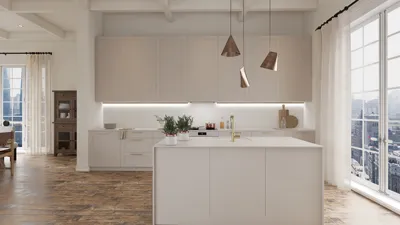


I've selected sleek black kitchen faucets for urban lofts, seaside cottages, and busy family kitchens, and their continued popularity demonstrates a clear fact: when applied thoughtfully, black hardware offers striking visual clarity while providing consistent durability. They are more than just a passing trend; these black finishes reinforce sightlines, minimize visual distractions, and organize task areas with purpose. According to Gensler's workplace research, maintaining visual contrast enhances navigation and cognitive focus—key principles that are equally applicable in kitchen designs where we transition between food prep, cooking, and cleaning zones. Explore the focus and navigation benefits backed by Gensler's findings.
From an operational viewpoint, both task lighting and the design of the faucet are crucial for optimum usability. The Illuminating Engineering Society suggests that greater lighting levels on task surfaces are vital for precision tasks; thus, matching faucet height and spout extension to these prominently lit areas can effectively minimize shadows and spills—reference IES standards for task-lighting guidance. Regarding aesthetics, black faucets act as a serene focal point against lighter countertops; in color psychology, this controlled contrast enhances perceived organization and diminishes cognitive overload—dive deeper into this at VerywellMind on color psychology.
The Brilliance of Black Faucets in Functional Kitchens
Black faucets truly excel under various circumstances that I encounter routinely: (1) in kitchens with lighter decor, where black adds depth and prevents a sterile all-white ambiance; (2) among mid-tone wooden cabinets, where the black finish serves as a timeless ‘ink line’ connecting hardware and lighting; and (3) within darker color schemes, where matte black taps blend seamlessly, allowing the countertop's veining or backsplash texture to shine. In open-plan spaces, a black faucet serves as a visual anchor at the island, clearly designating the sink as an essential workspace rather than an empty spot.
The Importance of Finish: Matte, Satin, and Textured Black
Not every ‘black’ is the same. Here's how I tailor the finish to functionality and style:
I steer clear of glossy black finishes in direct sunlight unless window coverings effectively manage glare; high gloss tends to highlight water spots.
Ergonomics Take Precedence: Height, Reach, and Controls
Design should prioritize human factors. An overall height of 16 to 18 inches generally allows for unobstructed upper-shelf visibility while accommodating most pull-down spray features. Spout reaches between 8 and 10 inches align perfectly with standard 24-inch-deep cabinets, centering the flow near the sink's geometric core to reduce splashback. Single-lever controls facilitate quicker adjustments with wet hands, suitable for both right- and left-handed users; if you lean toward dual handles for symmetry, position them for easy thumb rotation to minimize wrist strain. Touch and touchless options are particularly beneficial around areas where raw food is prepared to prevent cross-contamination—this aligns with WELL v2’s focus on hygiene-compliant fixtures.
Sink Compatibility and Proportions
In kitchen design, proportion is vital. For a single-bowl sink measuring 27–30 inches, I favor an arched pull-down faucet with an 8–9 inch reach; for a more spacious 33–36 inch workstation sink, consider a taller spring or commercial-style faucet, ensuring the spray head dock is secure to eliminate wobbling. In the case of double-bowl sinks, position the faucet at the divider while choosing a head with an extended fan spray to cover both bowls adequately. When designing layouts or checking clearances in a 3D environment prior to purchase, employing a room layout tool can assist in visualizing handle swing in relation to splashes, backsplashes, and window frames.
Managing Water Spots and Cleaning Routine
Matte black finishes hold up well against daily wear if you develop a two-step cleaning habit: a quick microfiber wiping after heavy use, followed by a weekly rinse using mild dish soap mixed with warm water. Avoid abrasive cleaning pads and harsh descalers; instead, utilize a 50/50 mix of water and white vinegar for limescale, then thoroughly rinse. If your water is particularly hard, consider installing an under-sink filter or a softening cartridge to slow mineral accumulation and keep the finish looking sharp.
Combining Metals, Woods, and Stones
Black works harmoniously with various finishes when you manage temperature and sheen appropriately:
Position the faucet as the darkest element in the upper section of your design to balance the visual weight of the base cabinets.
Illuminating the Sink Area
Excellent lighting transforms black fixtures from heavy-looking to intentional highlights. Direct pendants or under-cabinet lighting to the front third of the sink area to prevent casting shadows on the bowl. A color temperature between 3000 and 3500K provides warmth without distorting food colors. If glare is a concern, opt for matte diffusers and steer clear of bright filament bulbs directly above matte black finishes, as they can create unsightly highlights.
Functional Spray Modes I Recommend
Three settings cover nearly all culinary needs: an aerated stream for filling pots with minimal splatter, a broad fan spray for rinsing fruit and cookware, and a stronger spray mode for dealing with stuck-on starches. I rarely opt for needle jets; they mist the water overly fine, leaving a wet finish on black surfaces. Seek out magnetic or mechanical docking that provides an audible or tactile confirmation when the spray head seats correctly.
Installation Tips to Avoid Challenges
Specify the length of supply lines to avoid unnecessary bends, and double-check hole spacing on sinks with multiple openings. If transitioning from a lower spout to a taller arc, ensure that the window sash line accommodates at least 1.5 inches of visible clearance beneath the sills. Integrate a stabilizer plate on thin stainless sinks to limit flex when using a heavy pull-down sprayer. When including soap dispensers or air gaps, align them to maintain a clean sight line between the cooktop, sink, and prep areas.
Emerging Trends for 2024-2025: Keeping Black Faucets Relevant
I'm noticing an increase in mixed-material faucets—black bodies incorporating stainless collars or composite accents—simplifying coordination with a range of appliances. Sustainability trends are also evident in low-flow cartridges that maintain robust performance thanks to improved aeration. Touchless controls are evolving with quicker sensors and enhanced battery life. Subtle texture details (such as knurling and fluting) enhance grip and contribute to a crafted appearance without being overly conspicuous.
Frequent Mistakes to Avoid
Quick Selection Overview
FAQ
Matte black generally conceals fingerprints more effectively than glossy variants. A quick microfiber wipe and mild soap once a week are usually sufficient to keep it looking fresh, especially with non-extremely hard water.
No—consider black as your foundation. Pair matte or satin black with brushed stainless finishes, and keep other hardware either black or in a single complementary metal, like brushed nickel, to avoid a disjointed look.
High-quality PVD or powder-coated finishes are exceptionally durable when maintained with non-abrasive cleaning methods. Refrain from using harsh chemicals and scouring pads to preserve the coating.
Aim for an overall height of 14–16 inches and ensure at least 1.5 inches of visible clearance below window sashes so the installation doesn't appear cramped.
Rectangular single-bowl sinks with tight edges look sleek paired with black. For farmhouse or workstation sinks, opt for a taller arc while ensuring the spout’s reach adequately covers corners to avert splashback.
Absolutely, especially if you're often preparing raw meats. It decreases cross-contamination and keeps the handle cleaner, aligning well with high hygiene standards emphasized by WELL v2.
To avoid shadows, position task lighting ahead of the user. Utilize 3000–3500K LED options and matte diffusers to lessen glare against the black surface.
Certainly. Keep both the faucet and major lighting black, while introducing warm brass pulls for accent. Ensure sheen levels are matched (e.g., matte with brushed) for visual consistency.
Typically, a reach of 8–9 inches centers the flow and minimizes splashes while allowing easy access to rear corners.
Control mineral build-up with filtering or softening methods, wipe down after extensive use, and utilize a vinegar-water solution for rare descaling—followed by thorough rinsing.
Yes. A slender matte-black arc provides a pointed focal feature without overwhelming visual clutter, striking a fine balance with light countertops and adequate task lighting.
Mocking the clearances for handle movement, spout height, and window alignment using a room design visualization tool can help catch potential conflicts before installation.
Homestyler is an outstanding online home design platform that empowers you to realize your interior design dreams effortlessly. With its user-friendly design tool, stunning 3D renderings, and a wealth of DIY video tutorials, transforming your space has never been easier or more fun!
지금 무료로 디자인하세요
































