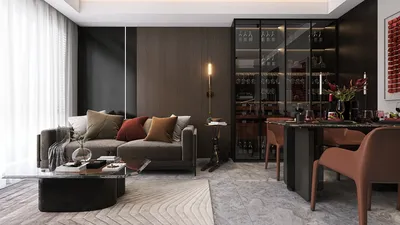


As we move closer to the future with each passing quarter, the prevailing challenges—such as increasing costs, fragmented daily routines, and unwanted noise—compel my clients to envisage apartments as optimized operating systems. Data from the NAHB reveals a trend towards smaller new-home footprints, transforming the layout of a two-bedroom apartment into a sophisticated interface rather than mere square footage. Through this lens, I interpret this design as early programming for blending work and life, facilitating parenting rituals, and ensuring guest privacy within the spatial framework offered by tools like Homestyler.
Split-Wing Quiet + Social Core
Design Framework: Bedrooms positioned at opposite ends effectively manage noise, while the central area evolves into a communal core for dining, working, and play—future lifestyles necessitate this dual capability.
Flow Sequence: Entry → drop-off area → kitchen central node → living space → each sleeping quarter; this streamlined path minimizes interactions during peak activity periods.
Sightlines: From the dining area, expansive views stretch through the living space towards a window focal point; strategically placed doors prevent direct line-of-sight into sleeping areas—privacy is approached as a layered user interface.
Storage Capacity: Two wall-length wardrobes along with a hallway pantry; vertical, shallow storage units are designed for quick access rather than deep chaotic stacks.
Furniture Compatibility: A maximum sofa length of 84", an oval table at 60", and queen beds maintaining 30" side aisles—all set parameters that ensure clear pathways during busy weekdays.
Conclusion: This layout is designed with the anticipation of hybrid work patterns and children's bedtime routines as separate paths; even five years down the line, its segmentation effectively absorbs noise akin to a smart buffer.
save pin
Primary Suite + Flexible Secondary
Design Framework: One bedroom acts as a stable primary suite while the second adapts—functioning as a nursery now and a studio later—ingraining adaptability within the design’s essence.
Flow Sequence: Primary → bathroom → linen storage loop; the secondary room connects directly to the living area, allowing for seamless transitions from work to hosting guests.
Sightlines: The desk is positioned perpendicular to the window for effective glare management; doorways align to reveal glimpses of greenery instead of bedroom views—this visual hierarchy eases cognitive demands.
Storage Capacity: The primary suite boasts a double closet; the flexible room incorporates a rail and cabinet system, a modular solution that adjusts with the shifts in life’s circumstances.
Furniture Compatibility: The primary area includes a queen bed with 24–30" pathways; the flexible room alternates between a 48" workspace and a daybed—maintaining precision for a nimble living environment.
Conclusion: This design feels like future-ready programming: one constant element and one variable thread. It retains high adaptability as lifestyles continue to evolve.
save pin
Galley Kitchen Spine + Corner Living
Design Framework: A streamlined galley operates as the essential processing spine, pushing the living area to the corner for ample daylight circulation—serving as a reliable background service.
Flow Sequence: Entry → galley → corner lounge → balcony; this orderly arrangement ensures efficient meal preparation while promoting leisure activities in natural light.
Sightlines: Staggered tall cabinets shield views; cooking remains in the background visually, with windows being the foremost visual element.
Storage Capacity: A full-height pantry along with toe-kick drawers, and a bench near the balcony door for outerwear; small volumes yet highly organized.
Furniture Compatibility: An L-shaped sofa measuring under 96", coupled with nesting tables and a 30" deep console—each dimension caters to flow and maneuverability.
Conclusion: Looking five years ahead, this design continues to resonate with efficiency: energy, groceries, and routines navigate smoothly through a compact core without excessive visual clutter.
save pin
Final Insights
The value derived from the two-bedroom layout shines when perceived as an interaction interface: channels of privacy, flow, and light are intentionally crafted. Variations such as split-wing configurations, adaptable bedrooms, and galley kitchens transform small spaces into reactive systems. In my observations, the most intelligent homes of the future won’t necessarily be more spacious—they'll simply be more deliberate, and I've consistently noted that minor dimensional decisions can significantly reshape everyday life through platforms like Homestyler.

ivoros 75" Convertible Folding Sofa Bed, Modern Sl

Tribesigns 47" Round Dining Table for 4, Farmhouse

Tennozu Linen Fabric Loveseat Sofa, Convertible Fu
Homestyler is your go-to online home design platform. With its user-friendly design tool, stunning 3D renderings, and a wealth of DIY video tutorials, you can effortlessly transform your home ideas into reality. Explore and create with Homestyler today!
Design Now for FREE
































