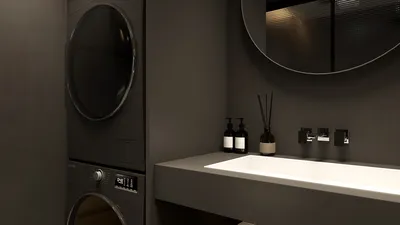


In my early days, I made a rookie mistake by placing a washer beneath a floating bench, as a client believed it would enhance the room's aesthetics. This resulted in a steamy towel situation and taught me a valuable lesson about prioritizing functionality over looks. When dealing with small spaces, every inch needs to justify its existence, making visualization crucial before making any purchases. This practice has saved me from countless trips back to the store.
Small spaces are a breeding ground for creativity, especially when it comes to compact laundry nooks. Here are five practical ideas for optimizing a small laundry area that I’ve successfully implemented, each accompanied by their advantages, practical considerations, and easy DIY-friendly tips.
1. Optimize with vertical stacking: position your washer above and install a shelf on top
By stacking a front-load washer and dryer, you can free up valuable floor space while creating a vertical area for storage. I prefer open shelving above the stacked unit for holding baskets and daily essentials; it’s a cost-effective and quick solution. However, keep in mind that accessibility may be limited for shorter individuals, so it's wise to add a step stool or consider a pull-down shelf for easy access to laundry supplies.
save pin
2. Combine a slim sink with a folding counter
A slender utility sink (12-16 inches deep) positioned beside a foldable countertop provides washing capability without consuming too much space. I once transformed a narrow 60 cm corridor into a functional laundry area using this setup—the foldable surface doubles as a folding station and tucks away when not in use. The limitation is the small basin size, so it may not be ideal for soaking larger items frequently.
save pin
3. Employ pull-out storage and concealed hampers
Drawer-style pull-outs can be positioned between appliances or underneath countertops to keep your detergents and tools organized and within reach. For effective layout planning, I typically sketch out my design and quickly create a floor model to check for spacing; it’s surprising how a mere 2 cm adjustment can prevent clashes with doors. These solutions promote tidiness, although custom pull-outs can be pricier than open shelves.
save pin
4. Utilize hanging drying solutions and retractable rails
Retractable drying rails or ceiling-mounted pulley drying racks simplify the hanging process without introducing permanent clutter to your vision. I once installed such a system above a compact washer in an apartment, and the client appreciated how it vanished when not in use. Be cautious about weight limits and humidity; adequate ventilation or a dehumidifier is essential to prevent mildew in enclosed spaces.
save pin
5. Enhance with smart lighting, mirrors, and a compact folding table
Bright, layered lighting can significantly improve a cramped laundry space, while a small mirror or light-colored backsplash might visually enlarge the area. To preview your desired aesthetics, consider using a platform like Homestyler for realistic 3D visualization, allowing you to experiment with colors and lighting before making a commitment. The challenge lies in ensuring functionality meets aesthetic needs—do not compromise on durable materials in high-moisture environments.
save pin
FAQ
Q1: What are the most efficient washers for limited laundry spaces?
A: Slim, front-loading washers (around 24 inches wide) are ideal since they are stackable and often maintain the same capacity as standard-size units, although be aware that they may produce slightly more noise and vibration in tight spaces.
Q2: Is it feasible to install a dryer vent in a compact apartment?
A: Vented dryers typically require an exterior vent, which isn't always practical in apartment settings. It's best to look for ductless heat-pump dryers or check your building regulations before planning a new vent installation.
Q3: What clearance do appliances require in a small laundry room?
A: Generally, leaving 1–2 inches on each side and 4–6 inches at the back for hoses and airflow is recommended. Always refer to manufacturer specifications, as inadequate space can lead to overheating or vibrations.
Q4: Are stackable appliances effective?
A: Many stackable front-load models are very efficient and conserve floor space, but loading and unloading can become awkward without ergonomic design enhancements, such as a raised platform.
Q5: How can I prevent mold in a small laundry area?
A: Ensure proper ventilation, utilize moisture-resistant paint, and leave doors ajar after use to air out the room. A compact dehumidifier can be extremely helpful in humid environments.
Q6: What type of lighting works best for a laundry nook?
A: Bright, cool-toned task lighting above work areas combined with ambient lighting reduces eye strain while allowing for clearer visibility of stains. Using LED strips beneath cabinets provides effective illumination and is energy-efficient.
Q7: Are there sustainable options for washers?
A: Absolutely—look for ENERGY STAR certified washers and dryers, as they use less water and energy. According to the ENERGY STAR website, certified appliances can use up to 50% less water and 25% less energy than conventional models.
Q8: What’s the estimated cost for a small laundry refresh?
A: Basic DIY upgrades like shelving, painting, or simple countertop additions can range from $100 to $800. More comprehensive updates involving new appliances or custom cabinetry typically cost between $1,000 and $4,000. I always advise prioritizing ventilation and durable materials upfront to avoid costly repairs later.
save pin
Homestyler is an exceptional online home design platform that empowers you to create stunning spaces effortlessly. With its user-friendly design tool, impressive 3D rendering, diverse design projects, and helpful video tutorials, you can easily transform your home ideas into reality. Start designing today!
Progetta ora GRATIS
































