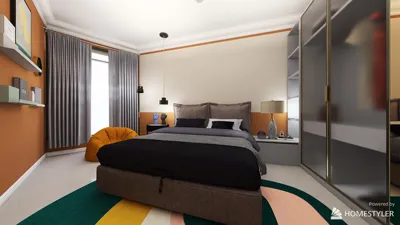


The future of residential design increasingly addresses the challenges of modern living, as households confront issues like excessive noise, commute stress, and clutter. When designing spaces, I envision the next five years arriving sooner than expected. According to AIA, there is an ongoing trend toward versatile, multi-functional rooms, while NAHB highlights a sustained interest in single-level living across various age groups. This indicates that a 4-bedroom, single-story home must function seamlessly, much like an efficient operating system. Utilizing my spatial reasoning toolkit, I view layouts not merely as diagrams but as lifestyle applications, akin to a user-friendly interface like Homestyler.
Courtyard Spine Layout
Design Concept: The central courtyard serves as a hub for light and climate, with bedrooms positioned to provide privacy while benefiting from shared brightness.
Flow: Entry leads into a spine corridor, connecting the living area, courtyard, and bedroom zones, creating a continuous loop that effectively eliminates dead ends.
Sightlines: The design includes layered sightlines from the foyer to greenery, the living area to the sky, and bedrooms that are shielded yet can observe the horizon through clerestory windows.
Storage: Built-in perimeter millwork acts as a consistent storage solution, with linen and gear hubs strategically placed at corridor intersections; the garage drop zone helps mitigate noise levels.
Furniture Adaptation: Modular sofas fit within a 12 to 14-foot living space, while beds are designed to accommodate queen or king formats with 30 to 36 inches of clearance, creating a functional and spacious environment.
Verdict: This design promotes a daylight-first approach where family interaction flourishes without interruptions; I envision a future with established routines centered around the central green space.
save pin
Split-Wing Family + Studio
Design Concept: In this layout, the parents’ suite and children’s cluster are situated on opposite wings, with a small studio near the entryway to facilitate remote work and entrepreneurial activities.
Flow: The sequence begins with arrival, moving through a mudroom to a kitchen hub, then to a studio node and wings; morning routines differ while evening pathways converge at the dining table.
Sightlines: This design allows views from the kitchen to a play yard, the studio to the street for situational awareness, and the primary suite directed towards the garden rather than facing the glare of a television.
Storage: Two separate pantries cater to bulk storage needs and quick access, while wing closets operate as organized archives for seasonal items.
Furniture Adaptation: Dining areas feature 9 to 10 feet of clearance for extendable tables, and the studio accommodates a desk measuring 60 to 72 inches along with acoustic panels for sound management.
Verdict: This design harmonizes work and life, ensuring that instead of clashing, they synchronize. The split-wing structure serves as a governance layer that prevents communication from becoming disruptive noise.
save pin
Linear Gallery with Flex Room
Design Concept: A long gallery streamlines movement, with the fourth bedroom functioning as a flex space that can adapt into a guest suite, media center, or wellness area.
Flow: The route starts at the porch, proceeds through the gallery, into the living/kitchen core, then into the flex room before leading to the backyard; the flow reads like a precise command prompt.
Sightlines: The gallery showcases art and natural light, while the living area offers a view of treetops instead of appliance clutter; the flex room maintains controlled visual engagement.
Storage: The gallery features niches for accessible storage, complemented by deep hallway closets for less-frequently used items, with attic-light truss pockets for seasonal storage.
Furniture Adaptation: The living area allows for an 11 to 12-foot depth to accommodate sectionals and movement, while the flex room is designed for a Murphy bed with sufficient clearance while folded down.
Verdict: This design effectively reduces noise and creates a routine; I foresee a flexible environment where a room can evolve like updated software without requiring major renovations.
save pin
Final Takeaway
A thoughtful 4-bedroom single-story layout should operate like a well-integrated interface, where sites of privacy, communal areas, and storage solutions ensure the home remains responsive. The various terms—single-level family layout, ranch-style design, and single-story four-bedroom home—illustrate that intention holds more significance than mere scale. Through my work, I've observed that the most outstanding homes of the future will not necessarily be larger but more purposefully designed, and I'm consistently witnessing how effective flow redefines daily living, made even easier with tools like Homestyler.
Homestyler's roots trace back to Autodesk, the global leader in design and engineering software. That heritage lives on in every feature we build. Today, with a community of more than 18 million users worldwide, Homestyler continues to make professional-quality interior design accessible to everyone — from first-time decorators to seasoned architects.


Minimalist Japandi Solid Wood Rattan Nightstand 3D Model

Minimalist Solid Oak Bookshelf Open Storage Cubby 3D Model

Modern Minimalist Solid Wood Metal Freestanding Storage Shelf 3D Model
Discover your creative potential with Homestyler! This user-friendly online home design platform offers an array of features, including a versatile design tool, stunning 3D renderings, inspiring design projects, and helpful DIY video tutorials. Bring your dream home to life effortlessly!
立即免费设计
































