


Direct Answer
The optimal home office desk configurations for writers, researchers, and students ensure frequently used books are within easy reach while maintaining a clutter-free desk surface for active tasks. This is typically achieved by pairing a dedicated writing space with vertical shelving, side-mounted book racks, or a rear reference wall, keeping resources accessible without compromising workspace.
Experts who rely extensively on physical books tend to be most productive when their workspace distinctly separates "active writing zones" from "reference storage areas," yet keeps both within immediate reach.
Quick Takeaways
Introduction
After creating numerous home workspaces for authors, academics, and graduate students, a recurring theme is evident: standard desks are not built for heavy book usage.
Typical desk designs assume a fully digital environment. However, writers consulting physical references, researchers accessing journals, and students using textbooks often find themselves overwhelmed by materials stacking on the desk. This clutter diminishes writing space, hampers mental clarity, and transforms the desk into mere storage rather than a productive area.
An effective home office desk arrangement resolves this by systematizing book access to avoid workspace congestion. One practical method I recommend to clients is visualizing layouts first through intuitive room planning tools—like Homestyler—to arrange desks and shelving efficiently. This helps pinpoint ideal locations for books, keeping the desk functional and organized.
This guide explores proven layouts I have applied for professionals who depend heavily on printed materials—writers, researchers, and students. Additionally, it highlights common pitfalls that reduce efficiency in book-centric offices.
save pin
Why Book-Accessible Desks Matter for Knowledge Work
Key Insight: Knowledge-intensive tasks slow down when retrieving references requires leaving the seat or searching through disorderly piles.
Observing professional writers and researchers reveals a clear pattern: continuous switching between reading and writing every few minutes. If a book is not within a quick arm’s reach, the workflow suffers.
From a design perspective, this concerns the reach zone. Ergonomic studies recommend maintaining essential materials within a 24 to 30 inch radius around the seated position to maximize efficiency.
Common errors in book-heavy desks include:
The optimal solution involves segmenting the desk into three zones:
This zoning drastically cuts desk clutter while ensuring resources remain easily accessible.
Desk Layouts for Writers Referencing Multiple Books
Key Insight: Writers thrive with a "wraparound reference" configuration, where books flank the desk rather than piling upon it.
Writers seldom need dozens of books simultaneously but often require several open references during composition. The most effective layout incorporates two side shelves or slender book towers alongside the desk.
A productive desk setup for writers looks like this:
This arrangement mimics how professional editors manage manuscripts and reference sources.
A common mistake is selecting overly large desks, which encourage stacking books and distractions. A more compact desk enhanced by side shelving often promotes concentration better.
save pin
Research Workstations with Extensive Book Storage
Key Insight: Researchers gain from vertical storage walls instead of desk-mounted shelves.
Academic research spaces typically house hundreds of books and journals, making desk-attached storage impractical.
The recommended setup features a "reference wall" positioned behind or beside the desk.
A standard researcher arrangement includes:
Architectural evaluations in university libraries confirm that vertical storage considerably enhances space utilization in book-heavy environments.
When planning this configuration, early visualization of shelf depth and desk clearance can prevent spatial conflicts. Tools like Homestyler allow designers to preview 3D layouts, ensuring that shelves don’t crowd the work area.
Student Study Desks with Systematic Book Management
Key Insight: Students require quick access to textbooks while maintaining a visually tidy workspace for focus.
Many student desks fail because textbooks are piled chaotically, creating distraction and wasting time hunting materials.
An effective student desk setup often consists of:
In dorms or compact living spaces, the most overlooked strategy is vertical storage. Wall-mounted shelves, positioned 12 to 18 inches above the desk, keep textbooks reachable yet clear the desk surface.
save pin
Integrating Digital Tools with Physical Book Storage
Key Insight: The most efficient modern desks treat physical books and digital resources as complementary elements.
Digital materials now play a critical role even in research, but eliminating physical books completely rarely supports deep study effectively.
Ideal hybrid desk arrangements incorporate:
Lighting is often underestimated: books require directed task lighting, whereas monitors benefit from diffused ambient light. Properly balancing these prevents eye fatigue during extended use.
If you’re redesigning a workspace combining digital and physical research, experimenting with layouts via AI-enhanced interior design platforms like Homestyler can uncover configurations overlooked by conventional approaches.
Example Professional Home Office Layouts
Key Insight: High-performing book-centric workspaces follow predictable spatial principles rather than random furniture placement.
Based on numerous projects, three layouts consistently prove effective.
Layout 1: Writer’s Corner Studio
Layout 2: Academic Research Station
Layout 3: Student Study Wall
The underlying design principle common to all three: separate the desk’s working surface from surrounding book storage, keeping the desk solely for thinking and producing.
save pin
Answer Box
Top desk arrangements for writers, researchers, and students keep books reachable but safeguard the desk surface for active tasks. Vertical shelving, side book towers, and dedicated reference walls are superior to cluttering the desk with stacks.
Final Summary
FAQ
What is the best desk setup for writers with many books?
A writer benefits most from placing books on side shelves or narrow towers, maintaining access without covering the writing area.
How should researchers arrange books near their desk?
Researchers perform best with a vertical bookshelf wall near the desk and occasionally a small rolling cart for regularly used items.
What constitutes an effective student study desk with book storage?
Key features include vertical organizers for textbooks, a compact desk surface, and wall-mounted shelves for semester materials.
Is it preferable to store books on or beside the desk?
Beside the desk: storing books on the desk reduces usable space and creates distracting clutter.
How many books should stay within arm’s reach?
Usually five to ten active references; larger collections belong on nearby shelving.
Do professional writers keep books on their desks?
Most keep current reference books close but not constantly on the desk surface.
What is an ideal furniture setup for an academic home office desk?
Typically includes a spacious desk, vertical bookcases, and a comfortable chair for extended reading sessions.
How can small rooms accommodate book-heavy research workspaces?
Utilize wall-mounted shelves, vertical towers, and under-desk drawers to maximize storage without crowding the desk.
References
American Library Association workspace design guidelines
Steelcase research on ergonomics for knowledge workers
UCLA Interior Architecture studies on workspace design

Minimalist Wood and Yellow Metal Table Lamp 3D Model

Modern Minimalist Solid Wood Metal Office Desk With Shelves 3D Model
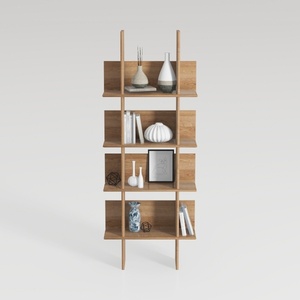

Minimalist Solid Wood Open Bookshelf Display Shelf 3D Model
Homestyler offers an easy-to-use online home design tool with stunning 3D renderings, inspiring design projects, and helpful DIY video tutorials—ideal for anyone looking to create and visualize their perfect living space.
今すぐ无料でデザイン
































