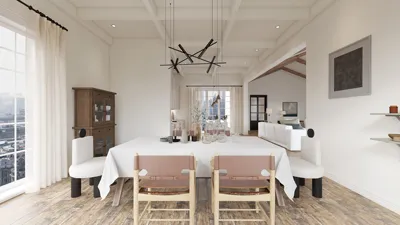


I once attempted to fit a charming vintage drop leaf dining table into a client's 7-foot-wide breakfast nook, which nearly led to a culinary mishap — our furry friend ended up dining on the windowsill. This minor disaster taught me the importance of sketching out a quick room layout before making any purchases, as it allows for rapid checks of clearances and sightlines. In confined spaces, making intelligent choices is essential, and that's why I love drop-leaf tables as unsung heroes for tiny homes, especially when using tools like Homestyler to visualize the space.
1. Select the Appropriate Leaf Mechanism and Size
I prefer tables that feature reliable, simple hinges and an effortless drop mechanism; these are less prone to squeaking or wobbling when guests lean against the edge. The key is to get the sizing right: the closed table depth should ideally not exceed 18–20 inches along a wall, and when opened, there should be at least 24 inches of depth allocated per person. Though it may not seem glamorous, the perfect mechanism seems almost invisible and provides a dependable small win in daily living.
save pin
2. Secure One Side to the Wall for a Floating Appearance
In spaces where every inch counts, I often suggest attaching one side to the wall while using a fold-down leg on the opposite side. This creates a floating appearance and allows for easy chair storage beneath when not in use. The trade-off is a lack of mobility; if you enjoy rearranging regularly, opt for a lightweight folding base instead.
save pin
3. Multipurpose Tops: Prep Area by Day, Dining by Night
One of my most successful modifications was incorporating a butcher-block top to a drop leaf table, transforming it into an extra prep space during busy evenings. This setup is perfect situated next to the stove or in a compact preparation zone — you can gauge the workflow by using the table during meal prep to see if the height and overhang suit both functions. This method enhances functionality without incurring hefty costs, though a durable finish is advisable for accommodating knives and potential spills.
save pin
4. Diverse Seating: Benches, Stools, and Foldable Options
Benches can slide neatly under a closed leaf, while stools can be tucked away in cabinets, allowing for flexible seating arrangements for four without taking up much room. I usually pair a slim bench on one side with stackable stools on the other — this setup appears casual and accommodates various guest numbers easily. A minor compromise in comfort arises here; although benches are snug, they can be less supportive during lengthy dinners, so consider adding cushions if you often host guests.
save pin
5. Finishing Touches and Visual Tricks to Enlarge the Perception of Space
Utilizing light colors and reflective surfaces can significantly enhance the perception of a compact drop leaf dining table. I favor a light-toned tabletop paired with slender metal legs and a mirror or a luminous fixture overhead to visually lift the ceiling. If you're eager to explore further, utilizing Homestyler to visualize in 3D can help you assess lighting and color combinations before applying any final touches — helping you to avoid repainting challenges later on.
save pin
FAQ
Q1: What size should a drop leaf table be for two people?
I recommend a minimum finished width of 30–36 inches and a depth of 30 inches when opened — sufficient for accommodating two place settings with some elbow room.
Q2: Can a drop leaf table function as a kitchen counter extension?
Absolutely, many individuals utilize a drop leaf top as a temporary prep area. Just ensure that its height aligns with standard counters, which are typically 36 inches high, or limit its use to low-prep tasks.
Q3: How much clearance is necessary around a dining table?
You should allow at least 30–36 inches from the table edge to walls or neighboring furniture to ensure comfort while seated and for ease of movement. For wheelchair accessibility, the ADA recommends maintaining clear pathways of 36 inches (refer to ADA Standards: https://www.ada.gov/2010ADAstandards_index.htm).
Q4: Are drop leaf tables stable enough for everyday use?
High-quality models equipped with proper supports are entirely suitable for daily dining. Search for reinforced hinges and strong leg braces, as the cheapest hinges often wear out first.
Q5: What seating options are most compatible with wall-mounted drop leaf tables?
The best options are benches or backless stools, as these can easily slide under the table when closed. If you prefer traditional chairs, opt for designs with slim profiles that can fit neatly under the leaf.
Q6: How do I select a finish that conceals wear and tear?
Matte or textured finishes are better at hiding scratches compared to glossy surfaces; for wooden tops, a medium-toned stain offers more forgiveness. For heavy usage, consider laminate or sealed butcher-block surfaces.
Q7: Is it possible to transform a regular table into a drop leaf design myself?
Yes, but it involves moderate carpentry work — you'll need to accurately fit hinges and support legs. If you're uncertain, a local carpenter can perform the retrofitting without compromising stability.
Q8: Where can I plan the layout of my tiny dining nook before making purchases?
If you're keen on visualizing various layouts and clearances quickly, using an online room planner, like Homestyler, can assist you in testing dimensions and flow before making any financial commitments.
save pin
Looking to transform your home design ideas into reality? Homestyler is your go-to online platform! With its user-friendly design tool, stunning 3D renderings, a plethora of design projects, and helpful video tutorials, creating your dream space has never been easier or more inspiring!
Concevez maintenant gratuitement
































