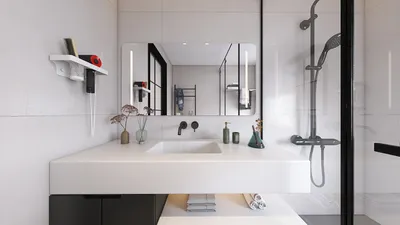


Once, I had a client who insisted that their bathroom door should be 'as small as a closet' to maximize wall space for towel hooks—I almost suggested a trapdoor! This unusual request prompted me to rethink the concept of door sizing, revealing that smaller doors can indeed be both stylish and highly functional. In fact, compact spaces often inspire innovative solutions. Here, I am excited to share five practical ideas I've implemented in various projects to address the challenges of tiny bathroom entries, using Homestyler for visual planning along the way.
1. Pocket Door with a Slim Opening
Pocket doors are a favorite of mine since they neatly slide into the wall, optimizing every inch of space in front of the sink. Depending on building codes and user comfort, you can reduce the clear opening to about 24–28 inches (60–70 cm). The primary advantage lies in unobstructed floor space and clean sightlines; however, you will need wall cavity space and a bit more carpentry work. In a studio renovation I managed, a 26-inch pocket door created enough space for both a slim vanity and a laundry basket.
save pin
2. Bi-Fold Door — Compact and Budget-Friendly
Bi-fold doors can be crafted to as narrow as 18–22 inches (45–55 cm) in width and fold neatly to one side, providing usable opening space without needing the full swing clearance of traditional doors. They’re cost-effective and easy to install but tend to feel less robust and can be somewhat noisy compared to solid options. For sensitive clients, I recommend using soft-close hinges to minimize noise.
save pin
3. Sliding Barn Door with a Short Track
Even when wall space is limited, a sliding barn door can still be effective; just use a wall-mounted track that requires only half the door's overlap. A 24-inch wide slab can be put in place so it slides completely open within the constraints of the wall. This style not only offers a modern aesthetic but also sufficient access. However, be prepared for some light and sound leakage, as barn doors don’t provide the tight seals of traditional doors. I utilized this setup in a compact loft where easy access was crucial due to exposed piping.
save pin
4. Narrow French Door Pair
For those who prefer a softer look, two narrow hinged leaves, each measuring 14–18 inches (35–45 cm), can create a mini French door effect. This design doubles the visual opening while keeping each leaf manageable. The result is a charming symmetry and enhanced accessibility for those with mobility challenges; however, it does require additional hardware and slightly more intricate weatherstripping or privacy seals. In one case, I paired this design with frosted glass to brighten a small guest bathroom while maintaining privacy.
save pin
5. Half-Door or Stable Door
A half-door, or stable door, allows for airflow and imparts a cozy, cottage-like ambiance while retaining the bottom portion for privacy. The lower half can be designed to a compact height of 18–22 inches (45–55 cm), based on visibility needs. This solution is ideal for bathrooms without windows that require ventilation, although it may not be suitable if complete privacy is a concern. I integrated one of these doors in a farmhouse renovation where ventilation was paramount, and it added delightful character to the space.
When selecting the most compact door options, it is essential to review local building codes that dictate minimum clear widths and accessibility criteria, alongside careful measurement of swing or track space. For optimal visual planning in tight spaces, consider utilizing a 3D floor planner, like Homestyler, to visualize door swings and furniture layouts before finalizing your design.
save pin
FAQ
Q: What is the required minimum width for a bathroom door? A: While minimum widths can vary by location, many building codes stipulate at least 24–32 inches (610–813 mm) for general use; accessible bathrooms often require widths of 32–36 inches. Always refer to your local code for guidance.
Q: Is a 24-inch door suitable for a bathroom? A: Yes, in many residential settings, a 24-inch door is functional for single users, but ensure compliance with local minimums and assess the bathroom users' needs, as mobility devices necessitate wider openings.
Q: Are pocket doors permissible in bathrooms? A: Yes, pocket doors are a popular choice for bathrooms, but it’s essential to verify that the wall structure can accommodate this option and include moisture-resistant materials near plumbing.
Q: Do barn doors offer adequate privacy for bathrooms? A: While barn doors provide a stylish look, they don't offer tight seals; for those prioritizing sound and light control, consider adding overlaps, seals, or privacy inserts.
Q: How narrow can a bi-fold door be? A: Bi-fold panels can be designed to be narrow, ranging from 18–22 inches per leaf, but hardware limitations may apply; consult manufacturer specifications for minimum panel widths.
Q: Are half-doors suitable for contemporary apartments? A: This ultimately depends on privacy needs — half-doors are charming and well-ventilated but offer less privacy; they are best suited for homes where airflow and visual appeal are prioritized.
Q: How can I visualize various door options in my floor plan? A: Utilize an online room planner, like Homestyler, to test door swings and ensure proper clearances in a 3D format prior to construction.
Q: Which resource confirms door accessibility standards? A: For accurate guidance, refer to the Americans with Disabilities Act (ADA) Standards for Accessible Design (https://www.ada.gov), which outlines specific requirements for clear openings.
save pin
Homestyler is your go-to online home design platform! With its user-friendly design tool, stunning 3D renderings, and a wealth of inspiring DIY video tutorials, transforming your space has never been easier. Dive into countless design projects and unleash your creativity today!
Progetta ora GRATIS
































