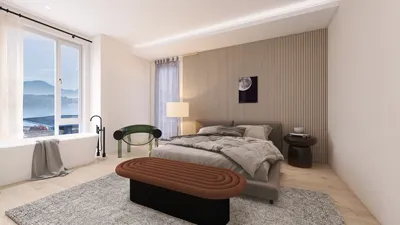


I vividly recall a time when a client insisted that her living room required a multifunctional piece that could serve as a footrest, provide additional seating, and even accommodate a pet — all while being under 18 inches tall. I nearly chuckled at the challenge, yet I designed a compact ottoman that became the highlight of the room. In small areas, you must think creatively, and ottomans stand out as one of the simplest ways to maximize functionality within a limited space.
1. Round pouf for an airy and gentle ambiance
Round poufs seamlessly fit into narrow corners, softening the rigid lines created by sofas and coffee tables. I favor them for their lightweight design, kid-friendly nature, and ability to visually expand a small seating area. However, they do have the limitation of minimal storage; if hidden storage is a priority, consider a slightly elevated version with a removable lid.
save pin
2. Nested cube ottomans offer adaptable seating
Nested cubes are invaluable when unannounced guests arrive. You can tuck smaller cubes beneath a larger one for everyday use and easily pull them out for extra seating as needed. They are suitable for both modern and eclectic interiors, although it's wise to consider the durability of the fabric if they will be frequently moved around.
save pin
3. Storage ottoman bench serves dual purposes
A sleek storage bench ottoman offers a flat surface along with a hidden compartment for items such as throws, magazines, or board games. I once placed one beneath a floating shelf in a studio apartment, and my client appreciated how mess could be concealed in seconds. The only downside is its weight; once filled, it becomes heavier to relocate, so be strategic about its placement.
save pin
4. Leather cube for a stylish and robust alternative
Leather cubes develop a unique character over time and resist stains, making them ideal for families with children or pets. I suggested one for a family fond of mid-century decor; it was easy to clean and maintained its shape well. Cost can be an issue — true leather tends to be more expensive, but a quality faux leather can offer a similar aesthetic without the high price tag.
save pin
5. Foldable ottoman for ultimate small-space living
Foldable ottomans flatten for storage and re-emerge when required, making them perfect for micro-apartments. I once utilized them in a petite living room that also functioned as a home office; they were easily tucked under a console when video calls were on the agenda. Just be sure to check the weight limit and fabric weave to prevent premature wear.
Compact ottomans are a small investment that yield significant benefits: extra seating, surface area, and personality without overwhelming your space. If you're looking to quickly visualize various layouts, consider using Homestyler's room planner to experiment with sizes and placements before making a purchase.
save pin
Tips 1:
Budget tip: Choose durable performance fabrics for regular usage, and reserve precious leather or designer textiles for decorative pieces. Ensure that you measure seat heights against your sofa to maintain consistent comfort, and think about adding casters to pieces that require frequent movement.
save pin
FAQ
Q: What is the ideal height for a small ottoman? A: Aim for a height within 1–2 inches of your sofa seat to ensure it serves comfortably as a footrest or extra seat.
Q: Can small ottomans function as coffee tables? A: Yes, opt for a firm, flat top or use a tray for drinks to avoid spills and enhance stability.
Q: What fabrics are suitable for homes with heavy traffic? A: Performance fabrics and leather are top choices; they resist stains and are easy to maintain.
Q: Are storage ottomans beneficial in a compact living room? A: Absolutely — they offer concealed storage and help minimize visible clutter, making smaller spaces feel more open.
Q: How many small ottomans should I incorporate in a living room? A: One to three, depending on seating needs and circulation space; nested options provide excellent versatility.
Q: Can ottomans damage flooring? A: Heavier ottomans or those with rigid feet might scratch; consider using felt pads or casters designed for your flooring type.
Q: Where can I find layout tools to test ottoman positioning? A: Utilize an online 3D floor planner like Homestyler to play with scaling and traffic patterns before your purchase.
Q: Are there recommended sizing standards? A: Yes — the American Society of Interior Designers (ASID) offers spacing guidelines for seating layouts (refer to ASID resources for detailed information).
save pin
Homestyler is an exceptional online home design platform that empowers you to create stunning spaces effortlessly. With its user-friendly design tool, impressive 3D renderings, a wealth of design projects, and helpful video tutorials, transforming your home has never been easier or more enjoyable!
Concevez maintenant gratuitement
































