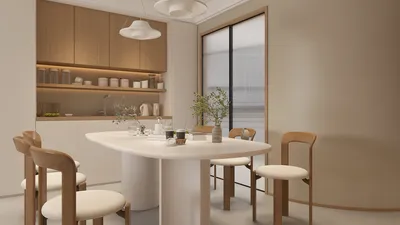


I once arrived at a client's apartment excited about a beautiful pale limewash sample, only to find out it clashed with their mid-century sofa, looking “too farmhouse.” This taught me a valuable lesson: context is everything. Nowadays, I meticulously sketch, test, and preview finishes, often using AI home design mockups to understand how limewash appears under various lighting conditions. Small rooms benefit greatly from limewash, as its delicate texture and breathable properties help create a layered, serene environment rather than a confining one.
1. Allow the Walls to Breathe: Opt for Limewash for Texture, Not Just Flat Colors
I have a strong affinity for limewash because it’s not solely about achieving perfect coverage — it’s about capturing nuance. When applied in thin layers, it produces a soft, slightly varied surface that mimics fabric on walls. This technique yields a lived-in, tactile appearance that conceals minor wall imperfections; however, one must be prepared for some irregularities and embrace a more artisanal finish compared to a factory-smooth coat.
save pin
2. Light Neutrals to Visually Enhance Compact Spaces
In a recent tiny flat project, I utilized warm, muted limewash hues on three walls and a slightly darker shade on the short wall, creating depth without making the space feel cramped. The mineral base of limewash reflects light softly, allowing light greiges and chalky greens to broaden a narrow room's appearance. However, it's important to note that strong overhead lighting can highlight texture, so ensure your lighting choices complement the finish.
save pin
3. Accent Walls — Subtle Depth Over Bold Contrast
Instead of opting for a stark contrast feature wall, consider using limewash for a more understated dramatic effect. I frequently recommend this to clients who desire visual interest without the intensity of wallpaper; limewash imparts depth, particularly on surfaces like chimney breasts or behind shelving. In kitchen nooks, limewash harmonizes beautifully with natural wood and brass elements — when reevaluating layouts, I sometimes incorporate kitchen layout concepts to ensure the finish aligns with storage and light flow.
save pin
4. Experiment with Application: Distress, Glaze, or Stipple
The application technique is where your personality shines through. A light wash reveals the substrate for a genuine aesthetic, while a double coat with intermediate sanding creates a smoother finish. For clients fond of vintage appeal, I have purposefully distressed limewash, but be cautious — aggressive distressing complicates maintenance and might necessitate more frequent touch-ups.
save pin
5. Practical Maintenance, Budget Tips, and the Use of Mockups
Limewash is breathable and well-suited for older homes, yet it does not provide the scuff-resistance of modern emulsions. I always advise clients to anticipate occasional touch-ups and to budget for a simple re-application every few years in areas with high foot traffic. Before finalizing a color, I create a small mockup and sometimes undertake a 3D home design preview with Homestyler to observe how the finish interacts with various light sources — this step saves both money and potential regret.
save pin
FAQ
Q1: What is limewash interior paint composed of?
A: Limewash consists of slaked lime (calcium hydroxide) blended with water and pigments; it cures into a breathable calcium carbonate finish. This distinguishes it fundamentally from contemporary acrylic paints in both composition and performance.
Q2: Is limewash appropriate for compact spaces?
A: Absolutely — limewash's subtle texture and matte finish can visually enlarge a small area by softening shadows and gently reflecting light. It is most effective on walls that can embrace an imperfect, handcrafted aesthetic.
Q3: Can limewash be applied in kitchens and bathrooms?
A: Limewash is breathable and has historically been used in kitchens, but in moist areas, it should be protected with sacrificial sealants or only applied in non-splash zones; significant moisture exposure may reduce its durability.
Q4: How do I maintain limewash walls?
A: Maintenance is straightforward — simply dust gently and perform occasional spot re-washes. For scuffed areas, a touch-up with the original mix or a thin new wash usually blends well because of limewash’s layered nature.
Q5: Is limewash environmentally friendly?
A: Generally, yes; limewash utilizes natural binders and low-VOC pigments, and its breathable quality promotes wall assembly health. Always check product labels for specific VOC information.
Q6: Can limewash be applied over existing painted surfaces?
A: It can, but adhesion and appearance will vary based on the underlying finish. Porous, mineral or previously lime-based surfaces take limewash best; glossy acrylics often require stripping or a bonding primer.
Q7: How long does limewash last?
A: Longevity depends on exposure and usage; on interior walls, expect several years before a light re-wash becomes necessary. For authoritative guidance on lime-based finishes and conservation, refer to Historic England: https://historicengland.org.uk.
Q8: Is limewash considered expensive?
A: The material cost can be similar or less than that of high-end paints, but the artisanal application may increase labor time. Financially, plan for testing, mockups, and potential touch-ups — these initial steps can reduce long-term costs and prevent dissatisfaction.
save pin
Looking to transform your home? Homestyler is your go-to online design platform! With its user-friendly design tool, stunning 3D renderings, diverse design projects, and helpful video tutorials, you can effortlessly create your dream space—perfect for design enthusiasts of all levels!
Progetta ora GRATIS
































