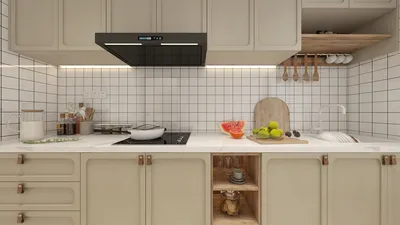


As we look forward, the retail industry serves as a proving ground for the future—customers increasingly desire transparency, rapid service, and personalized experiences while established retail spaces dwindle and pop-up shops flourish. Recent trend reports from AIA and NAHB bolster this observation, indicating that adaptable and reconfigurable retail designs are outperforming traditional fixed layouts in the evolving landscape post-pandemic. Under this mounting pressure, a basic mall floor plan transforms into an essential framework for the future of commerce, functioning as a spatial interface that accommodates new shopping behaviors, all of which can be designed using tools like Homestyler for optimal creativity and effectiveness.
Ring Spine + Radiant Nodes
Design Concept: A continuous corridor serves as the backbone for this layout, delivering balanced access to both large and small retailers. It is designed to accommodate future tenant changes and events seamlessly.
Traffic Flow: Starting from the entry, customers navigate through orientation hubs, continuing in a clockwise loop to key anchor spots and amenity areas, ultimately leading to an exit. This closed-loop design minimizes confusion and enhances decision-making.
Sightlines: Elaborate long-range views towards anchors at 0° and 180°, along with radial sight openings every 30 to 45 meters, where digital totems act as attention-guiding headers within the layout.
Storage Solutions: Back-of-house storage follows the tenants, with shared micro-docks in each quadrant, akin to mirrored caches that help reduce last-minute delays.
Furniture Arrangement: Kiosks function as modular components (3×3 meter grids), with spacious seating islands that accommodate stroller and ADA clearances designed with soft edges to handle crowd movements.
Conclusion: This ring design operates like a robust operating system—maintaining simplicity at its core, allowing tenants to innovate; in five years, it will still efficiently support new retail applications.
save pinOpen in 3D Planner Processing...
Linear Spine + Cross Aisles
Design Concept: A strong north-south axis, complemented by perpendicular paths, creates a clear navigational structure, perfect for narrow spaces and phased developments.
Traffic Flow: Begin at the entry plaza, move along the central spine, encounter cross aisles leading to anchor stores, proceed to a food street, and finally exit via transit access; this flow resembles an efficient command line.
Sightlines: A straightforward view extending 120 to 150 meters captures attention; openings in cross aisles act as navigational cues, revealing layers akin to UI tabs.
Storage Solutions: A linear service alley runs parallel to the spine; communal storage points every 40 meters minimize the bloat in tenant backrooms, leading to effective caching by segment.
Furniture Arrangement: Seating clusters arranged every 6 to 8 meters, with kiosks strategically placed to maintain a clear travel lane of 4 to 5 meters; pop-up spots can be added as 6×9 meter plug-in options.
Conclusion: For an uncomplicated mall design, this serves as a readable syntax, ensuring that over time, updates are like software enhancements rather than requiring complete redesigns.
save pinOpen in 3D Planner Processing...
Courtyard Hub + Short Loops
Design Concept: A light-filled central courtyard functions as the core processor, with short loops radiating outward, facilitating social interaction as a means of throughput.
Traffic Flow: Visitors arrive, orient themselves in the courtyard, select a micro-loop, enjoy food or retail spaces, and then return to the central hub; this design is ideal for quick visits.
Sightlines: Vertical views of the sky and surrounding balconies serve as the layout's header; lateral sight distances are kept under 60 meters for digestible information flow.
Storage Solutions: Each loop features micro-backrooms, alongside a shared docking area—balancing speed and storage with a hybrid cache system.
Furniture Arrangement: Movable amphitheater steps within the hub and flexible storefront modules ranging from 2.4 to 3 meters cater to indie brands, while soft partitions act as adaptable APIs.
Conclusion: This design prioritizes community and event spaces, easily adjustable in the next five years to accommodate trends in wellness, learning, and night markets without complications.
save pinOpen in 3D Planner Processing...
Final Thoughts
An effective mall floor plan goes beyond minimalism; it emphasizes a comprehensible interface: circulation serves as protocol, sightlines establish hierarchy, and storage functions as cache. Whether designed as a ring, linear, or courtyard, the future of retail layouts favors coherent flows and plug-in modules. From my perspective, the most innovative retail interiors will not simply expand in size; they will be more thoughtfully crafted, drawing inspiration from operating systems that welcome upgrades over time, ideally utilizing platforms like Homestyler to facilitate design processes.

ivoros 75" Convertible Folding Sofa Bed, Modern Sl
Coaster Home Furnishings Lynette Rectangular Eco F
Solid Wood Coffee Table - 42.5” Firwood Farmhouse
If you're looking to transform your living space, Homestyler is your go-to online design platform! With its user-friendly design tool, stunning 3D renderings, and countless DIY video tutorials, you can effortlessly create and visualize your dream home. Start your design journey today!
Zaprojektuj teraz za darmo
































