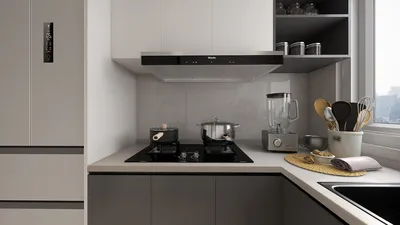


A while back, I worked with a client who was adamant about placing a full-sized dining table in her tiny 6-square-meter kitchen. Let's just say that after she found out that opening the fridge door caused it to bump into the chair, she finally decided to trust my design approach. Compact spaces often challenge us to think innovatively, and throughout my experience, I've discovered that how a kitchen is arranged can significantly affect your experience in that space. Today, I’m excited to share ten kitchen setup ideas that have proven effective in my real-world projects, and they might just transform your perception of your kitchen layout.
1. Utilize vertical storage
In a small kitchen, your walls can be your greatest asset. Installing tall cabinets or open shelving draws the eye upward while freeing up valuable counter space. Just a tip: keep the least-used items on the upper shelves to maintain accessibility and organization.
2. Designate functional zones
Even within a compact kitchen, establishing distinct areas for cooking, food prep, and cleaning is essential to avoiding clutter. I often utilize a room planner to visualize these zones for my clients, ensuring a clear workflow before any renovations commence.
3. Opt for light-reflective surfaces
Using glossy cabinets and glass tiles can enhance the light in your kitchen, resulting in a more open feel. Just keep in mind that these stylish choices may require more frequent cleaning to manage fingerprints.
4. Add under-cabinet lighting
Under-cabinet lights are a quick and effective way to enhance workspace functionality and set a cozy ambiance in the evenings. Consider LED strips or puck lights, both of which are easy to install and energy-efficient.
5. Select multifunctional furniture
An island can serve as both a dining table and extra food prep space, while a bench can cleverly conceal additional pots and pans. I once transformed a client's rolling cart into a coffee station, which saved space and budget.
6. Welcome open shelving
Open shelves can provide visual interest and make accessing everyday items a breeze. The key challenge is ensuring it remains styled and organized rather than cluttered, but with well-curated dishware, it can look exceptional.
7. Fine-tune your layout
Shifting the position of the stove by even just 30 cm can dramatically change how the space feels. I often experiment with various layouts using a free floor plan creator before recommending substantial alterations to my clients.
8. Consider sliding doors
Sliding barn or pocket doors can save space from swinging open and add a touch of character. Ensure they match your kitchen's aesthetic to maintain cohesiveness.
9. Integrate your appliances
Panel-ready appliances merge seamlessly with cabinetry, contributing to a tidy, decluttered look. This approach is particularly useful in open-concept designs where the kitchen is continually visible.
10. Layer your lighting
By combining task, ambient, and accent lighting, you can create a kitchen that's versatile for cooking, dining, or entertaining. I often simulate these lighting combinations using a kitchen layout planner to help clients visualize different moods.
FAQ
1. What layout is optimal for a compact kitchen?
The galley layout is often the best choice, maximizing wall space and enabling an efficient workflow.
2. How can I make my kitchen appear larger?
Incorporate light colors, reflective surfaces, and smart lighting to enhance the sense of spaciousness.
3. Is open shelving a practical option?
Absolutely, as long as you're disciplined in organization. Otherwise, it can quickly become visually chaotic.
4. How should I decide where to position appliances?
Adhere to the kitchen work triangle principle: the stove, sink, and refrigerator should form a triangle for optimal efficiency, with each leg measuring between 4 and 9 feet, as suggested by the National Kitchen and Bath Association (NKBA).
5. What space should I allow between counters?
I recommend a minimum of 36 inches for comfortable movement, increasing to 42 inches if there will be multiple cooks in the kitchen.
6. Is it feasible to have an island in a small kitchen?
Yes, if you choose a slim or portable island that doesn't obstruct essential pathways.
7. Why is lighting critical in a kitchen?
Good lighting is essential; it enhances safety, fosters a pleasant mood, and increases functionality for cooking and social gatherings.
8. Should I consider hiring a designer for a small kitchen?
If you're planning significant changes, a designer can optimize every square inch and help avoid mistakes—they often identify solutions that may not be immediately apparent to you.
Homestyler is your go-to online home design platform! With its user-friendly design tool, stunning 3D renderings, and a wealth of DIY video tutorials, you can easily transform your space into something extraordinary. Start your design journey today and unleash your creativity!
Desain sekarang Gratis
































