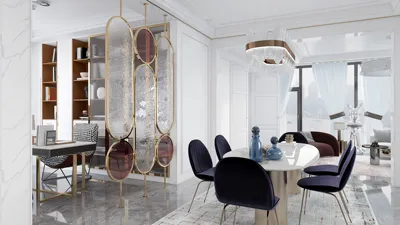


When designing dining rooms, it’s essential to consider how people naturally interact: from sitting and passing dishes to moving between the kitchen and the dining table. The dimensions measured in feet should focus more on comfort, flow, and lighting rather than just style. An effectively designed dining area enhances conversation, maintains clear sightlines, and effectively accommodates everyday meals, weekend gatherings, and seasonal occasions.
To substantiate sizing choices, I utilize two key benchmarks: The WELL v2 Lighting standards advocate for ambient lighting levels around 200 to 300 lux in dining or restaurant settings, increasing to 300 to 500 lux for focused tasks (source: v2.wellcertified.com). For ergonomic comfort, Herman Miller’s research suggests maintaining 36 to 48 inches clearance around seated areas, thereby minimizing physical congestion during meals (source: hermanmiller.com/research). These measurements provide reliable guidelines for creating spatial layouts.
Understanding how people behave in seating areas is also crucial; research by Steelcase indicates that a free flow of movement contributes significantly to comfort and enjoyment. Within dining spaces, it's important to account for the depth needed for chair pull-outs and walkway widths that allow guests the freedom to move comfortably. Typically, a dining chair requires about 18 to 20 inches of seat depth, plus an additional 12 to 18 inches for optimal pull-out space, informing the overall layout per chair and maintaining a clear area behind each seat.
Core Dimensions in Feet
• For table sizes, a compact rectangular table suitable for four usually measures 48 to 54 inches by 30 to 36 inches (4 to 4.5 ft by 2.5 to 3 ft). For six people, a size of 72 inches by 36 to 40 inches (6 ft by 3 to 3.3 ft) is effective, while for eight, a range of 84 to 96 inches by 40 to 44 inches (7 to 8 ft by 3.3 to 3.7 ft) allows for comfortable elbow spacing. Round tables for four are typically 42 to 48 inches in diameter (3.5 to 4 ft), accommodating six at 54 to 60 inches (4.5 to 5 ft), and eight at 66 to 72 inches (5.5 to 6 ft).
• For chair spacing, allocate 24 inches per person along the table edge—2 ft for each seat—to prevent shoulder clashes. Armless chairs can work within 22 to 24 inches in tighter settings, while armchairs benefit from 24 to 26 inches.
• For clearance behind chairs, aim for a minimum of 3 feet, ideally 3.5 to 4 feet. Maintaining at least 3 feet (36 inches) allows diners to stand and move behind seated guests, while 42 to 48 inches significantly enhances service and comfort.
• Circulation paths should ensure 3.5 to 4 feet of unobstructed space for primary routes (e.g., from the kitchen to the table, patio doors, or stairs). Secondary pathways can be 3 feet wide.
Room Size Recommendations
• For a small dining room accommodating four, dimensions of 9 x 10 ft to 10 x 10 ft are ideal, assuming a round table of 4 ft or a rectangular table of 4 to 4.5 ft and 3 ft of clearance.
• A medium dining room for six should measure 10 x 12 ft to 11 x 13 ft, featuring a 6 ft table and a clearance of 3 to 3.5 ft.
• For a spacious dining room for eight, dimensions of 12 x 14 ft to 13 x 16 ft with a 7 to 8 ft table and 3.5 to 4 ft clearance are recommended.
• A flexible layout for 10 to 12 guests would be at least 14 x 18 ft or larger, allowing space for extensions and a 4 ft clearance for smoother service.
Table Shape and Traffic Flow
Rectangular tables are preferable for narrow rooms, aligning with circulation along their longer sides. Round tables promote conversation but usually require more floor space in the center; they also enhance reach for shared dishes across the table. A racetrack oval table combines both features – reducing corner conflicts while promoting better movement near doorways. In uniquely shaped rooms with multiple passages like doors or staircases, take advantage of layout simulation tools like Homestyler before making a final purchase; adjusting by just a few inches can greatly improve flow.
Chair Pull-Out and Edge Distance
Allocate 18 to 20 inches for seat depth and an additional 12 to 18 inches for pull-out behind the chair. Maintain 12 to 15 inches from the table's edge to walls or furniture to ensure knee clearance while seated. If using armchairs on either end, slightly more elbow room will be necessary. Bench seating can reduce the required pull-out depth but will need additional legroom beneath the table; ensure that pedestal bases or trestles do not obstruct feet.
Lighting Levels, Color, and Glare Control
When it comes to dining lighting, I prefer a layered approach: combining ambient (pendants, recessed lighting) with accent lighting (such as wall sconces and candles) that can be dimmed. Aim for 200 to 300 lux of ambient light at the dining table, increasing to 300 to 500 lux on surfaces during food preparation or when reading labels. Using warm color temperatures around 2700 to 3000K promotes a relaxed and sociable atmosphere; resources on color psychology, including those from Verywell Mind, emphasize the positive effects of warmer shades on comfort and social connectivity (source: verywellmind.com/color-psychology). Avoid direct glare by selecting diffusers, fabric shades, or prismatic lenses, and position pendants 28 to 34 inches above the table surface while adjusting for the fixture brightness and table width.
Acoustics and Material Choices
To reduce noise levels, balance heavy materials with softer finishes; mixing a wooden table with upholstered chairs, fabric drapes, and a thick rug beneath can create a serene sound environment. Effective acoustic management leads to a more enjoyable dining experience, particularly in open-plan layouts. For taller or fully glazed rooms, consider incorporating wall art with acoustic properties or using microperforated panels.
Sightlines, Rhythm, and Proportion
In constrained spaces, establishing visual rhythm is key – align the centerline of the table with major fixtures and doorways. Positioning a pendant light directly above the table creates a focal point; use similar finishing materials (such as wood, metal, or fabric) throughout the room for harmony. Ensure that there is a visual corridor of 6 to 8 feet from the main entrance to the table edge, allowing the dining area to be easily perceived upon arrival.
Storage, Buffets, and Service Zones
Position buffets and sideboards along lengthy walls, ensuring 3 feet of clearance in front for serving convenience. If utilizing a bar cart, have it situated with a pocket of 3 feet near an outlet and away from main pathways. For items like fine china and glasses, install upper storage at a height of 54 to 60 inches for easy access; lower drawers should be placed at 24 to 30 inches high for utensils and linens.
Open-Plan Dining: Managing Transitions
In layouts combining kitchen and dining areas, aim for 4 feet of clearance between the edge of the table and appliance doors or kitchen islands to prevent collisions during meal prep. Maintain a distance of at least 3.5 feet from sliding doors to the table to ensure comfortable movement. In a combined living-dining space, anchor the dining section with a rug that extends at least 24 inches beyond the table's edges to accommodate chair pull-out.
Ceiling Height and Fixture Scale
For standard ceilings measuring 8 to 9 feet, a single pendant or a compact multi-light fixture works well. If the ceiling height reaches 10 to 12 feet, opt for larger fixtures or multi-tiered chandeliers, adjusting the height to fall within the 28 to 34 inches above the table range. In instances where the dining table measures over 8 feet, two to three pendants spaced evenly can provide adequate light while being dimmable to set the right ambiance.
Flexible Seating Strategies
To optimize space in narrower dining rooms, consider mixing chairs with a bench on one side. For frequent large gatherings, select an extendable table with leaves and size the room for its maximum extension, not just its typical use. If the layout is atypical, tools like Homestyler can assist in visualizing table rotations—turning a rectangular table 90 degrees might reclaim several inches, improving walkability.
Common Pitfalls to Avoid
• Avoid choosing an oversized table for a narrow space, as this compromises clearance and forces awkward adjustments.
• Limiting seating can cause shoulder conflicts and uneven legroom, especially if table bases infringe on space.
• Hanging a pendant too high or low may lead to glare or accidental bumps; ensure appropriate eye lines when seated.
• Don't overlook door swings; clearly marking arcs avoids clashes with chairs and handles.
• Rugs should be adequately sized; a small rug may catch chair legs, so opt for one at least 24 inches larger than the table perimeter.
Quick Reference: Minimums in Feet
• Ensure a minimum of 3 feet clearance behind chairs; 3.5 to 4 feet is more ideal.
• For primary circulation paths, maintain 3.5 to 4 feet of unobstructed space.
• Allocate 2 feet per person when assessing chair width.
• Round tables accommodating four should be 3.5 to 4 ft in diameter.
• Rectangular tables suited for six typically measure 6 ft by 3 to 3.3 ft.
• Pendant lights should hang 28 to 34 inches above the dining table.
FAQ
An area of approximately 9 x 10 ft with a 4 ft round or a 4–4.5 ft rectangular table, combined with 3 ft clearances behind chairs, is ideal.
Allow about 2 feet (24 inches) per seat to avoid shoulder clashes; armchairs work best at 24 to 26 inches.
Round tables are excellent for easing corners and improving circulation but require more space. Rectangular tables suit narrow spaces and align with wall edges, so choose based on room dimensions.
A minimum of 3 feet is required for standing and passing; increasing to 3.5 to 4 feet significantly enhances comfort and service quality.
Typically, pendants should be set 28 to 34 inches above the tabletop; adjustments should consider fixture brightness, table width, and ceiling height.
Aim for ambient light levels around 200 to 300 lux, with an increase to 300 to 500 lux for more task-driven activities. Warm color temperatures between 2700 to 3000K create a congenial atmosphere for social gatherings.
Extend the area of the rug at least 24 inches past the table’s edges so that chairs can comfortably remain seated on it when pulled out.
Yes, with the right layout including a 7 to 8 ft table and clearance of 3.5 to 4 ft, an area of 12 x 14 ft can typically accommodate eight people comfortably.
Prioritize clear paths of 3.5 to 4 feet width; utilizing layout planning tools like Homestyler to test table positions and necessary buffer zones prior to purchase is advisable.
To lessen noise, include upholstered furniture, thick rugs, decorative window treatments, and consider implementing acoustic wall art or panels to mitigate echoes and noise pollution.
Homestyler's roots trace back to Autodesk, the global leader in design and engineering software. That heritage lives on in every feature we build. Today, with a community of more than 18 million users worldwide, Homestyler continues to make professional-quality interior design accessible to everyone — from first-time decorators to seasoned architects.
Homestyler is your go-to online home design platform! With its user-friendly design tool, stunning 3D renderings, and a plethora of DIY video tutorials, you can effortlessly create and visualize your dream spaces—no prior experience needed. Transform your home today!
Design Now for FREE
































