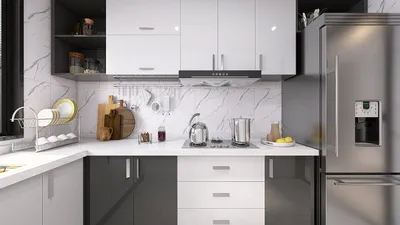


As we look towards the future, the concept of hospitality is evolving, particularly when guests become more of a semi-permanent presence in our lives. This presents a clear challenge: without well-defined boundaries, the essence of hospitality begins to fade. Insights from industry surveys, such as those from Houzz, consistently demonstrate that small homes thrive when circulation is purposeful. Here, the design of guest house floor plans at 500 sq ft emerges as a blueprint for forward-thinking living. Utilizing a spatial reasoning toolkit, we can effectively translate lifestyle needs into practical layouts. With tools like Homestyler, these designs become even more accessible and functional.
Linear Suite with Pocket Core
Design Logic: The layout follows a single-axis model comprising entry, kitchenette, bath, living space, and sleeping area. This sequence is designed to minimize friction and optimize space.
Flow: The design features a cohesive pathway starting from a micro-mud area that leads into the kitchenette, followed by the living space, and finally to the quiet bedroom area. This ensures that guests do not intrude on private spaces.
Sightlines: A long view from the entry points to a wall of windows; partial-height storage screens serve to visually separate the sleeping area, akin to dimming non-essential user interfaces.
Storage: A 16-inch-deep wall-run provides designated storage areas for luggage, coats, and pantry pull-outs, while shallow overheads prevent visual clutter.
Furniture Fit: The plan accommodates a 72-inch sofa, a 30-inch cafe table, and a queen-size Murphy bed measuring 60x80. Essential clearances are maintained within a range of 30–36 inches, adhering to strict movement guidelines.
Verdict: In a compact 500 sq ft space, this linear layout proves to be effective—adaptable and easily understood, allowing future guests to settle in without any adjustments needed.
save pin
Courtyard Loop Micro-Pod
Design Logic: The circular design around a small patio resets the environment, where daylight serves as the operating system, and social interactions increase during the night.
Flow: The design features a looping route connecting entry, living area, sleep space, and bath, which cycles back to the entrance, facilitating continuous activity without interruptions.
Sightlines: The design cleverly opens up to a courtyard, drawing the eye outward; diagonals create depth while utilities are discreetly tucked away behind a muted axis.
Storage: The benches' bases and surrounding vertical storage act as tiered organization systems, keeping frequently used items accessible while utilizing compact storage for less used goods.
Furniture Fit: A 48-inch round table serves as the central point, while space-efficient lounge chairs remain under sightlines; the platform bed at 54 inches optimizes available volume.
Verdict: The looped design keeps the space inviting and functional; looking towards the next five years, easy access to outdoor areas will significantly enhance the experience.
save pin
Split-Grid Studio with Sliding Partition
Design Logic: The layout is divided into two 10x25 grids—one for socializing and another for private use—connected by a sliding partition that functions similarly to software permissions.
Flow: Guests transition from the entry to the living area and kitchenette, easily gliding the partition to access the sleeping quarters and bathroom, establishing intuitive movement.
Sightlines: Creating a layered transparency, frosted panels ensure privacy while allowing light to permeate; the user interface only reveals the active areas.
Storage: Implementing grid-based cabinetry, the design includes 12-inch modules for daily items and deeper 24-inch sections for seasonal storage, minimizing organizational errors through consistent partitioning.
Furniture Fit: Featuring a compact sectional couch at 78 inches, a 48-inch wall desk, and a storage headboard, every piece adheres to 36-inch accessibility as a hard limit on space.
Verdict: The split-grid layout effectively integrates work, relaxation, and hosting functions into an adjustable setting, allowing seamless upgrades without the need to overhaul existing designs.
save pin
Final Takeaway: Designing guest house floor plans within 500 sq ft is about creating not just a physical space but a precise interface where the needs of hospitality blend with personal autonomy. The emergence of compact ADU layouts and micro guest suites illustrates that a focus on clarity in circulation and storage is more critical than sheer size. Ultimately, the future lies in privacy-centric hosting, enhanced by outdoor accessibility and modular storage, operating quietly in the background. Based on my experiences, the most intelligent small spaces prioritize intentional design over mere dimensions, making tools like Homestyler vital in achieving such goals.


Homestyler is the ultimate online home design platform for turning your ideas into reality. With an intuitive design tool, stunning 3D renderings, a plethora of design projects, and handy DIY video tutorials, it empowers everyone to create their dream space easily and creatively!
立即免费设计
































