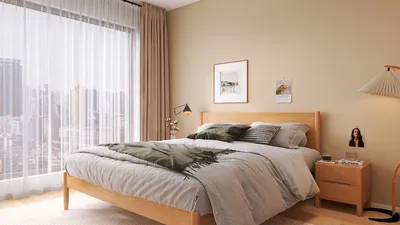


As the future approaches, clients are grappling with current challenges such as increasing expenses, clutter, and dwindling focus. Having a spatial reasoning toolkit is crucial when designing floor plans for a 1500 sq ft house, which must function like a multi-tasking home server. According to AIA data, homeowners are increasingly looking for spaces that are flexible and serve multiple purposes, indicating that our residences should operate like adaptive software rather than fixed structures. Tools like Homestyler can help in visualizing these dynamic designs.
Split-Wing Primary + Flex Node
Design Concept: The primary suite is positioned in one wing, while the secondary bedrooms are mirrored on the opposite side, with a flex room acting as a control hub; this layout allows families to maintain connections while enjoying separate spaces.
Flow: The pathway moves from the entry → through a gallery spine → into the flex node → into the living core → and into private wings; this layout ensures smooth movement and minimizes the need for contextual shifts.
Sightlines: A direct line of sight from the entry to the back windows, with lateral breaks in the view that preserve privacy while highlighting essential elements such as the kitchen, hearth, and terrace. Utilizing tools like Homestyler can enhance this design vision.
Storage: A pantry that stretches across the wall and a linen closet provide ample storage; an entry bench acts as a drop zone for daily items; additional shelving in the garage serves for larger bulk items.
Furniture Fit: A sectional sofa spanning 9'–10'; a dining table measuring 36"×72" serves as a central gathering point; clearances for queen and king beds are maintained at 24" to facilitate seamless transitions.
Conclusion: This winged layout is well-suited for hybrid work and quiet rejuvenation; in five years, the flex node can evolve into a studio, server space, or micro-gym without needing extensive redesign.
save pin
Central Core + Perimeter Rooms
Design Concept: A compact 1500 sq ft space operates like a chipset, with the kitchen and living area serving as the main processor, and bedrooms and study areas as peripheral components, ensuring minimal latency.
Flow: A mudroom offers a buffer → leading into the kitchen core → transitioning into the living area → with a loop back to the bedrooms; this circular design reduces conflicts and enhances family routines.
Sightlines: Transparency from the core to the yard; diagonal views provide insight into the status of different spaces without revealing everything—maintaining clearer UI hierarchies.
Storage: Drawers built into the kitchen island, a double-depth coat closet, and bed platforms with hidden compartments; these design choices help manage clutter efficiently over time.
Furniture Fit: An 8' island with 24" clearance surrounding it; a compact couch and lounge chair provide dual-purpose seating; workspaces are set at 48" for focused activities.
Conclusion: The core-perimeter structure is designed to accommodate changing needs—whether for school, meals, or micro-entertainment—ensuring a strong connection throughout various lifestyle shifts, enhanced by visualizing with Homestyler.
save pin
Courtyard Spine + Two-Porch Strategy
Design Concept: Light serves as the operating system here; a narrow courtyard invites natural light in, with front and rear porches functioning as input/output ports for social interaction.
Flow: Transitioning from the porch → through the threshold → into the courtyard spine → toward the living/kitchen area → and leading to the rear porch; establishes a peaceful progression from the street to the garden.
Sightlines: Layered perspectives allow for near (courtyard greens), mid (hearth), and distant (sky views); this design calibrates visual bandwidth for relaxation and focus.
Storage: Built-in hallway storage units, tall kitchen cabinets, and outdoor storage benches; seasonal equipment is stored at the periphery to keep central areas unobstructed.
Furniture Fit: A compact 48" round dining table for fluid movement; modular sofa pieces that can be rearranged for guests; a porch swing fosters social interactions.
Conclusion: By skillfully managing light and transitions, this design promotes mental well-being; in five years, it will feel like a finely-tuned interface rather than merely an area of space.
save pin
Final Thought
Designing 1500 sq ft house floor plans is less about sheer size and more about the orchestration of space—ensuring flow like code, storage like cache, and sightlines akin to user interfaces. Variations such as compact three-bedroom formats and split-bedroom designs demonstrate that a modest footprint can support multi-faceted lifestyles and adaptive routines. Long-term features—like adjacency between the mudroom and laundry, and flexible spaces with sound insulation—ensure daily convenience. In my view, the most intelligent homes of the future will not necessarily be larger, but will prioritize intentionality, aided significantly by tools like Homestyler.

Monarch Specialties 7657 Computer Desk, Home Offic
COLAMY Upholstered Parsons Dining Chairs Set of 4
Tribesigns 63'' Farmhouse Sideboard Buffet Cabinet
Homestyler is your go-to online home design platform, perfect for anyone looking to create stunning interiors effortlessly. With its user-friendly design tool, impressive 3D renderings, vast design projects, and helpful video tutorials, transforming your space has never been easier. Start designing today!
Projete agora para LIVRE
































