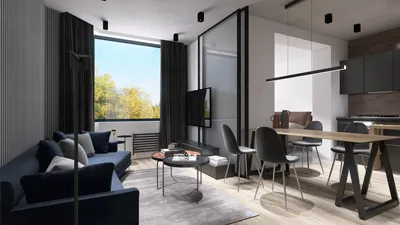


In my experience, there was a client who insisted on positioning their sofa to face the washing machine, stating it was the best source of natural light. It was a scenario worthy of a sitcom script! Such quirky requests have made me realize that designing tiny spaces can lead to unique creative possibilities, and I often begin this process with a free floor plan creator. This allows clients to visualize their options rather than just relying on their imagination, which is where tools like Homestyler come in handy.
Small living areas inspire big ideas. Here, I’ll share five layout inspirations for one-bedroom apartments that I have successfully utilized in projects. Each design will highlight its functionality, potential pitfalls, and a quick budgeting tip.
1. Open-plan concept with designated zones
I enjoy removing unnecessary walls and using elements like rugs, lighting, and strategic furniture placements to create distinct areas for living, dining, and sleeping. This approach not only enhances the perception of space in a one-bedroom apartment but also facilitates a fluid dynamic. However, it’s crucial to plan for storage meticulously to prevent the area from looking cluttered.
Practical tip: Utilize a low bookshelf as a visual barrier that also serves as storage and display space. It is more cost-effective and flexible than installing solid partitions.
2. Murphy bed integrated into a media wall
I once installed a Murphy bed nestled within a built-in media wall for a young professional. By day, it functioned as an office and lounge, while at night it transformed into a spacious bedroom. The advantages include maximizing floor space and maintaining tidiness, although it does involve initial carpentry costs and requires solid wall supports.
Budget consideration: Using a prefabricated Murphy mechanism combined with smart carpentry tends to be more affordable than an extensive loft conversion while providing significant flexibility in daily use.
save pin
3. Galley kitchen featuring a multifunctional island
For compact one-bedroom layouts, I often recommend a linear galley kitchen with a narrow island that serves dual purposes as both a dining area and preparation space. This design aligns perfectly for cooking enthusiasts and entertaining while keeping plumbing streamlined. However, the circulation might be restricted if the island is excessively wide.
If you need a quick layout simulation, I usually advise using a kitchen layout planner to check clearances and appliance positioning before making any cabinet purchases. Homestyler is an excellent option for this purpose.
save pin
4. Lofted sleeping area for high ceilings
Provided that the ceiling height permits, a lofted bed can free up floor space for either living or working underneath — I have implemented this in rentals that have turned into popular Airbnb spots. The benefits include more open floor space and an interesting spatial layout, while the drawbacks involve ladder accessibility and sometimes compliance with building regulations.
Consider lighting and headroom early; a mezzanine might be appealing, but window and smoke alarm regulations could restrict how high you can build.
save pin
5. Sliding partitions for adaptable privacy
Sliding panels or barn doors are my go-to solutions for clients seeking privacy without permanent walls. They allow for closing off the bedroom for guests or creating an open space for gatherings; however, they are not soundproof, so expect limited acoustic separation.
For final presentations and to share plans with contractors, I frequently export models into a 3D floor planner like Homestyler, ensuring everyone shares a coherent vision of the space.
save pin
FAQ
Q1: What layout works best for a one-bedroom apartment to enhance its size?
In my experience, open-plan arrangements with well-defined zones — utilizing rugs, lighting, and furniture segregation — create the greatest perception of space. Maintain long sightlines and minimal clutter.
Q2: What budget should I allocate for a Murphy bed or loft?
Anticipate having a moderate budget for installing a Murphy bed (considering the mechanism and carpentry), while a loft or mezzanine might be costlier due to necessary structural work and permits. Always obtain a contractor’s estimate early in the planning phase.
Q3: Is it possible to have both a home office and a bedroom within the same space?
Absolutely — you can use foldable furniture, vertical storage solutions, and clear zoning. A wall-mounted desk or a Murphy bed with a built-in workstation are effective options.
Q4: Do sliding partitions provide effective soundproofing?
While sliding doors offer visual privacy, sound isolation is limited unless specifically designed with seals and heavier materials. For comprehensive soundproofing, specialized doors and insulation will be necessary.
Q5: What strategies can I adopt to maximize storage space in a one-bedroom apartment?
Leverage vertical space: tall cabinets, over-door organizers, and under-bed drawers are excellent choices. Multi-functional furniture, such as sofa beds and storage ottomans, yield significant value for your investment.
Q6: Must every small kitchen include an island?
No — when space is limited, a slim peninsula or a movable cart can function as a prep or dining area without hindering movement. Ensure to measure clearances carefully to maintain a comfortable layout.
Q7: Are loft designs permissible in all building types?
Not necessarily — lofts and mezzanines must adhere to local building code requirements regarding ceiling height and accessibility options. Always consult your local building authority before initiating structural alterations.
Q8: Will improved insulation enhance comfort and reduce costs in my small apartment?
Indeed. As stated by the U.S. Department of Energy, sealing gaps and improving insulation can significantly decrease energy losses and bolster comfort levels. Even minor enhancements in small units can yield noticeable benefits.
save pin
Homestyler's roots trace back to Autodesk, the global leader in design and engineering software. That heritage lives on in every feature we build. Today, with a community of more than 18 million users worldwide, Homestyler continues to make professional-quality interior design accessible to everyone — from first-time decorators to seasoned architects.
Homestyler is your go-to online home design platform! With its user-friendly design tool, stunning 3D renderings, a plethora of design projects, and helpful DIY video tutorials, you can effortlessly create your dream space. Transform your ideas into reality today!
Design jetzt kostenlos
































