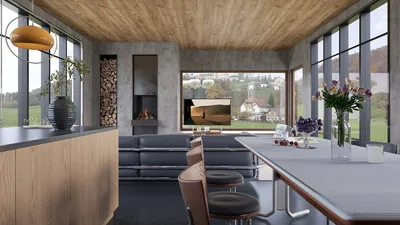


I once had a client who envisioned their dining area to be "as black as a moth-eaten tuxedo," which almost made me bring a flashlight. This project taught me the vital lesson that a dark space requires structure, particularly through effective lighting, or else it can overshadow your meal. While small rooms and dark hues can be daunting, they challenge your creativity. In this article, I’ll present five lighting ideas that can transform a black dining room into a dramatic, cozy, and inviting space, inspired by actual projects I’ve managed, featuring the Homestyler design tool.
1. Layered lighting featuring a standout pendant
A bold pendant light over the dining table is my signature move to create a central illumination point. An oversized pendant, whether in matte black or aged brass, draws the eye upwards and prevents the ceiling from merging into darkness. This technique provides immediate drama and necessary task lighting for dining. However, selecting an excessively large feature can unbalance the space. On one occasion, I replaced a large pendant with a more streamlined linear fixture to maintain warmth without dominating the scene.
save pin
2. Wall sconces for wall sculpture
In a black-hued room, wall sconces act as miniature sculptors: uplighting or wall-washing fixtures can showcase textures and disrupt the monochrome effect. These subtle elements can create intimate lighting pockets ideal for gatherings. However, the trade-off is that installation may require wiring — I often suggest surface-mounted options for quicker setup or plug-in sconces for those in rental situations.
save pin
3. Accent lighting for art and materials
Incorporate picture lights, directional recessed can lights, or narrow-beam track heads to emphasize artwork, wood textures, or unique backsplashes. Highlighting a warm feature such as a wooden sideboard or metallic mirror allows the black walls to recede rather than engulf the space. Although precise aiming is necessary, small, budget-friendly LED picture lights can effectively convert a dark wall into a curated art display.
save pin
4. Enhance with concealed cove or toe-kick lighting
Discreet LED strips along coves or beneath cabinets can introduce a soft halo effect that defines surfaces without overwhelming brightness. In a black dining room, this gentle lighting serves almost as a silhouette edge, enhancing depth. The challenge lies in selecting the right color temperature — it’s best to choose warmer tones (2700K–3000K) to maintain a cozy ambiance because cooler bulbs can make dark shades appear lifeless.
save pin
5. Utilizing dimmer controls and warm color temperatures
I can’t emphasize enough the importance of dimmers — they can effortlessly transform a moody dining area from intimate to fully functional with a simple twist. Combine dimmers with bulbs rated around 2700K for a candlelit glow or 3000K for brighter white light. The only caution is ensuring compatibility: verify that your fixtures and LEDs are dimmer-compatible to avoid flickering. In one of my renovations, switching to compatible LEDs eliminated buzzing problems and harmonized the overall design.
If you’re envisioning layouts or experimenting with lighting placements, utilizing a room planner like Homestyler can help mock up heights and shadows so you can visualize the effects before committing to installation.
save pin
FAQ
Q: What color temperature is best suited for a black dining room?
A: Aim for 2700K to 3000K to retain warmth and avoid a stark, flat appearance. 2700K gives a more candlelit ambiance, while 3000K is slightly brighter.
Q: Should I opt for glossy or matte finishes in a black dining room?
A: Generally, matte finishes absorb light and provide a sophisticated feel, while selective use of gloss on metals or accents can reflect light and create contrast. I often mix both finishes for added depth.
Q: Are recessed lights advisable for ceilings that are black?
A: Yes, but care should be taken with spacing to avoid hot spots. Using low-glare trims and warm LEDs allows recessed fixtures to provide general lighting without disrupting the moody vibe.
Q: How many lighting layers are necessary?
A: At least three layers are essential — ambient lighting (general illumination), task lighting (over the table), and accent lighting (for art or textures) — to ensure the space is both functional and visually captivating.
Q: Is it possible to incorporate smart bulbs in a black dining room?
A: Absolutely. Smart bulbs offer the flexibility to control color temperatures and dimming levels. Just ensure they are compatible with your existing dimmer circuits to avoid performance complications.
Q: What fixtures should be avoided?
A: It's best to steer clear of too many small, competing fixtures that clutter the ceiling; in darker rooms, one prominent focal fixture coupled with subtle layers results in a more organized and intentional look.
Q: How can I illuminate a small black dining room without making it feel cramped?
A: Enhance vertical lighting through the use of wall sconces and ensure the pendant is appropriately sized for the table; also consider hidden cove lighting to add perceived depth to the room.
Q: Where can I find authoritative guidelines on residential lighting levels?
A: You can consult the IES (Illuminating Engineering Society) publications for recommended illuminance levels and industry best practices — they are widely recognized as the standard (https://www.ies.org/).
save pin
Discover Homestyler, the ultimate online home design platform! With its user-friendly design tool, stunning 3D renderings, and a wealth of DIY video tutorials, you can effortlessly transform your space. Explore endless design projects and let your creativity shine, regardless of your experience level!
Design jetzt kostenlos
































