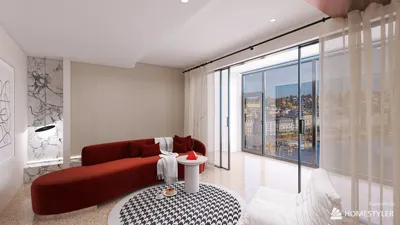


I recall a couple who requested my assistance in designing their bathroom; he desired a sleek, matte black aesthetic while she favored the elegance of soft pink marble. I contemplated recommending that they each occupy separate halves of the house. Instead, I discovered that even the smallest design choices could reflect both of their styles. For instance, a thoughtfully designed shared vanity could serve as the ideal compromise, blending their preferences seamlessly. Homestyler technology empowers designers to create such harmonious spaces.
Working with compact bathrooms often ignites my creativity; the limited dimensions can lead to some of the most ingenious design solutions. Here, I am excited to discuss five practical inspirations for his-and-hers bathrooms that I've implemented in real projects, along with insightful observations about their feasibility, challenges, and ways to save on costs without sacrificing charm.
1. Dual vanities with a shared identity
Consider installing two sinks on a single countertop, each side reflecting a unique touch — whether through different mirror frames, mismatched faucets that feature the same finish, or contrasting drawer pulls. This approach feels custom-tailored without significantly increasing the budget. The only caveat? You’ll need a tad more width, though opting for a narrow trough sink can maintain a compact footprint.
2. Two-tone tiles, one coherent story
Utilize a single tile family in two different shades: perhaps his preference for darker subway tiles on one wall, paired with her lighter patterned tiles on the opposite side, all tied together with a cohesive grout or trim. This method appears intentional rather than disjointed. I once implemented this in a small condo, and the clients adored the contrast, despite the necessity for careful material alignment during installation.
3. Shared lighting plan, separate moods
Create a layered lighting scheme that caters to both preferences: include dimmable overhead lights for ambiance alongside bright task lighting near the mirrors. I often incorporate a small switch or dimmer for each side to avoid conflicts during morning routines. Utilizing planning software like Homestyler can help visualize layouts before investing in fixtures, ensuring optimal sightlines and clearances.
4. Personalized storage niches
Incorporate divided niches or drawers — one designated for morning essentials and another for nighttime products. This configuration involves minimal carpentry costs yet offers immense daily convenience. My clients found joy in labeled trays at first (a humorous addition) and later appreciated the calm that comes from knowing everything has a designated space.
5. Unified flooring, split accents
Maintain a consistent floor to visually enhance the space, allowing wall treatments or accessories to exhibit personality: think towel colors, soap dishes, or artwork. For realistic previews before finalizing designs, I frequently use 3D rendering tools within Homestyler so couples can visualize their combined styles. However, it’s worth noting that bold accents might become more permanent choices, so select materials that can be easily swapped out.
FAQ
Q1: What’s the minimum width for a twin vanity?
Aim for at least 60 inches for two seated sinks to ensure comfortable elbow space, but it is feasible to fit two shallow sinks into a narrower range of 48–54 inches with space-saving fixtures.
Q2: How can couples agree on a shared color palette?
Identify a singular neutral base (such as warm gray or off-white) and allow each individual to select an accent color. This will create unity while enabling personal expression.
Q3: Are separate mirrors necessary?
Not necessarily — a large shared mirror can suffice if complemented with individual lighting and storage. Separate mirrors can help eliminate morning traffic jams and permit each side to showcase their unique flair.
Q4: What lighting levels should I aim for?
Implement a layering strategy for lighting: aim for 300–500 lux in task areas at the mirror with softer ambient lighting throughout the space. Dimmers provide a great way to transition between different moods.
Q5: How to manage storage in a small his-and-hers bathroom?
Take advantage of vertical storage solutions, install recessed medicine cabinets, and utilize divided drawer inserts. Categorizing items by daily routines (day/night) ensures each person has their dedicated area.
Q6: Any building guidelines I should follow?
As per the National Kitchen & Bath Association (NKBA), allow a minimum of 30 inches of clearance in front of fixtures, with 36 inches being preferable for comfort; such clearances enhance functionality in shared bathrooms according to NKBA guidelines.
Q7: How to budget for a dual-style bathroom?
Focus on prioritizing permanent elements (like flooring and plumbing) while saving resources on accessories (such as towels and art). Investing in one significant feature, like a quality vanity top, frequently surpasses the benefits of numerous smaller upgrades.
Q8: Can both personalities be reflected in a tiny bathroom?
Definitely — look for contrasts in textures rather than scale. Mixing matte and glossy tiles, warm woods with cooler metals, or diverse textiles can grant both users a sense of ownership while preventing spatial clashes.
Discover the ease of home design with Homestyler! This user-friendly platform offers a versatile online design tool, stunning 3D renderings, and a wealth of inspiring design projects and DIY video tutorials. Transform your space effortlessly and unleash your creativity today!
Progetta ora GRATIS
































