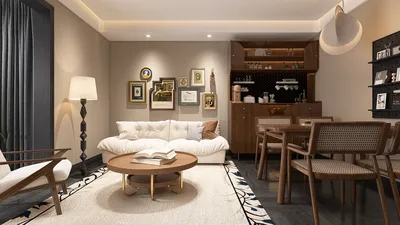


Common bank branch interior design issues typically stem from ineffective customer flow planning, improperly positioned service counters, overly rigid security setups, and lighting that compromises privacy. These challenges are often resolved by restructuring traffic paths, relocating service areas, incorporating subtle security measures, and enhancing lighting approaches. Using tools like Homestyler can assist in visualizing and redesigning these aspects effectively.
Modern bank interiors emphasize clear visibility, seamless movement, and balanced security systems that avoid making clients feel confined or uneasy.
After overseeing numerous financial facility projects, it has become evident that the root causes of bank branch interior design flaws rarely relate to budget constraints. Instead, early planning decisions often neglect mapping real customer movement through the space, leading to inefficiencies.
Architects tend to prioritize aesthetic or brand identity elements, while operational teams emphasize security. This often results in a compromised customer experience, characterized by long waiting lines, confusing navigation, and service desks surrounded by uncertain visitors.
Quite often, a full renovation is unnecessary. A strategic redraw of layouts, supported by visualization techniques such as those offered by Homestyler for simulating customer circulation, can pinpoint bottlenecks and areas of friction within the space.
Efficient bank branch designs typically fail when spaces are organized by departments rather than customer journey stages. Customers perceive the branch not by segregated functions but as a series of sequential steps, and if these steps lack spatial coherence, friction quickly emerges.
Common planning errors include neglecting the ordering of customer interactions and improperly sizing or placing service counters.
Studies from the American Institute of Architects highlight the importance of resolving circulation planning before focusing on furniture arrangement or branding visuals.
Mapping initial customer movements in the first 30 seconds often reveals the most significant layout shortcomings. Employing tools similar to Homestyler allows teams to simulate and analyze traffic flow in three dimensions before finalizing designs.
Queue congestion is less about staffing and more often linked to unclear spatial hierarchy, which causes hesitation and clustering among customers.
Successful branch layouts incorporate three visual anchors that guide visitors effortlessly through the space. A method commonly applied is "visual guidance design," using cues and sightlines to lead customers.
Layered security strategies prioritize subtlety and spatial planning over overt physical barriers, enhancing safety without creating a fortress-like atmosphere. Modern designs embrace principles akin to Crime Prevention Through Environmental Design (CPTED), focusing on visibility, natural surveillance, and controlled access.
Lighting design in financial spaces must strike a balance: while bright, open illumination promotes transparency and trust, it can inadvertently compromise customer privacy. Overuse of ambient lighting combined with glass partitions often exposes sensitive conversations.
To counter this, layered lighting configurations are recommended, which simultaneously enhance comfort and the perception of privacy. Research from the Illuminating Engineering Society supports this multi-tiered approach.
Service desks placed too close to entrances inevitably cause congestion and disrupt entrance flow. A more effective placement lies deeper within the branch, providing a buffer zone where queues don't impede newcomers.
Many bank redesigns replace traditional teller rows with flexible service islands and consultation tables, reflecting the evolving role of branches from transactional spaces to advisory environments. Homestyler can facilitate testing these flexible layouts prior to implementation.
Overall, solutions to common bank interior design challenges converge on three priorities: establishing clear circulation paths, implementing discreet layered security, and situating service zones away from main entrances to optimize customer experience and operational efficiency.
Typical bank interior design difficulties include confusing customer flow, ambiguous spatial hierarchy, poorly located service desks, inadequate privacy solutions, and security measures that obstruct movement.
Improving customer flow involves clear directional cues at entrances, prominent and easy-to-navigate service areas, well-defined waiting spaces, and unobstructed routes throughout the branch. Visualization tools like Homestyler are invaluable in planning these elements.
Banks can feel overcrowded regardless of size when spatial hierarchy is ill-defined—particularly near entrances and service points, leading to traffic jams.
Effective security design must balance customer visibility, surveillance capabilities, controlled access, and comfort, avoiding an intimidating atmosphere.
Service counters should be set back from entrance areas, allowing queues to form without blocking ingress or egress points, ensuring smoother circulation.
Contemporary bank branches increasingly employ modular service setups and consultation tables rather than conventional long teller desks, aligning with changing customer expectations and service models.
Lighting significantly impacts privacy; overly bright, uniform lighting in glass-heavy spaces risks exposing confidential interactions. Therefore, layered lighting schemes are essential to maintain discretion.
Advanced tools that simulate 3D branch layouts and customer flow, such as Homestyler, empower designers to identify and rectify circulation issues early, saving costs and enhancing space functionality.
What began as an Autodesk innovation has evolved into a design platform used by more than 18 million people around the globe. Homestyler combines powerful rendering, an intuitive editor, and a vast furniture library to help you turn inspiration into photorealistic designs — whether you're redesigning a single room or planning an entire home.

Modern Brass Frosted Glass Globe Chandelier 3D Model


Minimalist Marble Solid Wood Table Lamp 3D Model

Homestyler is an easy-to-use online home design platform offering powerful 3D rendering, inspiring design projects, and helpful video tutorials. It’s perfect for bringing your interior ideas to life and creating beautiful spaces with confidence.
立即免费设计
































