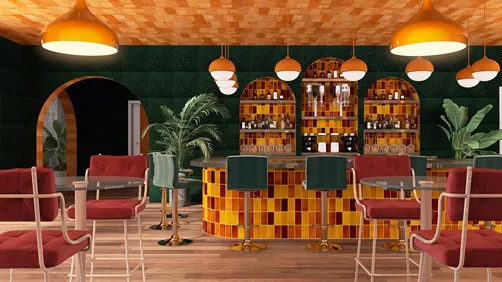
Vintage-Elegant Hotel Lobby Design
The 'Vintage-Elegant Hotel Lobby Design' is a refined interior space planning scenario that bridges historical charm and contemporary comfort. It represents the main public reception zone of a boutique or luxury hotel — not merely a transitional area, but a narrative threshold where guests first experience curated atmosphere, tactile richness, and emotional resonance. Drawing from AIDA competition entries, this scene emphasizes layered spatial storytelling: ornate moldings meet minimalist silhouettes; aged brass hardware contrasts with matte-finish stone; warm ambient lighting coexists with sculptural modern fixtures. It prioritizes human-centered flow, sensory harmony (sight, touch, acoustics), and symbolic elegance — all while serving functional needs like check-in efficiency, luggage handling, and social congregation. As a core application of indoor space planning, it demands precision in zoning (reception, lounge, concierge, waiting nooks), scale calibration, and material layering to evoke timeless sophistication without cliché.
Design Challenges & Common Pitfalls
Balancing vintage authenticity with modern usability is the foremost challenge. Overloading with period motifs (e.g., excessive damask, heavy gilding, or cluttered antiques) risks visual fatigue and feels theatrical rather than lived-in. Conversely, underplaying heritage cues dilutes the 'vintage elegant' identity. Other frequent issues include poor spatial hierarchy — where no focal point (e.g., fireplace, statement chandelier, or art wall) anchors the composition; inconsistent material palettes that lack tonal cohesion; inadequate lighting layering (missing accent + ambient + task); and neglecting acoustic comfort in high-ceilinged lobbies. Additionally, many designers overlook universal accessibility and flexible furniture arrangements needed for diverse guest profiles — a critical oversight in professional hotel interior space planning.
✨ Principle 1: Curated Contrast — Blend Eras with Intention
Avoid pastiche by selecting *one* dominant vintage era (e.g., Art Deco geometry or Victorian opulence) and anchoring it with *two* carefully chosen modern counterpoints — such as clean-lined seating or monolithic stone surfaces. Use contrast not for shock value, but for rhythm: a curved velvet sofa against a linear marble console; a gilded mirror above a matte-black reception desk. This principle ensures timelessness over trendiness and supports holistic Homestyler design techniques — especially AI-powered style transfer and material pairing suggestions within the platform.

Marty Z.’s 'Villa inside the mountain' exemplifies curated contrast masterfully in the hotel lobby context. The design juxtaposes rustic stone walls and arched doorways (vintage vernacular) with floating minimalist consoles and slender brass sconces (contemporary refinement). Using Homestyler AI design tools, Marty likely leveraged the 'Style Match' feature to harmonize textures — ensuring the aged plaster didn’t compete with polished metal finishes. The open-plan hall layout also demonstrates intelligent indoor space planning: clear sightlines from entrance to lounge zones support intuitive navigation while preserving visual grandeur.
Start Free Design🌿 Principle 2: Layered Lighting — Sculpt Ambience, Not Just Illuminate
Lighting must function as both utility and emotional conductor. Implement at least three layers: (1) ambient (e.g., recessed ceiling coves or concealed LED strips), (2) accent (focused on artwork, architectural details, or material textures), and (3) task (subtle under-counter or desk lighting). Vintage elegance thrives on warmth (2700K–3000K CCT) and dimmability. Avoid uniform brightness — instead, create pools of light and intentional shadow to enhance depth, intimacy, and drama. In Homestyler, users can simulate HDR lighting conditions (e.g., 'moonlit_golf' or 'g_sunny_vondelpark') to preview how natural and artificial sources interact across times of day — a vital step in professional interior space planning.

Isa Martinez’s 'La Esencia del Hotel Exclusivo' uses layered lighting to poetic effect in its reception zone. Sunlight streams through tall windows (ambient + natural accent), while delicate wall sconces cast soft halos on textured plaster and antique mirrors (accent + mood). A single sculptural pendant above the front desk provides focused task illumination. Through Homestyler’s real-time lighting simulation, Isa could refine the HDR setting ('g_sunny_vondelpark') to ensure daylight balance — proving how AI-powered tools elevate interior space planning beyond static mockups into experiential prototyping.
Begin Free Design🎨 Principle 3: Harmonized Palette — Restraint with Resonant Accents
Adopt a foundational palette of 3–4 neutral tones (e.g., warm ivory, taupe, charcoal, and soft sage) drawn from natural materials — limestone, oak, linen, aged brass. Then introduce *one* resonant accent color (e.g., deep emerald, burnt sienna, or dusty rose) used sparingly but deliberately: in upholstery piping, ceramic vases, or framed botanical prints. This restraint prevents visual noise while amplifying elegance. Homestyler design tips recommend using the 'Color Harmony' tool to test palettes against rendered surfaces — ensuring chromatic consistency across walls, floors, and furnishings before finalizing interior space planning decisions.

REM Studio’s 'Hotel Project' applies this palette principle with exceptional discipline. Its lobby features oat-colored linen sofas, raw-edge walnut reception desks, and pale limestone flooring — all neutrals grounded in organic authenticity. A single vibrant terracotta rug and matching ceramic vase serve as the sole accent, echoing earthy tones found in the greenery and stone. Leveraging Homestyler’s AI-driven material library, REM likely cross-referenced finish swatches across lighting conditions to guarantee hue fidelity — a best practice in sophisticated interior space planning and Homestyler design techniques.
Free Design NowFAQ
Q: What does 'vintage elegant' mean in practical hotel interior space planning terms?
A: It means intentionally integrating historic design language — such as symmetrical layouts, classical proportions, rich textures (velvet, marble, brass), and decorative millwork — while optimizing for modern functionality: accessible circulation paths, integrated tech (USB ports, wireless charging), acoustic absorption, and adaptable furniture groupings. It’s not about replication, but reinterpretation guided by human experience and contemporary standards.
Q: Can I use Homestyler AI tools to generate vintage-elegant lobby concepts quickly?
A: Yes — Homestyler’s AI Interior Design feature allows you to input prompts like 'Art Deco hotel lobby with modern minimalist touches, warm lighting, and natural materials' to generate photorealistic 3D renders in seconds. You can then refine using Style Transfer, Material Swap, and Lighting Simulation tools — accelerating your interior space planning workflow significantly.
Q: Are there specific Homestyler design tips for balancing old and new elements without clashing?
A: Absolutely. Start with a unified base (e.g., neutral wall color + consistent floor material), then layer vintage and modern items by *scale* and *finish*, not era. Use Homestyler’s 'Compare Styles' function to side-by-side evaluate two furniture sets against the same backdrop — a proven Homestyler design technique to avoid visual dissonance.
Q: How important is lighting simulation when designing a vintage-elegant hotel lobby?
A: Critical. Vintage elegance relies on luminous quality — soft shadows, warm glow, reflective highlights. Homestyler’s HDR lighting presets (e.g., 'wuhan_night', 'g_city_park') let you test how brass fixtures interact with dusk light or how pendant lamps cast ambiance at different hours — turning abstract interior space planning into an evidence-based, emotionally intelligent process.


Homestyler offers an easy-to-use online design tool with stunning 3D renderings, a vast collection of interior decoration projects, and helpful DIY video tutorials. It’s perfect for anyone wanting to create and visualize beautiful home designs effortlessly.
Design Now for FREE