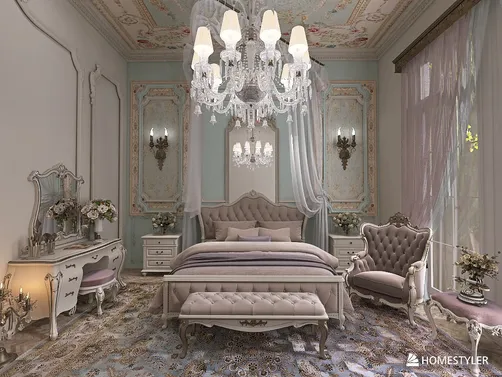
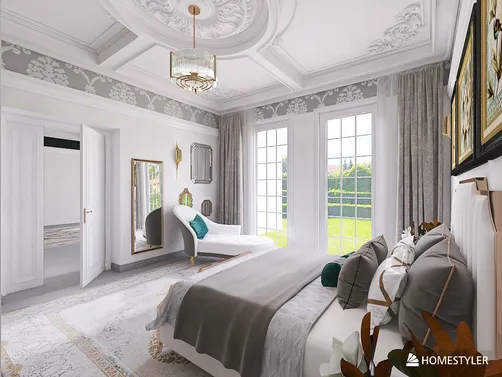
Rococo Style Bedroom Design
The Rococo Style Bedroom is a refined, artistic interior space characterized by romance, elegance, and luxurious ornamentation. Drawing inspiration from 18th-century French decorative arts, it emphasizes asymmetry, delicate curves, pastel palettes, gilded accents, floral motifs, and theatrical softness. Unlike formal Baroque, Rococo prioritizes intimacy, lightness, and sensory delight — making it ideal for private sanctuaries like bedrooms where comfort meets curated opulence. This scene transcends size or region: whether in a compact urban apartment or a grand château suite, the core lies in evoking poetic refinement through layered textures, bespoke furnishings, and intentional spatial choreography — all supported by modern digital tools like Homestyler for precise indoor space planning and photorealistic visualization.
Design Challenges and Common Pitfalls
Designing a true Rococo bedroom demands balancing historical authenticity with contemporary livability — a challenge many overlook. Key difficulties include avoiding visual clutter while layering ornate elements (e.g., excessive gilding or mismatched curves), maintaining proportion in furniture scale relative to room volume, and integrating delicate detailing without compromising functionality or comfort. Another frequent issue is color misalignment: using overly saturated or cold tones that clash with Rococo’s signature warmth and luminosity. Additionally, poor indoor space planning — such as blocking natural light paths with heavy drapery or oversized mirrors — undermines the style’s essential airiness and grace.
✨ Principle 1: Curvilinear Harmony & Asymmetrical Balance
Rococo rejects rigid symmetry in favor of rhythmic, organic flow — think serpentine bed frames, shell-shaped wall reliefs, and undulating moldings. Achieve harmony by distributing curved forms across vertical (mirrors, headboards), horizontal (bed skirts, console fronts), and planar (wallpaper scrolls, ceiling rosettes) dimensions. Avoid mirror-image repetition; instead, use mirrored *intent* — e.g., a left-leaning rocaille motif balanced by a right-sweeping floral garland. This principle ensures dynamism without chaos and supports intuitive indoor space planning by guiding the eye along gentle, human-scaled pathways.

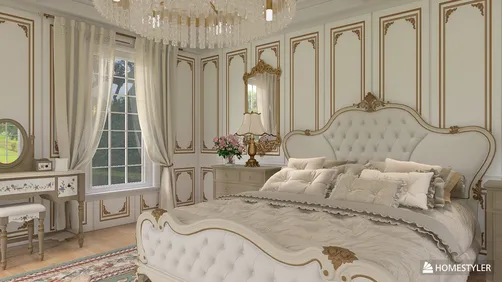
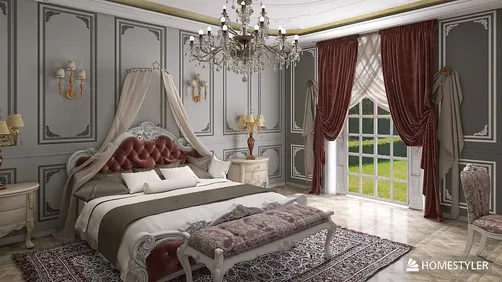
Designer sandro valeri’s 'Eleganza Vittoriana' masterfully applies curvilinear harmony: the bed’s scalloped tufting echoes the sinuous frame of the arched mirror, while the draped canopy flows asymmetrically — heavier on the left, tapering softly right. Using Homestyler’s AI design tools, he adjusted curvature radii in real time and tested multiple lighting angles (via HDR 'g_lilienstein') to ensure every curve catches light gracefully — proving how digital precision elevates historical intuition in indoor space planning.
Start Free Design🎨 Principle 2: Layered Textural Opulence with Purpose
Rococo luxury lives in tactile contrast: velvet against gilded wood, silk damask beside hand-painted porcelain, matte plaster next to burnished brass. But texture must serve narrative — not just abundance. Prioritize three dominant textures per zone (e.g., bed: tufted velvet headboard + sheer organza drapes + carved walnut nightstands) and anchor them with a unifying finish (e.g., antique gold leaf). Avoid flat uniformity; instead, vary sheen, pile height, and grain direction to create depth. This layering strategy enhances perceived spaciousness and supports effective Homestyler design techniques by enabling material-swapping simulations before physical commitment.

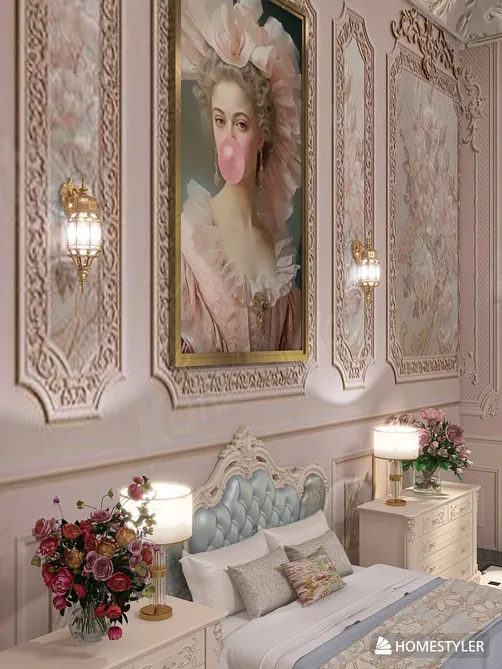
anjaa mmm’s 'ROCOCO BEDROOM' demonstrates purposeful textural layering: the deep-pile rose carpet grounds the space, while the high-gloss lacquered commode reflects both floral wallpaper and chandelier light — doubling visual richness without adding bulk. She used Homestyler’s real-time 3D rendering to preview how silk pillow shams interacted with matte plaster walls under different sunlight settings ('moonlit_golf' vs 'sunny_vondelpark'), refining her indoor space planning to maximize tactile storytelling within a compact 73.3 m² footprint.
Begin Your Design Now🕯️ Principle 3: Light-Centric Ornamentation & Strategic Gilding
In Rococo, light isn’t ambient — it’s a design material. Gilding, mirrors, crystal pendants, and pale reflective surfaces are deployed not for bling, but to amplify and diffuse natural and artificial light. Apply gilding selectively: on convex edges (to catch highlights), inner mirror frames (to deepen reflection), and ceiling medallions (to lift perceived height). Avoid full-surface gold — instead, use it as punctuation. This principle directly informs Homestyler design techniques: leveraging HDR environment presets and dynamic sunlight sliders to simulate how light interacts with gilded contours and curved planes before construction — optimizing both aesthetics and energy-aware indoor space planning.

Alice Bresolin’s 'Rococo suite' uses light-centric ornamentation with surgical precision: the central chandelier’s crystal drops are positioned to cast prismatic highlights onto the gilded bed crown at dawn, while the fluted mirror above the dressing table angles reflections toward north-facing windows — extending daylight hours. Through Homestyler’s 'sunny_vondelpark' lighting engine, she iterated over 12 sun-angle configurations to calibrate gilding placement, transforming static decoration into responsive, living light architecture — a hallmark of advanced indoor space planning.
Launch Free DesignFAQ
Q: How does Homestyler support authentic Rococo bedroom design when historical references are complex?
A: Homestyler simplifies historical accuracy through AI-powered style matching — upload a reference image or keyword (e.g., 'rocaille', 'pastel toile'), and its design engine suggests period-appropriate furniture, moldings, and color palettes. Its real-time 3D rendering also allows instant testing of scale, proportion, and light behavior — critical for Rococo’s nuanced balance of delicacy and grandeur.
Q: Can Rococo principles work in small bedrooms (<25 m²) without feeling cramped?
A: Absolutely. Rococo thrives on intimacy — small spaces benefit most from its emphasis on vertical ornamentation (tall mirrors, ceiling medallions), curved sightlines (rounded rugs, arched niches), and strategic gilding to enhance perceived volume. Homestyler design techniques let you simulate spatial perception using camera-height views and dynamic lighting, ensuring elegance never sacrifices practicality.
Q: What’s the biggest mistake designers make when applying Rococo in modern interiors?
A: Overloading ornament without hierarchy — treating every surface as a canvas for detail. Authentic Rococo uses restraint: one focal point (e.g., the bed), secondary accents (e.g., mirror frame), and tertiary rhythm (e.g., wallpaper scrollwork). Homestyler’s layer management and 'focus mode' help isolate and refine each element, supporting disciplined indoor space planning.


Pink White Solid Wood Kids Bunk Bed with Storage Drawer 3D Model
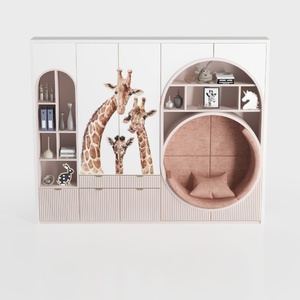
Modern Pink White Giraffe Print Multifunctional Cabinet With Reading Nook 3D Model

Baxton Studio Elora Pleated Velvet Storage Bed, Qu
Homestyler offers an easy-to-use online design tool paired with stunning 3D renderings, extensive interior projects, and helpful DIY video tutorials. It’s perfect for bringing your home design ideas to life with creativity and confidence. Try it and transform your space today!
Concevez maintenant gratuitement