


Mondrian-Style Living Space Design
The Mondrian Style design challenge reimagines interior spaces as abstract compositions—transforming rooms into dynamic canvases defined by geometry, balance, and disciplined color use. Rather than focusing on a single functional typology (e.g., kitchen or bathroom), the competition emphasizes *universal spatial principles*: vertical/horizontal linearity, precise proportional divisions, restrained primary-color palettes (red, blue, yellow, plus black/white/gray), and intentional negative space. This makes the core design scene not a specific room type—but a conceptual framework for *any residential or public interior*. The winning entries—including top-ranked works like Tamara Datsenka’s modular living environment and Cecilia Botha’s light-filled lounge—demonstrate how Mondrian’s artistic logic translates into immersive, navigable, and emotionally resonant living spaces. Thus, the central scene is best abstracted as the 'Mondrian-Style Living Space': a holistic, human-scaled interior where structure *is* expression, and every wall, partition, and color block serves both aesthetic clarity and experiential rhythm.
Design Challenges & Common Pitfalls
Applying Mondrian principles to real-world interiors introduces nuanced challenges beyond stylistic imitation. First, strict adherence to orthogonal lines and rigid grids can unintentionally create sterile or institutional atmospheres—especially in smaller areas where visual weight must be carefully calibrated. Second, limiting the palette to primary colors and neutrals risks overwhelming small spaces or clashing with existing architectural elements (e.g., non-white ceilings or textured walls). Third, balancing ‘abstraction’ with ‘livability’ remains critical: floating color blocks may look striking in renders but fail ergonomically—such as placing a bold red wall behind a sofa without considering glare, reflection, or spatial compression. Finally, many designers misinterpret ‘negative space’ as mere emptiness rather than an active compositional element—leading to underutilized zones or disjointed circulation flow. These pitfalls underscore that successful Mondrian-style design demands rigorous *interior space planning*, not just decorative layering.
✅ Principle 1: Grid-Based Spatial Zoning
Divide the floor plan using an invisible structural grid—anchored to walls, windows, and key fixtures—to define functional zones (e.g., seating, circulation, display) through alignment and proportion—not furniture placement alone. Each zone becomes a ‘canvas block’, with boundaries implied by floor transitions, ceiling planes, or linear wall treatments. Avoid arbitrary subdivisions; instead, derive proportions from golden-section logic or simple integer ratios (e.g., 1:2, 2:3) to preserve visual harmony. This method transforms layout decisions into deliberate compositional acts—turning spatial hierarchy into rhythmic order.

Cecilia Botha’s 'Mondrian Style' (Canada) masterfully applies grid-based zoning: the living area is subdivided into three horizontal bands—window wall (top), seating zone (middle), and baseboard/plinth strip (bottom)—each aligned with ceiling beams and floor transitions. Using Homestyler AI design tools, she precisely anchored furniture legs and panel edges to the grid, ensuring all verticals and horizontals interlock—even across transparent partitions. This demonstrates how *interior space planning* in Homestyler isn’t about dragging objects, but setting intelligent constraints to enforce geometric discipline.
Start Free Design Now🎨 Principle 2: Chromatic Block Integrity
Treat color not as surface treatment, but as volumetric architecture. Assign each primary hue (or neutral) to a continuous, unbroken plane—wall, ceiling segment, built-in cabinet, or freestanding screen—with clean, sharp edges and zero gradient or texture. No ‘accent pillows’ or ‘colored vases’—only monolithic color volumes that define spatial boundaries and generate contrast through adjacency (e.g., blue wall next to white ceiling). Reserve black for structural outlines (door frames, column wraps) and white/gray for background fields. This ensures color functions as spatial punctuation—not decoration.

Graca Doutel’s 'The Mondrian Project' (Portugal) exemplifies chromatic block integrity: a vivid red wall plane extends uninterrupted from floor to ceiling, wrapping seamlessly around a corner to define the entry axis—while adjacent white walls recede as pure ground. Using Homestyler’s material override and wall segmentation tools, she isolated each color zone as a discrete object, preventing bleed or accidental blending. Her approach proves that * Homestyler design techniques* enable precision color architecture—where hue becomes a spatial actor, not a cosmetic afterthought.
Begin Your Free Design📐 Principle 3: Negative Space as Active Composition
Intentionally design voids—not as leftover gaps, but as calibrated intervals between color blocks and structural lines. These negative spaces (e.g., wall margins, ceiling voids above cabinets, floor gaps beneath floating shelves) must hold proportional relationships to adjacent solids: e.g., a 120mm gap between two red panels echoes the 120mm width of a black column wrap. Use these intervals to modulate rhythm: narrow gaps create tension; wider ones evoke calm. Crucially, ensure negative space supports movement—aligning walkways with vertical voids or framing views through horizontal ceiling cuts. This transforms emptiness into expressive silence.

Dfanders 2022’s 'Mondrian Style Bedroom View On A Rooftop' (Mexico) leverages negative space as active composition: a dramatic 900mm-wide ceiling void runs parallel to the bed’s headboard, visually extending the sleeping zone while framing the window view—its width exactly matching the height of the yellow bedside unit below. Using Homestyler’s ceiling editor and custom void tool, the designer treated emptiness with the same rigor as solid elements. This reflects advanced * Homestyler design techniques*, where spatial breathing room is calculated—not improvised—enhancing both aesthetics and functional comfort.
Create Your Free DesignFAQ
Q: Do I need professional architecture software to participate in the Mondrian Style challenge?
Not at all. Homestyler is a browser-based AI interior design platform optimized for rapid spatial ideation. Its drag-and-drop grid system, one-click color-block application, and real-time rendering make it ideal for translating Mondrian principles into 3D environments—no CAD experience required.
Q: Can I use more than three primary colors in my design?
No. Authentic Mondrian style restricts the palette to red, blue, yellow, black, white, and gray only. Introducing orange, green, or pastels violates the core ethos of restrained chromatic language. Use saturation and scale—not new hues—to create variation.
Q: How important is furniture selection versus spatial layout in this challenge?
Spatial layout is paramount. Furniture should reinforce—not disrupt—the grid and color-block structure. Prioritize Mondrian-aligned models from the official 'Mondrian Furniture Model Collection' (linked in contest resources) to ensure proportional harmony and avoid visual clutter. Smart *interior space planning* always precedes furnishing.
Q: Is lighting design part of the Mondrian evaluation criteria?
Yes—indirectly. Lighting must enhance spatial clarity: directional downlights should accentuate horizontal divisions; linear LED strips can emphasize vertical joints. Avoid ornate fixtures that introduce organic forms or warm-toned glows that soften color purity. Light is a compositional tool—not ambiance.


Contemporary Colorful Glossy Acrylic Round Side Table Set 3D Model
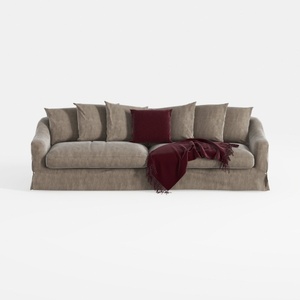
Minimalist Fabric Extra Large Sofa With Throw Pillows and Blanket 3D Model

Modern Red Fabric Curved Loveseat Sofa With Decorative Throw Pillows 3D Model
Homestyler offers an easy-to-use online design tool with stunning 3D renderings, inspiring interior projects, and helpful video tutorials—making it simple to create and visualize your perfect home design.
Design Now for FREE




