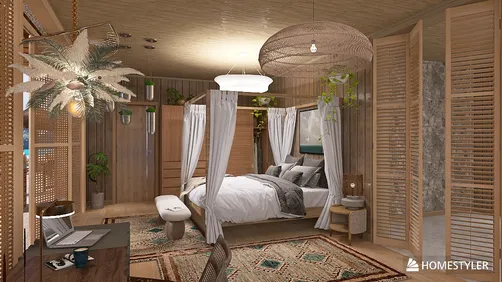
Sustainable Living Style Decoded: Harmony, Materiality & Light
Sustainable home design transcends mere 'green aesthetics' — it is a holistic philosophy rooted in coexistence with nature. As defined by Homestyler’s global 'Sustainable Home Design for Web' contest, this style merges ecological responsibility with refined beauty, prioritizing energy efficiency, material consciousness, and biophilic integration. It rejects performative eco-styling in favor of authentic systems thinking: passive solar orientation, rainwater harvesting, thermal mass strategies, and daylight optimization are not add-ons — they’re foundational. At its core lies a reverence for natural cycles, where reclaimed timber tells a story, cork flooring breathes with the room, and green roofs host pollinators while insulating homes. This is not just interior design; it’s spatial ethics made visible — where every window placement, material choice, and spatial flow reflects a commitment to planetary stewardship *and* human serenity.

This image showcases Cecilia Botha’s work titled Sustainable Serene Spaces. Its power lies in how effortlessly sustainability becomes sensory: a sculptural freestanding tub (low-water usage + timeless form), warm wood accents (reclaimed or FSC-certified), and abundant natural light (reducing artificial lighting needs). In Homestyler’s 3D rendering tool, designers can instantly simulate daylight hours across seasons using built-in HDR environments like 'g_lilienstein' or 'g_sunny_vondelpark', test material reflectivity (e.g., matte stone vs. polished concrete), and even visualize water-saving fixture specs — turning abstract sustainability goals into tangible, render-ready decisions.
Design Your Spa Bath🌿 Natural Material Integrity
Sustainable design treats materials as living legacies — not disposable commodities. Priority is given to renewable (bamboo, cork, wool), reclaimed (salvaged timber, vintage brick), recycled (glass countertops, metal fixtures), and locally sourced elements that minimize embodied carbon. Texture, grain, and patina are celebrated — not masked — affirming authenticity and durability over synthetic uniformity. Finishes avoid VOC-heavy paints and adhesives; instead, natural lime plasters, plant-based oils, and mineral pigments ensure indoor air quality aligns with ecological intent.

Andi Padmandi’s Sustainable Suburban House exemplifies material integrity: exterior cladding from recycled wood, cork flooring (renewable & hypoallergenic), sintered stone surfaces (low-maintenance & durable), and recycled bricks on the terrace. Crucially, her description notes the gravel bed filtration system on the green roof — a functional, beautiful integration of hydrology and horticulture. Within Homestyler, users can drag-and-drop certified sustainable assets directly from the library (tagged with #11515349, #11518863), adjust material properties like thermal resistance (R-value) in real time, and generate environmental impact summaries — making ethical sourcing both intuitive and visually verifiable.
Plan Your Green Patio☀️ Daylight-Centric Spatial Strategy
Rather than relying on artificial lighting, sustainable interiors are choreographed around sunlight. This means strategic window placement (north-south cross-ventilation, clerestories, light wells), high-performance glazing (low-E coatings), and reflective interior surfaces (white-washed walls, light-colored ceilings) to maximize diffusion. Skylights and glass roofs aren’t decorative — they’re calibrated daylight harvesters. The goal: eliminate midday electric lighting loads entirely while supporting circadian rhythms and reducing HVAC demand through passive heating and cooling synergy.

T Yener’s award-winning A Sustainable Living Experience centers on a luminous interior courtyard — a ‘green heart’ that floods adjacent rooms with diffused, glare-free light. Her use of large glass surfaces and a central planter isn’t just aesthetic; it’s a bioclimatic strategy that cools via evapotranspiration and provides natural ventilation. In Homestyler, designers leverage the Sunlight slider and dynamic HDR sky models (e.g., 'g_sunny_vondelpark') to preview exact light angles at 9 AM, 2 PM, or sunset — then refine window size, overhang depth, and interior reflectivity until daylight autonomy is optimized. This transforms passive solar design from theory into an interactive, visual workflow.
Create Bright Courtyard🌱 Biophilic Integration & Adaptive Systems
True sustainability embraces life — both human and non-human. Biophilic integration goes beyond potted plants: it includes operable windows for fresh air exchange, acoustic wood ceilings for sound absorption, green roofs and walls for biodiversity and insulation, and views to nature that reduce stress. Equally vital are adaptive systems — heat recovery ventilation (HRV), smart irrigation using collected rainwater, solar PV integration, and energy-monitoring dashboards. These features aren’t hidden infrastructure; they’re thoughtfully expressed, reinforcing transparency and user agency in ecological performance.

Amy ✨’s Project: Sustainable Home masterfully integrates biophilia and adaptation: preserved historical ruins become structural anchors (embodied carbon reduction), floor-to-ceiling windows dissolve boundaries between indoors and nature, and skylights amplify daylight deep into the plan. Her design honors legacy while embracing innovation — a hallmark of mature sustainability. With Homestyler’s AI-powered rendering engine, users can overlay real-time energy simulation layers, toggle solar panel visibility on roofs, and instantly compare renderings with/without green walls to assess visual impact and thermal benefit — empowering designers to make evidence-based, beautiful choices.
Build Sustainable HomeFAQ
Q: What defines 'sustainable home design' beyond using bamboo flooring or adding a few plants?
A: True sustainable home design is systemic — it integrates passive solar orientation, energy-efficient glazing, renewable/reclaimed materials, water conservation (rainwater harvesting, low-flow fixtures), indoor air quality (low-VOC finishes), and biophilic connections to nature. It’s about designing for longevity, adaptability, and harmony with local climate and ecology — not just surface-level 'green' aesthetics.
Q: How does Homestyler support sustainable design workflows?
A: Homestyler embeds sustainability directly into its 3D design process: real-time daylight simulation with adjustable sun angles and HDR skies, a curated library of certified eco-friendly assets (tagged #11515349, #11518863), material property editing (reflectivity, thermal resistance), and one-click rendering to visualize energy-efficient spatial strategies — all without switching tools.
Q: Can I enter the 'Sustainable Home Design for Web' contest using Homestyler’s free version?
A: Yes! The contest is open to all Homestyler users. The free version includes full access to the 3D editor, real-time rendering, sustainable asset library, and contest submission — no upgrade required. Top 6 winners each receive 200 Coins.
Q: Are there specific technical requirements for contest submissions?
A: Designs must be created in Homestyler’s web or desktop app (toolLimits: [4]), publicly published, and tagged with relevant sustainability hashtags (e.g., #11515349). Entries should clearly demonstrate integration of eco-principles — such as daylight optimization, material reuse, or energy-efficient systems — alongside strong visual appeal.


Homestyler offers an easy-to-use online design tool paired with stunning 3D renderings, inspiring design projects, and helpful DIY video tutorials—making it simple to create and visualize your perfect home design.
立即免费设计