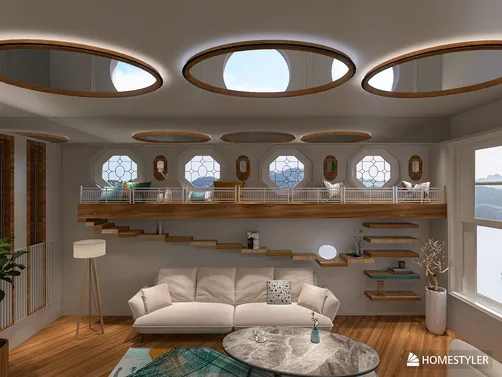
Illusion Living Room Design
The 'Illusion Living Room' is a conceptual interior space where perception-defying techniques transform modest square footage—such as a compact 50–72㎡ apartment—into an experientially expansive environment. Drawing from the 'Illusion Home for Web' contest theme, this scene prioritizes visual trickery over literal scale: using tilted planes, faux architectural elements (e.g., illusionary windows or floating ceilings), strategic light/shadow layering, and reflective surfaces to distort depth, height, and continuity. It’s not about optical gimmicks alone—but about intelligent indoor space planning that merges psychology, geometry, and real-time 3D visualization tools like Homestyler to craft emotionally resonant, spatially ambiguous living environments.
Design Challenges & Common Pitfalls
Designing an illusion-based living room presents unique hurdles: First, balancing perceptual drama with functional livability—tilted walls or mirrored floors may confuse navigation or hinder furniture placement. Second, avoiding visual clutter; too many competing illusions (e.g., simultaneous forced perspective, moiré flooring, and chromatic distortion) can cause cognitive fatigue rather than wonder. Third, technical execution—achieving seamless perspective alignment in 3D renders demands precise camera angles, HDR lighting control, and material reflectivity calibration, especially when simulating faux windows or infinite corridors. Without rigorous indoor space planning and iterative Homestyler design tricks, illusions risk appearing arbitrary—not intentional.
✅ Prioritize Depth-Enhancing Geometry
Use diagonal sightlines, sloped ceilings, and asymmetric wall alignments to elongate perceived dimensions. Avoid right-angle rigidity—introduce subtle cantilevers or staggered volumes to invite dynamic movement through the space. In Homestyler, leverage the 'Tilt Wall' and 'Custom Slope Ceiling' tools under Advanced Modeling to simulate architectural instability without compromising structural logic in render previews.

Irina Romanova 💫’s 'Parallel living room. Сhallenge' masterfully applies depth-enhancing geometry by splitting the room into two intersecting perspectival planes—one grounded in warm daylight realism, the other floating in cool, abstract symmetry. Using Homestyler’s real-time 3D rendering, she calibrated vanishing points across dual floor plans to create a convincing ‘split reality’ effect—proving how strategic geometry, not just decoration, drives spatial illusion. This exemplifies advanced indoor space planning where every line serves perceptual expansion.
Start Free Design🪞 Maximize Reflective & Transparent Layers
Strategically place mirrors—not only on walls but on ceilings, furniture undersides, or recessed niches—to multiply sightlines and dissolve boundaries. Combine with translucent materials (frosted glass partitions, acrylic shelving) and backlit panels to generate layered depth. In Homestyler, use the 'Material Reflectivity Slider' and 'Transparency Preview Mode' to test how light bounces across surfaces before final rendering—ensuring reflections enhance, not distort, spatial coherence.

auere val’s 'Patio en rose et vert' leverages reflective & transparent layers to dissolve the boundary between indoor and outdoor perception—even within an apartment. She embedded full-height mirrored backsplashes behind a floating console and used semi-transparent green-tinted glass dividers to blur foreground/background hierarchy. Through Homestyler design tricks like real-time sunlight simulation (HDR: sunny_vondelpark), she ensured reflections responded authentically to time-of-day lighting—showcasing how transparency + reflection transforms static square footage into fluid, breathing space.
Begin Your Free Design☀️ Harness Light & Shadow as Spatial Sculptors
Light isn’t ambient—it’s architectural. Use directional spotlights to cast elongated shadows that suggest unseen volume; install linear LED coves along ceiling perimeters to lift perceived height; deploy gobo projectors (simulated via Homestyler’s ‘Shadow Texture Overlay’) to imprint rhythmic patterns that imply depth beyond walls. Always pair strong highlights with deep, controlled shadows—contrast creates dimension. Homestyler’s ‘Sunlight Angle Control’ and ‘HDR Environment Sync’ are critical for testing shadow behavior across different times and sky conditions.

PG studio’s 'White Lotus Bureau' uses light & shadow as primary spatial sculptors: vertical LED strips frame a double-height staircase void, casting rhythmic vertical shadows that visually stretch the ceiling upward; meanwhile, downward-focused recessed lights on a glossy black floor generate sharp, elongated reflections that imply infinite descent. Executed entirely in Homestyler, this demonstrates how precise lighting orchestration—guided by indoor space planning principles—can redefine volume without altering footprint.
Launch Free DesignFAQ
Q: Can illusion techniques really make a 50㎡ room feel like 100㎡—and how does Homestyler help verify that?
Yes—through perceptual scaling, not physical expansion. Techniques like forced perspective flooring, mirrored alcoves, and ceiling-height lighting cues trick the brain into interpreting greater depth and volume. Homestyler’s real-time 3D rendering, especially with HDR environment sync (e.g., g_sea_sky or g_qwantani), allows designers to walk through the space at human eye level, adjusting camera height, focal length, and light direction to validate spatial believability before construction.
Q: Are tilted walls or faux windows structurally safe—and how do top winners implement them responsibly?
Tilted walls shown in contest entries (e.g., Amy ✨’s 'Architectural Balance') are aesthetic simulations—not load-bearing proposals. Winners use Homestyler design tricks to isolate illusion elements: faux windows are applied as high-res decals on flat walls; tilts are rendered as non-structural cladding layers. Structural integrity remains untouched—illusions live in the visual layer, verified via Homestyler’s collision-free preview mode.
Q: What’s the #1 mistake beginners make when designing illusion spaces—and how can indoor space planning prevent it?
The top mistake is prioritizing ‘wow factor’ over wayfinding—creating disorienting layouts where doors vanish, pathways loop, or scale cues conflict. Indoor space planning prevents this by anchoring illusions to functional zones: e.g., using mirrors only in circulation paths (not seating areas), aligning forced perspective lines with primary sightlines (like entry-to-window), and maintaining consistent floor-level references. Top entries like Andi Padmandi’s 'Illusions kf' prove clarity + wonder coexist when planning precedes illusion.

Modern Marble Top Fluted White Gold Accent Round Coffee Table 3D Model
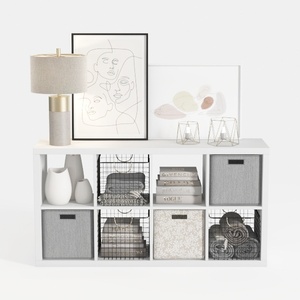
Modern Minimalist White Fabric Metal Storage Cabinet Console Table 3D Model

Minimalist Boucle Fabric Sofa Modern Tufted Living Room 3D Model
Homestyler is an easy-to-use online platform that lets you design your home with stunning 3D renderings. Explore a vast collection of interior decoration projects and learn through helpful DIY video tutorials to create your perfect space effortlessly.
Projete agora para LIVRE