Balcony Floor-to-Ceiling Window Design
The balcony with floor-to-ceiling windows is a transformative architectural element that merges indoor and outdoor living. It functions not merely as a transitional zone but as a primary living space—offering panoramic views, abundant natural light, and enhanced spatial perception. This design scenario emphasizes visual continuity, climate responsiveness, thermal comfort, and seamless indoor-outdoor flow. Whether integrated into high-rise apartments, penthouses, or suburban homes, it demands thoughtful interior space planning to balance openness with privacy, daylight with glare control, and aesthetics with structural integrity.
Design Challenges & Common Pitfalls
Key challenges include managing solar heat gain and UV exposure, ensuring thermal insulation without compromising transparency, addressing privacy concerns in urban settings, selecting appropriate glazing systems (e.g., low-E, laminated, or smart glass), integrating window operation mechanisms (sliding, folding, or fixed) within tight structural constraints, and harmonizing interior furnishings with dynamic daylight conditions. Poorly planned layouts may result in glare hotspots, overheating, furniture placement conflicts, or visual clutter that undermines the intended sense of openness and serenity.
🌞 Prioritize Visual Continuity & Spatial Flow
Floor-to-ceiling windows dissolve boundaries between interior and exterior—so interior space planning must reinforce this illusion of expansion. Avoid tall furniture or heavy drapery that obstructs sightlines; instead, use low-profile seating, recessed storage, and mirrored or reflective surfaces to amplify depth. Align flooring materials across threshold zones (e.g., extending indoor hardwood onto the balcony) to strengthen perceptual continuity. Homestyler AI design tools enable real-time sunlight simulation and multi-angle renders—helping designers test sightline clarity and spatial rhythm before finalizing layouts.

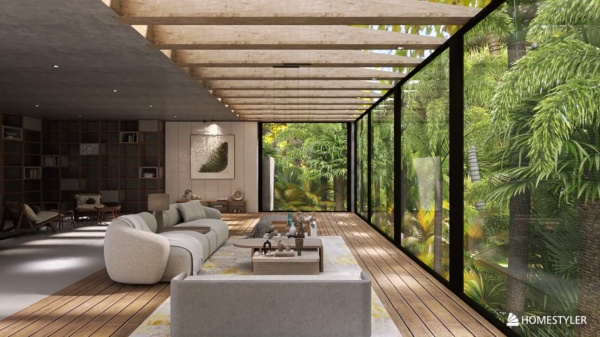
Grace Simmons’ '#Balcony Windows-Forest Rd' demonstrates seamless visual continuity by positioning a low-slung sectional sofa parallel to the glazing, preserving unobstructed city views at eye level. She uses reflective pendant lighting and mirrored side tables to extend perceived depth—a strategy easily prototyped in Homestyler using its material swap and lighting simulation features. Her interior space planning ensures every functional zone aligns with the window’s axis, reinforcing spatial flow rather than fragmenting it.
Start Designing Now🌿 Optimize Natural Light & Climate Responsiveness
Strategic orientation, shading integration (e.g., motorized louvers, external pergolas, or deciduous planting), and smart glazing selection are essential. Interior finishes should leverage light—light-colored walls, matte surfaces to reduce glare, and layered lighting for evening transitions. Use Homestyler’s HDR rendering and sunlight timeline tool to simulate seasonal sun angles and evaluate shadow patterns—critical for avoiding overheating while maximizing passive daylighting in all seasons.

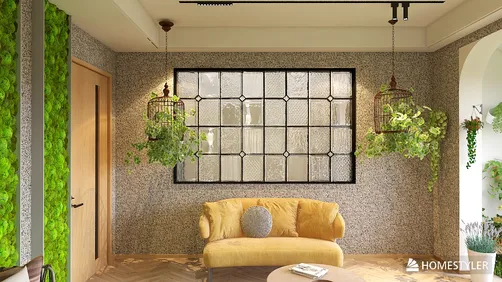
Alina Şapoşnicov’s 'Japandi apartment' employs light oak flooring and pale-toned textiles to diffuse daylight evenly across the compact balcony-living zone—minimizing glare while maintaining warmth. She integrates slender vertical blinds that retract fully into wall pockets, preserving clean lines during daytime use. Using Homestyler’s AI-powered daylight analysis, she refined her shading strategy to match local solar azimuth data—showcasing how Homestyler design tips empower evidence-based, climate-responsive interior space planning.
Create Your Cozy Space🪞 Balance Privacy & Aesthetic Transparency
Transparency shouldn’t compromise privacy—especially in dense urban contexts. Layered solutions work best: static elements (frosted glass panels, textured laminates, or interior landscaping) combined with dynamic controls (smart tinting, automated sheer curtains, or adjustable screens). Furniture arrangement also plays a role: placing taller pieces (bookshelves, planters) along perimeter zones creates natural buffers without blocking light. Homestyler’s multi-ratio render feature allows designers to preview privacy performance from street-level, neighbor-height, and seated viewpoints—enabling holistic evaluation.

Lis Bador’s 'Balcony windows for Web' achieves elegant privacy through compositional layering: a linear planter box with tall ornamental grasses sits flush against the glazing, softening the boundary while permitting filtered light. Inside, she places a low-profile lounge chair and open shelving—keeping sightlines open yet directing focus inward. Leveraging Homestyler’s real-time perspective toggle and privacy heatmap plugin, she validated visibility thresholds—proving how Homestyler design techniques support nuanced, human-centered interior space planning.
Design Your BalconyFAQ
Q: What are the submission requirements for the Balcony Floor-to-Ceiling Window Design Challenge?
A: Participants may submit a single high-resolution image (e.g., 2K, 4K, or HD) or multi-ratio views—including landscape, portrait, and video renders (e.g., 1080P fast video). All submissions must be created using Homestyler’s AI-powered design tools to ensure consistency and technical feasibility.
Q: How does Homestyler support realistic daylight simulation for balcony designs?
A: Homestyler offers dynamic HDR rendering, adjustable sunlight timelines (hour-by-hour and season-by-season), and built-in HDR environments (e.g., 'sunny_vondelpark', 'g_ljz_day', 'venice_dawn')—enabling precise evaluation of glare, shadow distribution, and color rendering under real-world lighting conditions.
Q: Can I optimize interior space planning for thermal comfort using Homestyler?
A: While Homestyler does not perform full thermal load calculations, its glazing material library includes low-E, laminated, and tinted options with visual thermal reflectivity cues. Combined with sunlight simulation and shading object placement (e.g., awnings, louvers), designers can iteratively refine interior space planning for passive climate responsiveness.
Q: Are there recommended Homestyler design tips for small balconies with floor-to-ceiling windows?
A: Yes—use Homestyler’s ‘Scale Fit’ tool to test furniture proportions, apply reflective materials to enhance perceived volume, and leverage the ‘Viewpoint Toggle’ to validate sightlines from multiple user heights. Prioritize foldable or modular furnishings to maintain flexibility—key to effective interior space planning in compact scenarios.
What began as an Autodesk innovation has evolved into a design platform used by more than 18 million people around the globe. Homestyler combines powerful rendering, an intuitive editor, and a vast furniture library to help you turn inspiration into photorealistic designs — whether you're redesigning a single room or planning an entire home.

Minimalist White Metal Round Tray Top Side Table 3D Model

Minimalist Walnut Marble Top Double Layer Coffee Table 3D Model

Modern Black White Solid Wood Extendable Multifunctional Tea Coffee Table 3D Model
Homestyler is a user-friendly online home design platform offering powerful 3D rendering, inspiring interior design projects, and helpful DIY video tutorials. It makes designing and visualizing your dream space easy and enjoyable for everyone.
Diseño ahora GRATIS