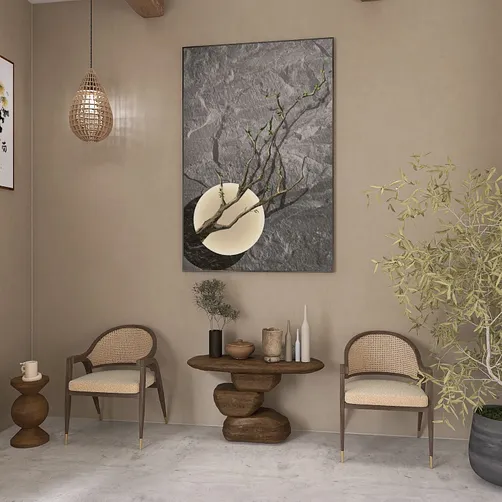
Chinese Wabi-Sabi Living Space Design
The 'Chinese Wabi-Sabi Living Space' is a holistic interior space planning concept that synthesizes the philosophical depth of Japanese wabi-sabi—celebrating imperfection, transience, and quiet authenticity—with the poetic restraint, symbolic motifs, and material wisdom of traditional Chinese aesthetics. Unlike minimalist or rustic styles alone, this scene emphasizes *intentional simplicity*: uncluttered layouts, hand-textured natural materials (e.g., raw wood, aged clay, unglazed ceramics), soft earth-and-ink tonal palettes (ochre, charcoal, bamboo green, rice paper white), and spatial pauses—like a courtyard void or a framed scroll alcove—that invite contemplation. It is not merely visual decoration but an embodied experience: a sanctuary where indoor space planning aligns with seasonal rhythm, light choreography, and mindful human scale—designed to slow time, deepen breath, and restore inner equilibrium.
Design Challenges & Common Pitfalls
Designers often misinterpret 'wabi-sabi' as mere 'rustic' or 'unfinished', leading to unintentional sloppiness rather than intentional humility. Key challenges include: (1) Balancing Chinese classical references (e.g., lattice screens, scholar’s objects) without cultural pastiche or ornament overload; (2) Achieving material authenticity digitally—rendering subtle grain, weathered patina, or matte mineral finishes convincingly in Homestyler AI design tools; (3) Maintaining spatial serenity in small-footprint layouts (e.g., under 80㎡) where every element must serve dual function and symbolic purpose; (4) Avoiding monochrome sterility by layering tactile variation—rough-hewn timber next to smooth river stone, woven rattan beside brushed linen—without visual noise. These require disciplined interior space planning and deep understanding of both traditions’ underlying principles—not just surface aesthetics.
🌱 Embrace Imperfect Materials & Natural Textures
Prioritize raw, unrefined, and locally resonant materials: reclaimed elm or paulownia wood with visible knots and saw marks; hand-thrown stoneware vases; rammed-earth or lime-washed plaster walls; bamboo blinds with irregular weave. Texture—not color—drives hierarchy. In Homestyler, use the 'Material Editor' to adjust roughness, bump depth, and subsurface scattering for realistic organic feel; avoid synthetic gloss or uniform repetition. Every surface should tell a story of making, aging, and quiet presence.

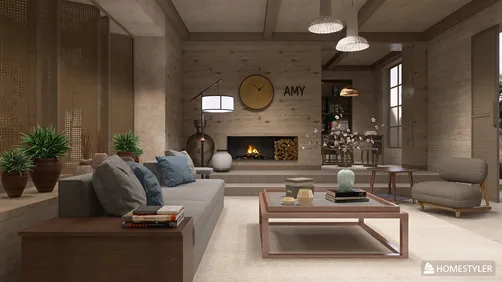
Cecilia Botha’s 'The Allure of Minimalism' masterfully applies this principle: her living space uses matte-finish oak flooring with visible grain variation, a handwoven jute rug with uneven pile height, and a low-profile sofa upholstered in undyed linen—no sheen, no symmetry. Using Homestyler AI design tools, she adjusted the HDR lighting ('570822c6-4bf3-46db-8997-18c6325927f3') to cast soft, directional shadows that accentuate texture depth rather than flatten it—proving how digital rendering can evoke tangible tactility within interior space planning.
Start Free Design🌿 Curate Silence Through Strategic Void & Scale
Wabi-sabi thrives in absence. Intentionally leave floor area bare; use floating shelves instead of full-height cabinets; frame windows as living scrolls rather than filling sills. Apply the Chinese principle of 'liú bái' (leaving blank space): let walls breathe, allow ceilings to recede, place furniture to define zones—not fill them. In Homestyler, leverage the 'Furniture Placement Tool' to test negative-space ratios; aim for at least 40% unoccupied floor area in key zones. A single Ming-style stool in an open corner speaks louder than a crowded arrangement.

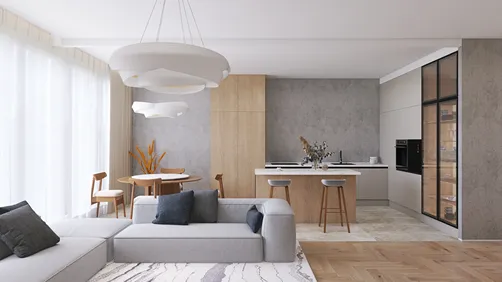
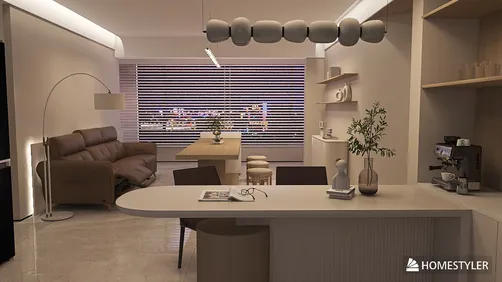
Khaoula’s 'Reflet d'une Modernité Élégante' demonstrates profound void curation: her kitchen-living zone features a wide expanse of pale concrete floor, a solitary walnut dining table with slender legs (emphasizing legibility of space), and wall-mounted open shelving with only three ceramic vessels—each placed with deliberate asymmetry. Using Homestyler’s real-time 3D rendering, she iterated lighting angles to ensure shadows fell softly into empty corners, reinforcing spatial calm—a hallmark of thoughtful interior space planning rooted in wabi-sabi silence.
Begin Your Free Design🎨 Layer Subtle Color with Earth-Inspired Hues
Reject saturated tones. Build palettes from nature’s muted archive: ink-wash greys, dried tea browns, crushed oyster shell whites, moss-tinged celadons, and burnt umber accents. Use color sparingly—as a wash on one wall, a glaze on a vase, or the stain on a wooden beam. In Homestyler, avoid default RGB presets; instead, import custom HEX values (e.g., #E6D3A7 for 'rice paper', #4A4A42 for 'aged ink') and apply them to large surfaces first to anchor the mood before adding texture.

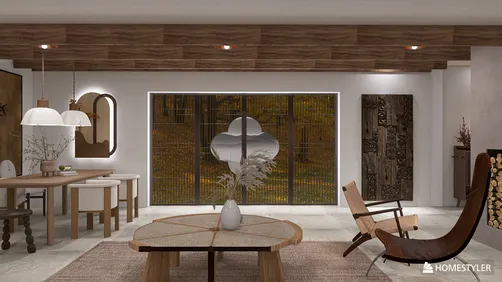
Ana’s 'between in the trees | chinese wabi sabi' exemplifies this chromatic restraint: walls rendered in warm, limewashed beige (#EAD8C5), bamboo seating in natural honey tone, and a single indigo-dyed cushion echoing mountain mist. She used Homestyler’s 'Color Palette Sync' feature to ensure all textiles and finishes shared the same LCH lightness/chroma range—creating harmony without monotony. Her approach transforms interior space planning into a painterly act, where color becomes atmosphere, not decoration.
Free Design NowFAQ
Q: How does Chinese wabi-sabi differ from standard minimalism?
It prioritizes warmth, history, and sensory richness over austerity. While minimalism removes clutter, Chinese wabi-sabi adds meaning through aged materials, asymmetrical balance, and cultural resonance—making interior space planning deeply human-centered.
Q: Can I apply this style effectively in a small apartment using Homestyler design tools?
Absolutely. Focus on vertical layering (hanging textiles, suspended plants), multi-functional pieces (a daybed doubling as seating and guest bed), and strategic voids—even 5㎡ can feel expansive when designed with 'liú bái'. Homestyler’s real-time 3D rendering helps visualize scale and flow instantly.
Q: What are essential Homestyler design tips for authentic wabi-sabi textures?
Use custom material uploads for scanned wood grain or handmade tile photos; reduce 'glossiness' and 'specular' sliders to zero; increase 'roughness' and 'bump intensity'; pair HDR environments like 'g_fallen_leaves' or 'mountain_ledge' to enhance naturalistic light interaction—key for credible interior space planning.
Q: Are there specific Chinese elements I should avoid to prevent cultural misappropriation?
Avoid literal symbols used out of context (e.g., oversized dragons, red lanterns as sole decor). Instead, integrate quietly: a scholar’s rock as a tabletop sculpture, a single calligraphy brush holder, or lattice-inspired screen patterns scaled subtly into room dividers—always honoring intent over ornament.
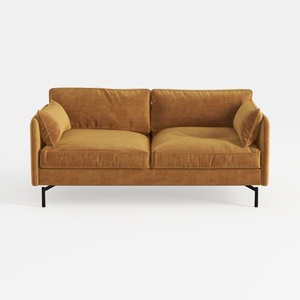
Modern Velvet Upholstered 2 Seater Sofa With Black Metal Legs 3D Model


Modern Rattan Solid Wood Linen Upholstered Chaise Lounge 3D Model
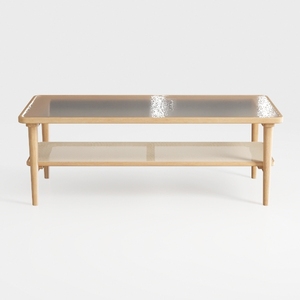
Minimalist Solid Wood Glass Top Coffee Table 3D Model
Homestyler is an easy-to-use online home design platform offering powerful 3D rendering, a vast collection of interior projects, and helpful DIY video tutorials. It’s perfect for bringing your design ideas to life and exploring endless decoration possibilities.
تصميم الآن مجانا