Chinese Wabi-Sabi Living Space Design
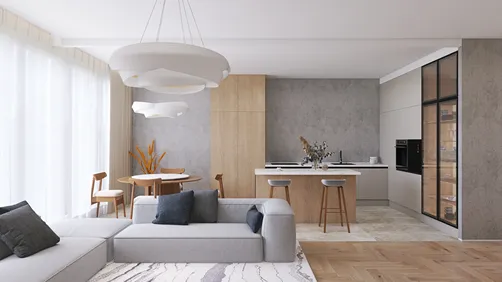
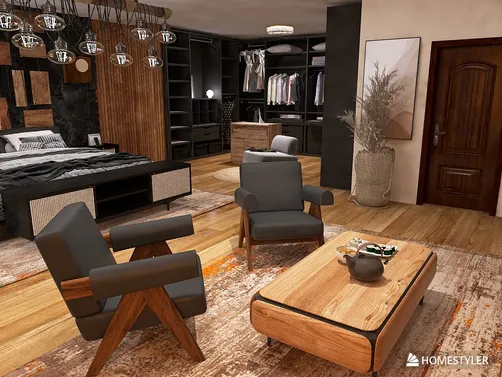
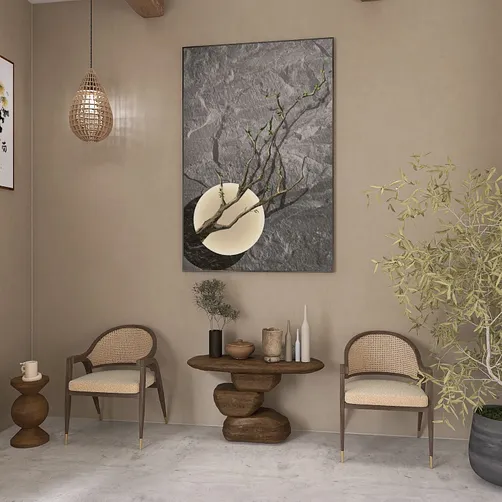
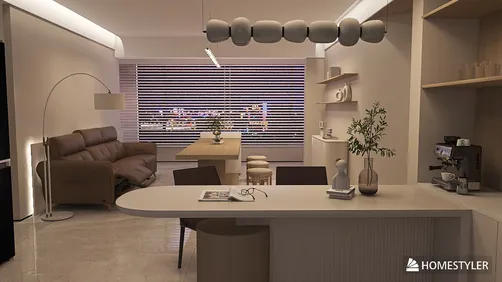
The 'Chinese Wabi-Sabi Living Space' is a holistic interior space planning concept that synthesizes the philosophical depth of Japanese wabi-sabi — embracing imperfection, transience, and quiet austerity — with the poetic elegance, compositional balance, and cultural symbolism of traditional Chinese aesthetics. Rather than a single functional room, it represents a serene, multi-zone residential environment (e.g., living-dining-reading nooks or transitional courtyard-inspired interiors) where natural materiality, restrained color palettes (earthy ochres, ink blacks, rice-paper whites), and intentional spatial voids foster mindfulness and emotional stillness. This design ethos prioritizes authenticity over polish: cracked glaze ceramics, hand-hewn timber, unbleached linen, and asymmetrical layouts are not flaws — they are narrative elements. As demonstrated across top-winning entries in the Homestyler contest, this style thrives in both compact urban apartments and expansive open-plan dwellings, making it a universally adaptable framework for modern indoor space planning.
Design Challenges
Key challenges include balancing minimalism with cultural richness without slipping into cliché; sourcing or digitally rendering authentically textured natural materials (e.g., weathered wood grain, raw clay plaster) within Homestyler’s model library; achieving tonal harmony across varied light conditions (morning mist vs. golden-hour warmth); and avoiding visual emptiness — where 'less' risks feeling sterile rather than serene. Many designers also struggle to integrate symbolic Chinese motifs (e.g., scholar’s rocks, lattice screens) without compromising wabi-sabi’s anti-decorative ethos, requiring subtle abstraction rather than literal reproduction.
🌱 Principle 1: Embrace Imperfect Materiality & Natural Texture
Prioritize tactile honesty: choose visibly grainy woods, unglazed ceramics, rough-hewn stone, and undyed organic textiles. Avoid uniformity — celebrate knots, cracks, uneven edges, and subtle color variations as evidence of time and craft. In Homestyler, leverage the 'Material Editor' to adjust bump maps and roughness sliders on default models, or upload custom texture swatches to simulate aged bamboo or hand-brushed plaster walls.

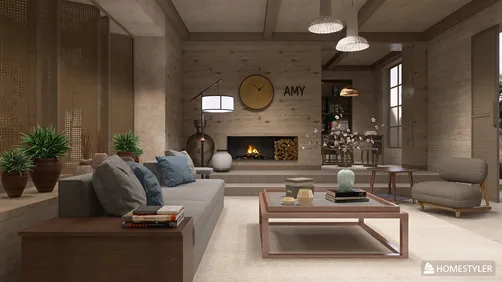
Amy ✨’s 'Wabi Sabi With Chinese Elements' masterfully applies this principle in a living space context: she pairs a low, solid elm coffee table with visible grain and subtle wormholes alongside matte-finish ceramic vases bearing irregular glaze pooling. Using Homestyler AI design tools, she adjusted the wall material’s ‘roughness’ parameter to mimic handmade rammed earth, then positioned soft-shadow lighting to accentuate texture depth — proving how digital precision can enhance, not erase, material imperfection.
Start Designing Now🌿 Principle 2: Curate Spatial Silence Through Intentional Void & Scale
Apply the Chinese concept of 'liu bai' (leaving blank space) and wabi-sabi’s reverence for stillness: avoid visual clutter by limiting furniture to essential pieces, using generous negative space around objects, and selecting low-profile, grounded forms. Scale matters — oversized rugs, ceiling-height shoji screens, or singular sculptural stools create gravitational calm. In Homestyler, use the 'Measure Tool' to verify clear circulation paths (>900mm) and deploy the 'Scene Composition' preset 'Zen Clarity' to auto-balance object density and breathing room.

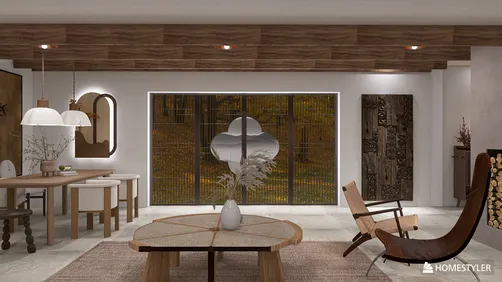
Sara HEMDESIGN’s 'L'essenza del Wabi Sabi' exemplifies spatial silence: her living space features only three key elements — a sunken tatami platform, a single curved walnut bench, and a suspended washi paper lamp — all isolated within vast floor and wall voids. Leveraging Homestyler’s real-time 3D rendering, she tested multiple HDR environments ('g_sunny_vondelpark') to ensure ambient light washed evenly across empty surfaces, transforming architectural emptiness into an active design element — a core tenet of advanced indoor space planning.
Create Your Zen Space🍂 Principle 3: Layer Subtle Cultural Narrative Without Ornamentation
Integrate Chinese aesthetic philosophy — not decorative tropes. Reference 'shanshui' (mountain-water) composition via asymmetrical plant groupings or horizon-line artwork placement; echo 'qi flow' with gentle, meandering circulation paths; suggest scholar’s garden restraint through single-stem flower arrangements or miniature rock trays. Avoid dragons, red lanterns, or overt calligraphy. In Homestyler, use the 'Tag Search' function with keywords like 'bamboo lattice', 'ink wash', or 'scholar rock' to find abstracted, minimalist-compatible assets — then scale and rotate them to imply meaning, not declare it.

Kaire Hunt’s 'Autumn Elegance in Asian Fusion' demonstrates narrative layering: instead of hanging a scroll painting, she positions a slender black pine branch in a celadon vase beside a low dining table — evoking 'shanshui' verticality and seasonal impermanence simultaneously. Using Homestyler AI design tools, she applied the 'Seasonal Filter' ('g_fallen_leaves') to cast warm, dappled light through virtual window apertures, aligning natural light rhythm with cultural metaphor — a sophisticated application of Homestyler design技巧 for emotionally resonant interior space planning.
Begin Your Calm HomeFAQ
Q: Can I apply Chinese wabi-sabi principles to a small apartment using Homestyler?
Yes — in fact, compact spaces benefit most from this style. Focus on vertical material texture (e.g., woven reed wall panels), multi-functional low furniture, and strategic mirror placement to amplify 'void'. Homestyler’s 'Small Space Optimization' AI tool suggests scaled-down authentic assets and auto-adjusts lighting for perceived spaciousness.
Q: How do I source wabi-sabi–appropriate Chinese-style models in Homestyler’s library?
Use filters: Style = 'Traditional Chinese' + Tags = 'natural material', 'asymmetry', 'handcrafted'. Search keywords like 'unglazed stoneware', 'hemp cloth', or 'bamboo lattice'. Avoid 'ornate', 'gilded', or 'symmetrical' tags. The top contest entries prove curated minimalism beats maximalist authenticity.
Q: Is it possible to achieve true wabi-sabi texture digitally?
Absolutely — texture lives in perception, not just physics. Homestyler’s PBR material system (roughness, normal, and ambient occlusion maps) lets you simulate weathered wood grain or cracked plaster convincingly. Combine with directional soft lighting and shallow depth-of-field renders to emphasize tactility — a key Homestyler design技巧 for believable interior space planning.
Q: What’s the biggest mistake when blending Chinese and wabi-sabi aesthetics?
Overloading symbolism — e.g., placing a feng shui bagua mirror next to a kintsugi bowl. True fusion respects both traditions’ shared values: humility, nature reverence, and quietude. Let one principle lead (e.g., wabi-sabi’s imperfection) and let Chinese elements support it (e.g., a cracked Song-dynasty–inspired teacup), not compete. This mindful hierarchy is central to successful indoor space planning.
What began as an Autodesk innovation has evolved into a design platform used by more than 18 million people around the globe. Homestyler combines powerful rendering, an intuitive editor, and a vast furniture library to help you turn inspiration into photorealistic designs — whether you're redesigning a single room or planning an entire home.
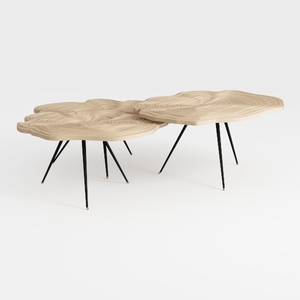

Modern Natural Solid Wood Irregular Double Coffee Table With Black Metal Legs 3D Model
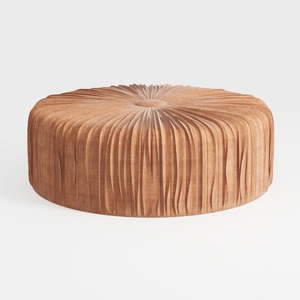
Minimalist Round Tufted Fabric Ottoman 3D Model

Minimalist Fluted Solid Wood 6 Drawer Dresser 3D Model
Homestyler offers an easy-to-use online design tool with stunning 3D renderings, inspiring interior design projects, and helpful DIY video tutorials—perfect for bringing your home design ideas to life effortlessly.
Design Now for FREE