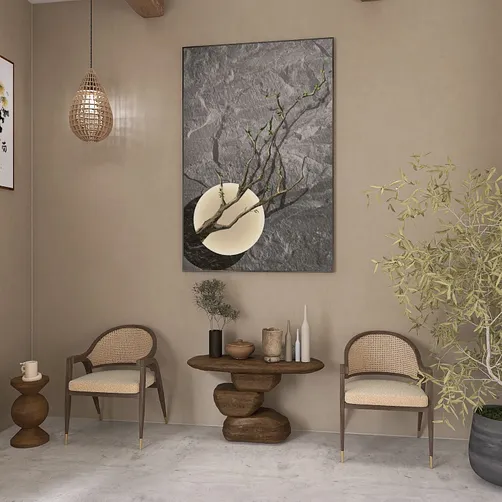
Chinese Wabi-Sabi Style Decoded: Where Ancient Wisdom Meets Imperfect Beauty
The Chinese wabi-sabi style is a poetic fusion of two profound philosophies: the Daoist and Confucian reverence for harmony, restraint, and quietude in Chinese classical living—and the Japanese aesthetic of wabi-sabi, which finds deep beauty in transience, asymmetry, and gentle imperfection. Unlike minimalist design that追求 sterility, Chinese wabi-sabi embraces *lived-in elegance*: weathered wood grain echoing centuries-old temple beams; hand-thrown ceramics with irregular glazes reminiscent of Song dynasty celadon; ink-wash murals where mist dissolves mountain contours—suggesting rather than stating. It favors natural light diffused through bamboo screens, tactile textures over glossy finishes, and spatial pauses—empty corners or unadorned walls—that invite contemplation. At its heart lies *qi* (vital energy) flow and *shanshui* (mountain-water) balance: stillness grounded by earthy materials, movement evoked by soft curves and organic silhouettes. This is not decoration—it’s meditative environmental storytelling.

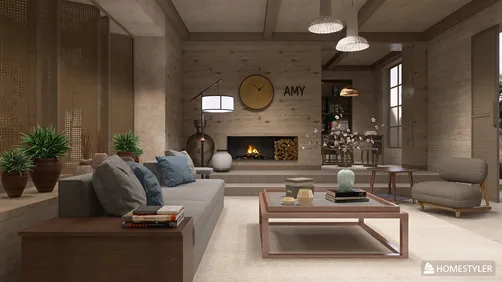
Wabi-Sabi Retreat by Coretta Wintz — This Homestyler-rendered space masterfully embodies the style’s soul: a deep charcoal sectional anchors the room, its raw linen texture contrasting softly with a serene mountain landscape mural rendered in subtle ink gradients. Notice how aged oak flooring flows beneath—its knots and tonal shifts celebrated, not concealed. The lighting is deliberately low and warm, casting gentle shadows that deepen the sense of quiet introspection. In Homestyler, achieving this look is intuitive: select ‘Natural Wood’ material presets with visible grain variation, apply ‘Soft Ambient’ HDR lighting (like 'd_mountain_forest'), and use the ‘Wall Mural’ tool to layer custom shanshui art—all in real time. No coding, no rendering wait—just authentic, tranquil atmosphere, built in minutes.
Start Free Design🌿 Natural Material Integrity & Honored Imperfection
Chinese wabi-sabi rejects synthetic perfection. Instead, it elevates raw, unrefined, and time-worn materials: unfinished ash or paulownia wood with visible grain and subtle warping; hand-thrown stoneware with ash-glazed surfaces and intentional cracks (kintsugi-inspired); rammed earth or lime plaster walls with soft, uneven texture and subtle color variation. Imperfections are not flaws—they’re signatures of authenticity and history, echoing the Daoist principle of *ziran* (spontaneity). In this style, a chipped edge on a ceramic vase or a knot in reclaimed timber isn’t hidden—it’s spotlighted as evidence of life, resilience, and quiet dignity.
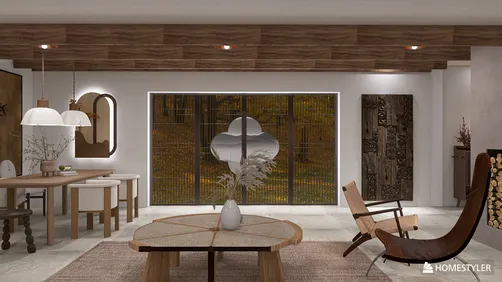
Wabi-Sabi Retreat by Coretta Wintz demonstrates this principle with exceptional clarity. The floor uses Homestyler’s ‘Reclaimed Ash’ material preset—showcasing natural grain variation and subtle tonal shifts across planks. The low-profile coffee table appears hand-carved, its surface lightly textured and asymmetrically shaped. Even the wall mural isn’t digitally perfect: soft ink bleeds at the edges, mimicking traditional sumi-e brushwork. In Homestyler, designers achieve this instantly by selecting ‘Organic Texture’ material filters, adjusting ‘Surface Roughness’ sliders, and applying ‘Hand-Painted’ decal overlays—no external assets needed. The result? A space that feels breathed into, not built.
Start Free Design🎋 Harmonious Spatial Rhythm & Intentional Emptiness
Drawing from Chinese *feng shui* and classical garden design, Chinese wabi-sabi treats space as dynamic and relational—not static volume. It employs *liu bai* (‘leaving blank’), where voids—unfilled corners, open wall sections, or simple tatami mats without furniture—are as vital as occupied zones. Furniture placement follows gentle curves and diagonal sightlines (not rigid grids), evoking the meandering path of a scholar’s garden. Windows act as ‘living scrolls,’ framing seasonal views or sky gradients. Every element is placed to guide qi flow: low platforms encourage grounding, curved shelving invites slow movement, and layered thresholds (e.g., stepping stones into a reading nook) create mindful transitions.

"La mia casa è piccola ma si apre su un mondo infinito" (Confucius) by Elena Turricchia transforms a compact layout into an expansive sensory journey. Using Homestyler’s precise dimensioning tools, she creates layered zones: a sun-drenched seating area flows into a recessed tea nook defined only by a change in floor level and a single hanging paper lantern. Large glass doors dissolve interior boundaries, turning the garden beyond into a living mural. The composition avoids symmetry—sofas sit at gentle angles, plants spill organically across thresholds. In Homestyler, this rhythm is achieved effortlessly via ‘Zone Grouping’, ‘Custom Floor Level’ adjustments, and ‘Real-Time Sun Study’ to preview natural light progression—all within one unified 3D canvas.
Start Free Design🎨 Subtle, Earth-Rooted Color Poetry
Color in Chinese wabi-sabi is never loud or saturated—it’s whispered. Palettes are drawn directly from the earth and seasons: the muted grey-green of aged bamboo, the warm taupe of sun-baked clay tiles, the soft ochre of dried reeds, the whisper of indigo-dyed linen. These hues rarely appear pure; they carry subtle undertones—green with grey, beige with rust—to evoke weathering and time. Accent colors are rare and deeply intentional: a single branch of crimson maple against neutral walls, or the faint blush inside a cracked celadon bowl. The goal is chromatic calm—a palette that recedes, allowing texture, light, and form to speak first.

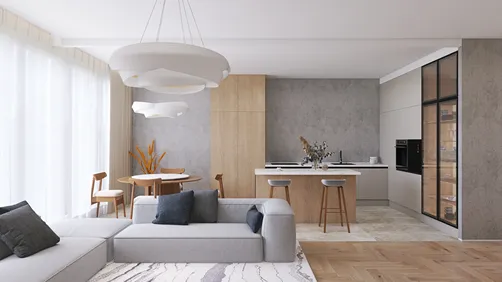
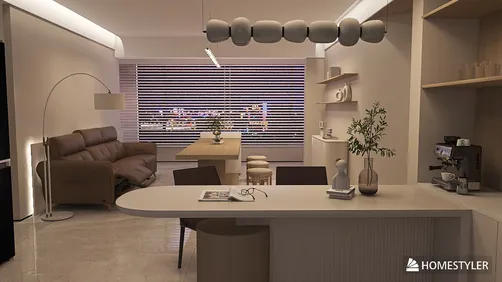
Reflet d'une Modernité Élégante by Khaoula exemplifies this chromatic restraint. Walls are rendered in Homestyler’s ‘Lime Wash Beige’—a soft, matte finish with subtle tonal variation. The sofa is upholstered in ‘Weathered Linen Taupe’, its fabric visibly textured and slightly faded. Even the wooden dining table carries a warm, low-saturation amber tone—not golden, but honeyed and hushed. Notably, there’s zero black, white, or primary color; every hue has been gently desaturated and greyed to harmonize. In Homestyler, designers replicate this instantly using the ‘Earth Tone Palette’ swatch library and the ‘Saturation Reduction’ slider on any material—achieving gallery-level sophistication in seconds.
Start Free DesignFAQ
Q: Is Chinese wabi-sabi just 'minimalism with wood'?
No—it’s fundamentally different. Minimalism seeks reduction for visual clarity; Chinese wabi-sabi seeks resonance through authenticity. It welcomes patina, asymmetry, and quiet complexity. A minimalist room might have a sleek white sofa; a Chinese wabi-sabi room features a handwoven rush seat with visible fiber variations, softened by decades of use.
Q: Can I achieve this style in small apartments?
Absolutely—and it’s ideal for them. Chinese wabi-sabi thrives in intimacy. Use Homestyler’s ‘Room Resize’ and ‘Furniture Scale’ tools to adapt low-platform beds, compact tea tables, and vertical plant walls. Embrace *liu bai*: leave one wall entirely bare, or use a single scroll painting instead of a gallery wall.
Q: Do I need expensive antiques or imported materials?
No. Authenticity comes from intention, not price tags. In Homestyler, use ‘Reclaimed Wood’ and ‘Hand-Thrown Ceramic’ material presets—they simulate texture, weight, and age without physical cost. Focus on proportion, light quality, and thoughtful placement—the essence of the style is accessible to all.
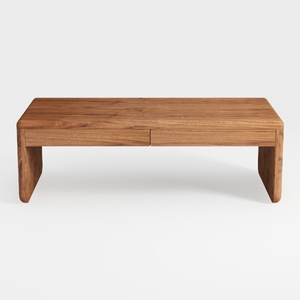
Minimalist Solid Wood Two Drawer Coffee Table 3D Model

Minimalist Tan Leather L-Shaped Sectional Sofa 3D Model
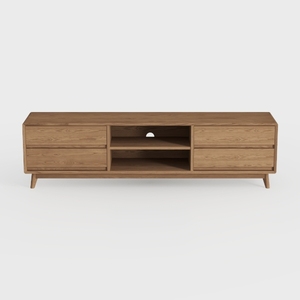
Mid Century Modern Solid Oak TV Stand With Storage Drawers 3D Model
Homestyler is an easy-to-use online home design platform offering powerful 3D rendering, a vast collection of interior projects, and helpful DIY video tutorials. It’s perfect for turning your design ideas into stunning, realistic visuals quickly and effortlessly.
Design jetzt kostenlos