Coastal View Style Decoded: Light, Air, and Nature in Harmony
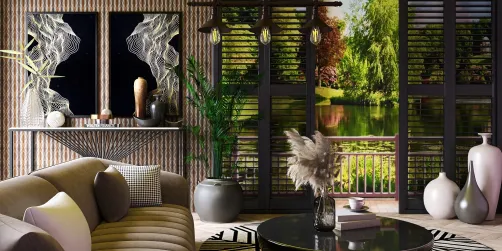
The 'Room with a view' design challenge — hosted by Homestyler as part of the AIDA global competition — has crystallized a distinctive, emotionally resonant interior aesthetic: the Coastal View Style. Far more than just 'beach-themed decor', this is a holistic spatial philosophy rooted in biophilic principles, where architecture dissolves into landscape. It prioritizes visual continuity between indoors and outdoors — large glazed openings, unobstructed sightlines, and reflective surfaces that capture sky, water, or greenery. The style embraces serenity through restraint: minimal ornamentation, honest natural materials (weathered wood, linen, rattan, stone), and a palette drawn directly from coastal light — soft whites, sea-glass greens, misty blues, warm sands, and sun-bleached neutrals. Texture replaces pattern; calm replaces clutter. Crucially, it’s not location-dependent: whether in a Chicago high-rise or a São Paulo apartment, this style uses design language — not geography — to evoke openness, breathability, and quiet joy.

Tracy Rogers’ 'Designing Serenity' exemplifies how Homestyler’s 3D rendering tools empower designers to prototype this aesthetic instantly. Using Homestyler’s intuitive drag-and-drop interface, she placed oversized glass sliders, selected real-time material swatches for weathered oak floors and linen upholstery, and positioned curated greenery to frame the view — all while maintaining perfect scale and natural lighting simulation. With Homestyler, achieving the Coastal View Style isn’t about complex modeling — it’s about smart, fast, photorealistic storytelling.
Design Your Serenity🌊 Natural Light as Structural Element
In Coastal View Style, windows aren’t apertures — they’re primary architectural features. Designers maximize glazing (floor-to-ceiling, corner windows, sliding glass walls) and eliminate heavy drapery. Instead, they use sheer, textural linen or bamboo blinds that diffuse light without blocking views. The goal is dynamic daylighting: soft morning glow, dappled afternoon shadows, golden-hour warmth — all captured and amplified by reflective surfaces like polished concrete, mirrored accents, or glossy white cabinetry. Light becomes the room’s most active, ever-changing material.

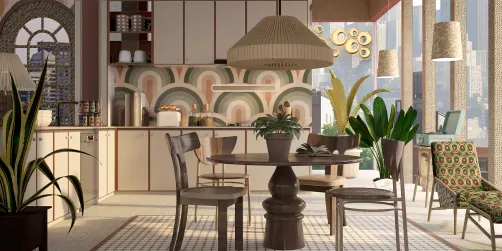
Patrizia Diana Rocco’s 'Vista sul mare' masterfully demonstrates light orchestration in Homestyler. She used the platform’s advanced sunlight simulator to preview how the sun traverses her arched windows across seasons — adjusting furniture placement and material reflectivity (e.g., choosing matte vs. glossy finishes) to avoid glare while preserving luminosity. Homestyler’s real-time shadow casting ensures every design decision enhances, rather than fights, natural light — making it the ideal tool for crafting truly view-forward spaces.
Start Your Seaside View🌿 Biophilic Material Palette & Texture Layering
This style rejects synthetic uniformity in favor of organic authenticity. Key materials include reclaimed or whitewashed wood (for ceilings, beams, or furniture), natural fiber textiles (linen, cotton canvas, jute, seagrass), raw stone or terracotta tiles, and hand-thrown ceramics. Texture is layered intentionally: smooth plaster walls contrast with nubby bouclé throws; sleek marble countertops sit beside rough-hewn timber stools. These tactile contrasts create depth and warmth without color overload — letting the view remain the undisputed focal point.

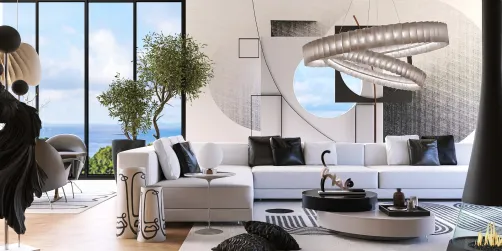
Olga H’s '🤎' proves how powerfully texture speaks in Homestyler. Without relying on bold colors, she built rich sensory interest using Homestyler’s extensive library of hyper-realistic material textures: the subtle grain of whitewashed brick, the plush nap of a wool rug, the glossy sheen of ceramic vases. In Homestyler, designers can swap materials in one click and instantly see how linen curtains interact with oak floors under midday light — accelerating the creation of deeply tactile, nature-connected interiors.
Feel Coastal Light🪴 Intentional Green Framing & Outdoor Integration
Plants here are never afterthoughts — they’re strategic compositional devices. Large-scale foliage (olive trees, fiddle-leaf figs, palms) is placed to frame views, soften architectural lines, or create transitional zones between interior and exterior. Indoor-outdoor flow is enhanced via consistent flooring (extending tile or decking across thresholds), matching furniture silhouettes (e.g., identical lounge chairs inside and out), and shared color tones. The boundary blurs: the garden becomes an extension of the living room; the balcony, a reading nook suspended in nature.

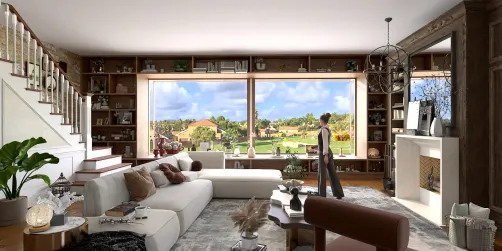
Alaa’ J.M.’s unnamed coastal bedroom highlights Homestyler’s strength in seamless indoor-outdoor integration. Using Homestyler’s ‘Room Extension’ feature, she modeled the exterior greenery visible through the tall windows — then matched the indoor rattan headboard and macramé hanger with the same botanical motif outside. This cohesive storytelling — achievable in minutes within Homestyler — transforms passive viewing into immersive, multi-sensory belonging.
Create Natural TextureFAQ
Q: Do I need a real ocean view to apply Coastal View Style?
A: Absolutely not. The essence lies in design language — not geography. Use Homestyler to simulate expansive views (city skyline, forest canopy, mountain ridge, or even a curated digital backdrop) and apply the core principles: light amplification, natural material honesty, and intentional green framing.
Q: Which Homestyler tools accelerate Coastal View Style design?
A: Prioritize the Sunlight Simulator (to optimize window placement and material reflectivity), the Realistic Material Library (for authentic wood, linen, stone, and rattan), and the AI View Enhancer (to intelligently extend or stylize outdoor scenery visible through windows).
Q: Can this style work in small apartments or urban settings?
A: Yes — and it shines there. Homestyler helps maximize perceived space: use mirrored panels opposite windows, choose low-profile furniture to preserve sightlines, and add vertical greenery (wall planters, hanging vines) to bring nature inward without sacrificing square footage.

Minimalist White Glass Top TV Cabinet 3D Model

Modern Marble Top Black Metal Round Side Table 3D Model
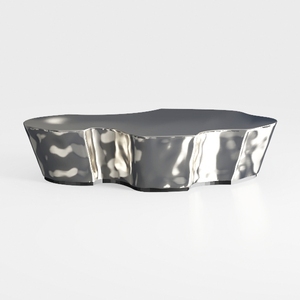

Modern Polished Metal Irregular Shaped Coffee Table 3D Model
Homestyler offers an easy-to-use online home design tool with stunning 3D renderings, inspiring design projects, and helpful DIY video tutorials—perfect for bringing your interior decorating ideas to life effortlessly.
Design Now for FREE