Emoji-Themed Children's Bedroom Design
The Emoji-Themed Children's Bedroom is a vibrant, emotionally expressive interior space that merges playful digital communication symbols with functional residential design. Drawing inspiration from World Emoji Day and the Homestyler Emoji Model Package, this scene transforms a standard children’s bedroom into a joyful, personality-driven environment—where color psychology, developmental ergonomics, and real-time 3D visualization converge. It prioritizes emotional resonance (e.g., happiness, curiosity, safety) through intentional emoji placement—not as novelty clutter, but as curated visual anchors that support storytelling, spatial identity, and child-centered interior space planning.
Design Challenges and Common Pitfalls
Designing an emoji-themed children’s bedroom presents unique challenges: balancing visual playfulness with long-term adaptability (as children outgrow cartoon motifs), avoiding sensory overload through excessive color or pattern density, ensuring emoji elements integrate functionally (e.g., storage disguised as emoji shapes, wall decals aligned with sightlines and safety standards), and maintaining cohesive scale—especially when mixing oversized emoji graphics with age-appropriate furniture. Poor indoor spatial planning often leads to cramped circulation, unsafe furniture arrangements, or mismatched proportions between digital-style emoji assets and physical room dimensions—issues easily mitigated using Homestyler’s AI-powered scale validation and real-time 3D rendering.
🎨 Prioritize Emotional Clarity Through Color & Symbol Hierarchy
Emojis convey emotion—but only when legible and contextually anchored. In children’s bedrooms, use a maximum of 3–4 emotionally distinct emojis (e.g., 😊 for comfort, 🌟 for wonder, 🛏️ for rest) as focal points—not scattered decor. Anchor them to architectural features: a smiling sun emoji above the bed reinforces security; a rainbow emoji arching over the reading nook sparks imagination. Pair each emoji with a harmonizing base color (e.g., warm yellow for joy, soft teal for calm) and limit competing patterns. This approach supports cognitive development by reducing visual noise while strengthening emotional associations through consistent spatial cues.

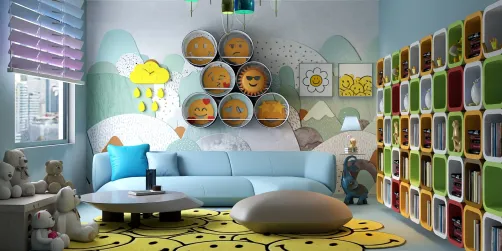
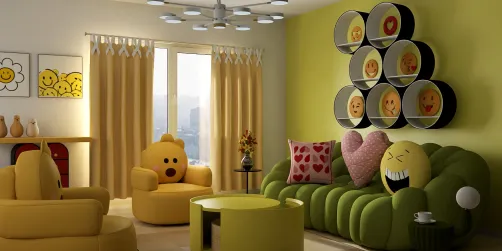
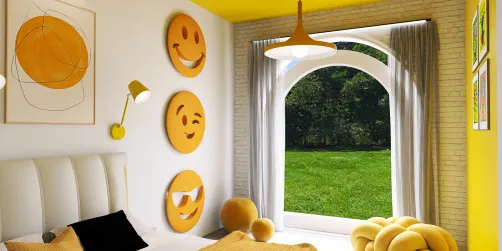
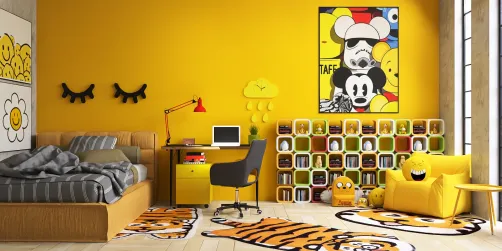
Designer Edison Mustafaj’s 'emoji ' bedroom demonstrates this principle masterfully: a bold yellow wall acts as both emotional backdrop and unifying canvas, while large-scale, clearly rendered emoji motifs (e.g., smiling sun, starry eyes) are strategically placed at child-eye level near key zones—bed, bookshelf, and rug. Using Homestyler’s real-time 3D rendering, he validated emoji scale against ceiling height and furniture footprint, ensuring visual impact without overwhelming the small room. His interior space planning reflects intentional symbol hierarchy—no competing emojis distract from the primary ‘joy’ narrative.
Start Free Design📏 Optimize Spatial Flow with Emoji-Integrated Furniture Layout
Children need safe, intuitive movement paths—and emoji-themed rooms must never compromise ergonomics for whimsy. Use emoji-shaped furniture (e.g., cloud-shaped ottomans, heart-shaped shelves) only where form follows function: rounded edges, non-toxic finishes, and stable construction are non-negotiable. Arrange core zones (sleep, play, study) using the ‘triangle rule’—keeping bed, toy chest, and reading chair within easy reach. Integrate emoji visuals into built-in elements (e.g., emoji cutouts in closet doors, emoji-patterned area rugs defining activity zones) to reinforce wayfinding and spatial logic—enhancing both usability and imaginative engagement.

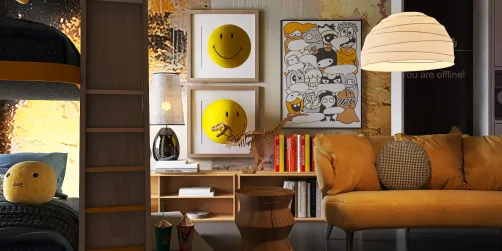
K1ra 90’s minimalist yet expressive design (titled '..') applies this principle in a compact children’s bedroom: emoji motifs appear exclusively on functional surfaces—heart-shaped drawer pulls, smiley-face shelf brackets, and a gradient emoji rug that subtly defines the play zone. Using Homestyler’s drag-and-drop furniture planner, she tested 7 layout iterations before locking in a configuration with clear 60cm circulation paths around the bed and desk—proving that emoji integration strengthens, rather than disrupts, effective indoor spatial planning.
Begin Free Layout✨ Leverage Homestyler AI Tools for Real-Time Emotional & Ergonomic Validation
Homestyler’s AI design tools go beyond aesthetics—they enable data-informed emotional and physical wellness checks. Use the ‘Lighting Simulation’ to ensure emoji wall decals remain vivid under natural and artificial light; apply ‘Material Preview’ to test tactile emoji textures (e.g., soft-touch vinyl vs. glossy print) for child safety; and run ‘Accessibility Overlay’ to verify contrast ratios for emoji icons used as visual cues (e.g., a green checkmark emoji guiding to the bathroom). These features transform subjective creativity into evidence-based Homestyler design techniques—ensuring every emoji serves purpose, not just presence.

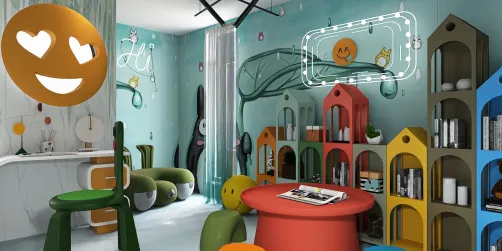
Framsammy’s 'emoji reading/recreation room' showcases advanced Homestyler design techniques: they embedded animated emoji GIFs (via Homestyler’s AR overlay mode) that respond to time-of-day lighting shifts—sun emoji brightens at dawn, moon emoji glows softly at night—validating emotional continuity across usage hours. Using the tool’s collision detection, they confirmed zero clearance conflicts between emoji-decorated floating shelves and child-height reach zones. This exemplifies how AI-powered simulation elevates emoji use from decorative to deeply responsive interior space planning.
Free Design NowFAQ
Q: How do I prevent emoji decor from looking childish or outdated as my child grows?
Use scalable, abstracted emoji forms (e.g., minimalist line-art smiles or geometric hearts) instead of literal cartoon faces. Anchor them to timeless materials—matte ceramic tiles, oak veneer panels, or hand-dyed textiles—so the emoji becomes a stylistic motif, not a dated trend.
Q: Can emoji-themed designs meet safety standards for children’s rooms?
Absolutely. Homestyler’s compliance checker validates furniture anchoring points, sharp-edge radius, and non-toxic material tags. When sourcing emoji models, filter for ‘ASTM F963-certified’ or ‘EN71-compliant’ assets in the Emoji Model Package library.
Q: What’s the best way to start an emoji bedroom design using Homestyler?
Begin with the ‘Room Scan + Auto-Layout’ tool to generate a baseline plan, then import emoji assets via the ‘Theme Palette’ tab. Use ‘Real-Time Emotion Heatmap’ (under View > Analytics) to simulate how color-emotion pairings (e.g., yellow+smile = energy) affect perceived spaciousness and calm—key for effective indoor spatial planning.
Q: Do top emoji designs rely more on creativity or technical precision?
Both—winning entries like Edison Mustafaj’s Top 1 design prove that emotional resonance emerges from precision: exact emoji scaling, calibrated wall saturation, and millimeter-perfect furniture alignment—all achievable via Homestyler design techniques. Creativity thrives within constraints, not outside them.


TREATLIFE HOME Maximize Space with Full Size Loft

Cute Cartoon Style Kids Fabric Bed with Cactus Headboard 3D Model

Cartoon Cute Yellow Leather Kids Bed With Lightning Decor 3D Model
Homestyler offers an easy-to-use online design tool with stunning 3D renderings, inspiring interior projects, and helpful DIY video tutorials. It’s perfect for anyone looking to create beautiful home designs effortlessly.
Progetta ora GRATIS