Halloween-Inspired Living Room Design
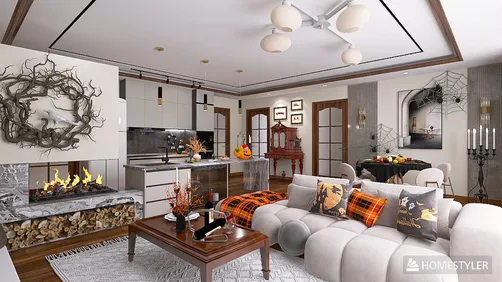
The Halloween-inspired living room is a thematic interior space that merges seasonal festivity with everyday functionality. It transforms the traditional living room into an immersive environment where darkness and light coexist—think flickering jack-o'-lantern glows against deep velvet textures, spectral silhouettes cast by strategic lighting, and curated decor that balances playful spookiness with warmth and comfort. This scene isn’t about permanent horror aesthetics; rather, it’s a masterclass in temporary atmospheric storytelling through interior space planning—leveraging color psychology, layered lighting, tactile contrast, and narrative-driven props to evoke autumnal mystery without compromising livability.
Design Challenges & Common Pitfalls
Designing a Halloween-themed living room presents unique challenges: balancing thematic intensity with daily usability, avoiding visual clutter from excessive props, maintaining cohesive color harmony amid high-contrast seasonal palettes (e.g., orange/black/purple), and ensuring lighting supports both mood and function (e.g., ambient glow vs. task illumination). Many designers overemphasize novelty at the expense of spatial flow—crowding seating zones with oversized decorations or neglecting scale relationships between furniture and seasonal elements. Another frequent issue is poor integration of AI-assisted design tools: users often treat Homestyler AI as a decoration overlay engine rather than a holistic spatial planning assistant for lighting simulation, material rendering, and real-time proportion validation.
🎯 Principle 1: Mood-First Lighting Layering
Lighting is the emotional backbone of any Halloween-inspired living room. Prioritize three complementary layers: (1) ambient base light (e.g., dimmable ceiling fixtures with warm CCT), (2) accent light that animates key features (e.g., directional uplight on wall-mounted ghosts or shelf-integrated LED strips behind translucent pumpkins), and (3) focal point light (e.g., flicker-effect bulbs inside carved gourds or candle-lit lanterns). Use Homestyler’s HDR render presets (like 'moonlit_golf' or 'autumn_scene') to preview how shadows evolve across time-of-day simulations—critical for validating dramatic yet functional illumination.

Alena Valueva’s 'Black & White Vimpire Room' demonstrates expert lighting layering: she uses stark monochrome contrast not as a gimmick, but as a spatial amplifier—black walls recede while white sculptural elements (e.g., geometric lamp bases, minimalist shelving) advance under focused downlights. Crucially, she leverages Homestyler AI’s 'moonlit_golf' HDR preset to simulate low-angle, cool-toned ambient fill—proving how AI-driven indoor lighting simulation enables precise control over shadow depth and emotional temperature *before* physical installation. This exemplifies advanced indoor space planning where light defines volume, not just visibility.
Start Free Design Now🎃 Principle 2: Thematic Texture Stacking
Texture carries narrative weight in seasonal design. Combine at least three contrasting tactile families: (1) soft/draped (e.g., velvet throw pillows, sheer curtain panels), (2) rough/organic (e.g., burlap table runners, dried wheat stalks in vases), and (3) glossy/mysterious (e.g., lacquered black side tables, mirrored ghost motifs). Avoid flat uniformity—even subtle surface variation (e.g., matte vs. satin paint finishes on adjacent walls) enhances perceptual richness. Homestyler’s material library allows instant swapping of texture maps (e.g., applying 'aged wood' to flooring or 'woven rattan' to chair backs), enabling rapid iteration of tactile hierarchies during early concept stages.

Faye Wade’s 'Spooky Time 2025' excels in thematic texture stacking: her living/dining room juxtaposes plush charcoal carpet (soft), exposed brick fireplace surround (rough), and glossy black-framed mirrors flanking the mantel (glossy). She uses Homestyler AI not just to place models, but to test how material reflectivity interacts with her chosen 'moonlit_golf' lighting preset—ensuring mirror placements amplify—not distract from—the pumpkin-lit focal wall. This showcases how Homestyler design tips extend beyond layout to predictive material-light behavior analysis, a core aspect of professional interior space planning.
Design Your Spooky Room👻 Principle 3: Narrative-Driven Prop Curation
Every prop must serve dual purpose: aesthetic cohesion *and* story reinforcement. Prioritize pieces with implied movement or hidden detail—a clock with reversed hands, a bookshelf holding vintage spellbooks with visible embossed titles, or a rug pattern subtly echoing cobweb geometry. Limit decorative density to ≤3 hero props per zone (e.g., mantel, coffee table, entry console); use negative space intentionally to let narratives breathe. Homestyler’s search-by-tag feature (e.g., filtering models by '11515349' for Halloween icons) accelerates discovery of thematically resonant assets, while its AI-generated room descriptions help validate narrative consistency before rendering.

Hilola Mamadhanova’s 'Halloween' courtyard-to-living transition uses narrative-driven prop curation masterfully: a weathered wooden bench holds a single lit candle beside a hand-carved wooden raven—no clutter, yet immediate folklore resonance. She employed Homestyler AI’s 'eilenriede_park' daylight preset to verify how natural light would interact with the raven’s carved grain at golden hour, confirming the prop’s legibility and emotional impact. This illustrates how Homestyler design techniques support intentionality over ornamentation—transforming prop selection from decorative afterthought into a cornerstone of spatial storytelling and indoor space planning.
Create Your Haunted SpaceFAQ
Q: Do I need professional interior design experience to participate in the Spooky Season Inspiration Challenge?
Not at all! The challenge welcomes all skill levels. Homestyler’s intuitive drag-and-drop interface and AI-powered suggestions (e.g., auto-furniture arrangement, lighting previews) make professional-grade interior space planning accessible—even for beginners.
Q: Can I use my own 3D models alongside Homestyler’s Halloween-themed assets?
Yes. You can upload custom models (in .obj or .fbx format) and integrate them seamlessly with Homestyler’s library. Just ensure textures are embedded and scale is calibrated— Homestyler’s ‘Measure Tool’ helps validate proportions instantly.
Q: How does the voting system work for the top designs?
Voting occurred from October 26–31, 2025. Designs were ranked by weighted score combining public votes, technical execution (assessed via render quality and spatial logic), and narrative coherence. Top 6 winners received 200 Coins each.
Q: Are there restrictions on room size or architectural style for submissions?
No strict limits—but successful entries consistently demonstrated intentional indoor space planning: clear circulation paths, human-scale furniture grouping, and contextual appropriateness (e.g., cozy timber-frame cabins vs. sleek urban lofts). The winning 'Trick or Treat at the Timber Frame' (16,576 sq ft) proved scale diversity is welcome when grounded in functional logic.
Q: Where can I find more Halloween-themed models for future projects?
Visit the Homestyler Model Library → Filter by 'Trends' → Search 'Spooky Season' or use contest tag ID '614'. All models are optimized for real-time rendering and compatible with Homestyler AI design tips for lighting, texture, and placement validation.

Minimalist Black Solid Wood TV Stand With Open Shelves Storage 3D Model

Modern Two Tone Metal Double Door Storage Cabinet 3D Model

Traditional Black Solid Wood TV Stand With Ornamental Hardware 3D Model
Homestyler is an easy-to-use online home design platform offering powerful 3D rendering tools, inspiring design projects, and helpful DIY video tutorials. It’s perfect for anyone wanting to creatively visualize and customize their space with professional-quality results.
تصميم الآن مجانا