


Every day, I engage in discussions about how rooms function as cohesive ensembles—their interactions, how traffic flows among them, and how their distinct identities collaborate to convey a unified architectural narrative. While our language offers us clever nouns for grouping, the design field relies on terms that capture functionality, proximity, and movement. This guide merges linguistic elegance with architectural accuracy, enabling you to articulate groups of rooms effectively in plans, specifications, and walkthroughs, much like utilizing the Homestyler tool for virtual layouts.
Beyond language, the functionality of spaces is paramount. In workplace environments, thoughtfully organized room groupings have been shown to enhance both productivity and well-being. Research from Steelcase highlights the significance of acoustic privacy and focus areas as crucial elements for effective performance in open layouts. This emphasizes the necessity of creating intentional room ensembles to facilitate varying work styles. Additionally, WELL v2 recognizes that room organization and access to calming spaces impact cognitive load—illustrating that when grouped thoughtfully, rooms result in better work experiences. For guidelines on this concept, refer to the WELL v2 Mind framework.
Lighting standards support this notion. The Illuminating Engineering Society (IES) recommends a task illuminance level of 300–500 lux for reading surfaces, while hallway lighting should be lower to help with orientation without causing glare. When rooms are arranged in clusters—such as libraries or learning areas—adjusting illuminance and color temperature based on their function enhances visual clarity and minimizes fatigue. Aligning the lighting design with the ensemble's spatial purpose is crucial, just like customizing layouts with tools such as Homestyler.
Core Collective Nouns Utilized in Design
Suite: This term refers to a connected arrangement of rooms designed for a specific purpose, like hospitality suites (bedrooms, sitting areas, bathrooms) or clinical suites (exam rooms with shared amenities). Suites denote managed access and a coherent service framework.
Cluster: A loosely connected grouping of rooms surrounding a central node—common in educational contexts (classrooms grouped around a breakout zone) or workplace neighborhoods (meeting spaces located near a project center). Clusters strategically balance proximity with adaptable boundaries.
Enfilade: This term describes a linear arrangement of aligned rooms featuring axial views; originating from classical architecture, it remains impactful in galleries and residential spaces. The enfilade determines rhythm and visibility through doorways and sightlines.
Program: In architectural terms, 'program' outlines the inventory and relational dynamics of rooms—such as conference areas, laboratories, storage spaces, and social zones—treated as an integrated system with specific adjacency criteria.
Block: Defined as a contiguous grouping of rooms treated as a unit during planning or phasing, blocks simplify structural, service, and circulation arrangement.
Suite of Labs / Studio Suite: This term is commonly used in higher educational settings or creative environments; it underscores shared utilities (such as gas lines and sinks) and regulated access.
Poetic and Traditional Groupings
Gallery: A series of display rooms or a lengthy area connecting different rooms; in residential designs, a gallery could serve as a natural light source linking a suite together.
Wing: This term describes a significant division of a building containing multiple rooms, such as a healthcare wing or the east wing of a museum, marked by a specific function or orientation.
Quadrant: A useful collective term in campus settings or large floor plans where room groups occupy a particular sector of the design.
Nave and Aisles: In religious architecture, rooms and their subspaces are referred to according to their liturgical sequence; these terms also aid in planning processions even outside spiritual contexts.
How Room Ensembles Influence Behavior
The arrangement of rooms influences behavior. Clusters encourage brief interactions and casual conversations, whereas suites foster privacy and control; enfilades facilitate movement with anticipation. Research findings from Steelcase confirm the need for focus, collaboration, and social rejuvenation to coexist without disturbances. Optimally grouping rooms to isolate noisy activities from quiet zones enhances user satisfaction. Other factors like lighting and acoustics are equally important: corridors should have lower brightness and reverberation compared to task spaces, while meeting areas gain from layered lighting and materials rated for sound performance.
Adjacency Criteria: The Framework of Collectives
I create adjacency matrices from the outset. Position resource-intensive rooms near vertical cores; arrange noisy spaces away from tranquil zones; consolidate shared utilities into central corridors. For suites, locate service areas (storage, printing, kitchens) along internal walls to preserve daylight for occupied areas. In clusters, anchor them with a social or functional hub—like a coffee bar or study area—ensuring movement, sound, and visibility have a central focus. Utilizing a room layout tool like Homestyler can help simulate traffic flow and sightlines ahead of construction.
Lighting and Color Across Room Groups
Room ensembles require a color and lighting gradient. In study clusters, maintain lighting levels of 350–500 lux at desks with warm-neutral tones around 3500–4000K; keep corridors at 100–200 lux to minimize glare; and use accent lighting to draw in visitors subtly. Color psychology can guide the design intent: cooler colors enhance alertness in collaborative areas, while warmer neutrals create a calming atmosphere in private settings. Transition spaces should manage contrasts to avoid causing visual stress.
Acoustics and Material Considerations
Think of acoustics as the health of the ensemble. Meeting clusters achieve optimal performance with NRC-rated ceiling tiles of 0.7 or higher, soft floor materials, and upholstered furnishings to control sound reverberation. In suite configurations, it's vital to isolate mechanical noise and employ soundproof doors when confidentiality is essential. Choose materials that reflect the usage patterns: durable finishes in communal areas and softer surfaces in quiet zones enhance comfort. Sustainable material selections—such as low-VOC paints, FSC-certified woods, and recycled acoustic materials—support well-being and indoor air quality.
Circulation: Connecting Elements
Circulation pathways define the narrative of the ensemble. Main corridors should provide clear decision points and access to natural light; secondary pathways may curve to unveil smaller programs or serene spaces. I align entrances for immediate navigation cues—who is here, what activities are permitted—and adjust widths according to expected traffic. Enfilades reward straight views, whereas clusters benefit from looped paths to evenly distribute access points.
Nomenclature for Varied Contexts
Residential: Suite, wing, gallery, enfilade, annex.
Workplace: Neighborhood, cluster, suite, block, hub-and-spoke.
Education: Pod, cluster, studio suite, department wing.
Healthcare: Unit, suite, wing, block, bay line.
Museums/Galleries: Enfilade, gallery suite, wing, circuit.
Planning Checklist for Room Collectives
- Determine the intent of the ensemble (privacy, teamwork, display, restoration).
- Outline adjacency rules: quiet versus loud, public versus private access.
- Establish lighting levels and color schemes based on room function.
- Set acoustic goals (NRC, RT60) and use materials compatible with the intended purpose.
- Design circulation for clarity: consistent sightlines, decision points, and daylight access.
- Validate design choices with a layout simulation tool to analyze flow and capacity.
- Document the program to ensure consistent naming across all drawings and teams.
FAQ
Q1: How do suites differ from clusters in a practical sense?
A suite consists of a controlled, interconnected set of rooms designed for a unified purpose, while a cluster is a more flexible arrangement surrounding a central node promoting interaction.
Q2: When is an enfilade layout appropriate?
Enfilade designs are best suited for enhancing visibility and flow, particularly in galleries, waiting areas, or ceremonial pathways where axial perspectives create engaging experiences.
Q3: How does lighting design vary among grouped rooms?
Task areas require lighting levels of 300–500 lux with low glare, circulation areas can be maintained at 100–200 lux. Incorporating ambient, task, and accent lights while adjusting color temperature to function minimizes fatigue.
Q4: What acoustic standards benefit meeting clusters?
Aim for ceilings with NRC ratings of 0.7 or higher, utilize soft flooring, and moderate RT60 levels to maintain speech clarity while avoiding a stark silence.
Q5: How do adjacency rules facilitate performance?
By separating noisy functions from quieter ones, aligning shared utilities, and keeping support areas shielded from exterior walls, daylight is preserved and friction is minimized.
Q6: Are there proven advantages to strategic room grouping?
Indeed. Steelcase’s workplace studies indicate that spaces that align with specific work modes lead to greater satisfaction, further supported by WELL v2’s Mind concept advocating restorative spaces within design.
Q7: What naming conventions are best for residential projects?
Terms like ‘suite’ and ‘wing’ are straightforward for owners and contractors, while ‘gallery’ and ‘enfilade’ provide precision when design involves axial views and processional qualities.
Q8: How can I visualize room ensembles pre-construction?
An interior layout planner can effectively simulate adjacency, circulation loops, and sightlines. Iterating designs quickly reveals bottlenecks and conflicts within grouped room layouts.
Q9: Can color psychology aid in grouped room design?
Yes. Cooler shades enhance alertness in collaborative spaces while warmer neutral tones provide tranquility for private areas. Smooth transitions can reduce visual stress whilst maintaining flow.
Q10: What materials balance durability with acoustic comfort?
Utilize resilient flooring in high-traffic communal areas alongside upholstered items, acoustic panels, and sound-reducing ceiling tiles to manage reverberation while simplifying maintenance.
Q11: How should circulation planning differ between suites and clusters?
Suites lean towards defined, controlled routes that grant privacy, while clusters benefit from interconnected paths around shared nodes to enhance interaction and distribute traffic more evenly.
Q12: Is daylight an important factor in collective planning?
Definitely. It's essential to allocate perimeter daylight for occupied spaces, utilize semi-transparent dividers for light access, and direct circulation pathways to offer consistent navigation reminders.
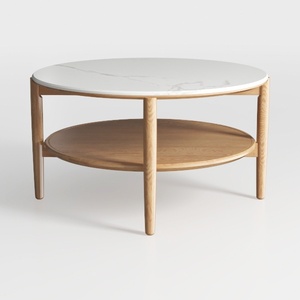
Minimalist Marble Top Solid Oak Round Two Tier Coffee Table 3D Model

Minimalist Solid Oak Linen 3 Seater Sofa 3D Model

Meridian Furniture 77054Natural Everson Collection
Discover your inner designer with Homestyler! This user-friendly online platform offers an intuitive design tool, stunning 3D renderings, and a wealth of DIY video tutorials. Perfect for all levels, it empowers you to create and visualize your dream spaces effortlessly. Start designing today!
Desain sekarang Gratis
































